April 2, 2022

Girl 27: The Brutal Assault of Patricia Douglas

 An MGM Extra Makes Rape a Federal Case

Patricia Douglas (photo source)


I wasn't trying to get anything.  I just wanted someone to believe me. - Patricia Douglas

Hollywood and MGM


Located at 8439 Sunset Boulevard, on the Sunset Strip in trendy West Hollywood, the Hacienda Park Apartments was home to many Hollywood notables of the late 1920s and early 1930s.  Built in 1927 as luxury apartments, the 54,000 square foot space was relatively close to the studios, as well as next door to the famed nightclub Ciro's, making it a prime location for, at times, Marie Dressler, Loretta Young, Grant Withers, Jeanette MacDonald, and others.  In 1935, dress designer Paul Ivar Wharton not only lived and worked at the Hacienda Park but was also murdered there. 

During the 1930s, a woman by the name of Lee Francis also moved in. 

April 22, 1927 rendering of The Hacienda Park Apartments (photo source)


Francis had worked out of brothels in San Francisco and Reno before arriving in Los Angeles in 1920 at the age of 25.  Soon after she arrived in town, she caught crime kingpin Charlie Crawford's eye.  Crawford not only gifted her with a small house on Norton Avenue in West Hollywood but set her up to run the high-class brothels she became infamous for.  By 1936, she was running brothels from a house on Bedford Drive in Beverly Hills, a location on Kings Road in West Hollywood, and an apartment building on the Westside.  Her clientele included leaders in the downtown establishment, studio executives, and movie stars.  Clark Gable, Errol Flynn, John Gilbert, and Spencer Tracy were reported to regulars, enjoying the swimming, billiards, drinks, fine food, and a variety of women at Francis' establishments.  MGM was said to keep a standing business charge account with Francis, albeit under an assumed name.  

Although flush with business, Francis did not -- could not -- own the properties she ran her businesses out of.  Once neighbors realized that a brothel was operating out of their neighborhood and notified law enforcement, she would often have to move overnight.  

That said, the LAPD were well aware of what went on and around town with Lee Francis and her businesses -- and who frequented them.  She allegedly paid 40 percent of her profits to first, Charlie Crawford and his network of corrupt cops and politicians, who graciously looked the other way.  After Crawford was murdered in 1931, the payouts would have continued - possibly to Bugsy Siegel, once he arrived from the east.

The "girls" who worked for Francis made around $1000 per week -- much more than the contract starlets of the studios, the goal of many Francis girls when they first arrived in Hollywood.  Believing their beauty alone would score them film work and stardom, when it did not, they chose prostitution over accepting jobs as salesclerks, secretaries or waitresses -- or worse, returning home with their dreams of Hollywood defeated.  

Some of Francis' girls came to her by way of the studios themselves, where they had managed to score short-term contracts (usually six months) that had not been picked up or optioned.  If they had been "favorites" of studio executives, meaning they did not spark enough interest as an actress but were appropriate to entertain in other ways, working for Lee Francis was suggested.  

In May of 1937, MGM had planned for its annual sales convention to be held for the first time in its history in Culver City.  Although the studio had been in mourning since producer Irving Thalberg (considered MGM's "Boy Wonder") had died suddenly in September of 1936, it had also been a banner year for MGM financially.  The coffers were full and shareholders and employees alike were flush -- this at a time when other studios were struggling to stay afloat (some of the less fortunate studios had gone into receivership and/or bankruptcy).  A proper celebration had to be planned.  

At the end of April, nearly 300 men from the Midwest and the East Coast boarded a private MGM railway car to spend three days aboard "pregaming" for the five-day conference in Culver City.  Louis B. Mayer himself was at the station in Pasadena on Sunday, May 2 to greet them, a bevy of "starlets" in tow.  By that point, the men were good and soused.  Mayer, ever the accommodating host, promised them a good time, complete with anything they wanted.  

Over the next few days, they were treated to dinner at the Ambassador Hotel and luncheons with stars like Jean Harlow, Clark Gable, Joan Crawford, Norma Shearer, Charles Boyer, and Rosalind Russell.  The big finale, planned for Wednesday, May 5, was a Wild West Party at producer Hal Roach's ranch which was touted to be "a stag affair out in the wild and wooly West where men are men."  

David Ross (circled) at MGM's May 3, 1937 luncheon (photo source)

Girls brought in from Lee Francis would have been very aware of what was up, and what would go down, at such a party.  Girls like Patricia Douglas would not.


Patricia Douglas, a Missouri native, was a dancer and movie extra.  Only 20 years old that spring of 1937, she had chestnut hair, beautiful porcelain skin, and movie-screen perfect teeth.  She had migrated west with her mother, Mildred, who wanted to design gowns for motion picture stars.  Instead, Mildred ended up designing wears for high-end call girls.  Patricia dropped out of school at fourteen, but she didn't run wild.  Unlike other teenagers in the Los Angeles area, she did not drink, smoke, or date.  Despite her proximity to Hollywood, she was not impressed by fame, nor have any desire for it.  Dancing was her main passion in life.  She drifted into the movies, as she later recalled, "for something to do."  She counted as friends George Raft, Jimmy Durante, Dick Powell, Bing Crosby, and Bill Frawley (before his I Love Lucy days), who treated her as kid sister and would buy her a Coke while they vented on their career issues and personal lives.  By the time she was fifteen, she was dancing behind Ginger Rogers in Gold Diggers of 1933.  

    
Patricia was told about the casting call on Sunday, May 2, 1937 -- the same day the drunken entourage was disembarking the train in Pasadena.  Initially, she turned it down as she had no need for work.  Later, she agreed to show up, believing she was being hired as an extra in a western film.  Later, she said that had she known it was for a party, she never would have gone.  


May 5, 1937

At 4 p.m. on Wednesday, May 5, Patricia, along with nearly 120 other young women, reported to the Hal Roach Studio on Washington Boulevard in Culver City, just blocks from MGM.  The young women, most of whom were either dancers or considered themselves to be dancers, were outfitted in short suede skirts, bolero jackets, cowboy hats and boots.  As payment, they were promised a hot meal and $7.50 ($150 in 2022 dollars) -- standard for extras.  

After thick camera make-up was applied, the group of young women was bussed several miles away to "Rancho Roachero," where Hal Roach filmed his Our Gang comedy shorts.  The changing of location would not have given off any red flags to Patricia or the other girls as many movies, particularly Westerns, were shot on location.  What would, however -- at least for some of the girls -- were the 300 drunken men en route to the festivities.  

Upon arrival, the girls were herded into a large banquet room and instructed to sit down and wait.  Two hours passed, during which time an orchestra and bar were assembled, but not a single light, camera, or movie crew.  

It was seven o'clock before the MGM businessman, along with Mayer, Roach, and studio "fixer" Eddie Mannix, showed up.  The very intoxicated and revved up salesmen immediately took the real dancers of the group as nothing more than party favors and treated them as such.  With no telephones or transportation at their disposal, the young women were literally trapped with the men, the majority of whom were not only inebriated but sexually aroused, and left to fend for themselves.  

Although there was a proliferation of alcohol -- 500 cases of scotch and champagne -- there were other, more innocent diversions in connecting tents.  Barbecue was served while Laurel and Hardy spoke about the upcoming Kentucky Derby.  The Dandridge Sisters, including a 13-year-old pre-fame Dorothy, performed a live revue, while exhibition boxing matches took place in an arena set up for the event.  

Patricia Douglas, tricked into the job as doubtless, others had, did her best to endure it by dancing with some of the attendees.  It was while she was on the dance floor that David Ross spotted her.  Ross was 36 years old, a somewhat dumpy bachelor from the Chicago sales office.  He approached Patricia and demanded a dance lesson, to which she obliged.  He attempted to cop a feel and, as soon as she could politely get away, she hightailed it to the ladies' room, where she told the attendant that the handsy Ross was all over her and "sticking" to her.

By 10 p.m., the party had lost any attempt it may have had at a decent presentation.  Henry Schulte and Oscar Boudin, both waiters, later swore in affidavits that "there was filth in conversation," that men were "attempting to molest girls at the tables," "trying to force liquor on the girls," and "running their hands over the girls' bodies," and that "the party was the worst, the wildest, the rottenest I have ever seen."  

One 18-year-old, a former Miss Wichita, begged actor Wallace Beery, in attendance, for help, stating she was tired of being mauled.  Beery, gruff and one of MGM's biggest stars of the time, escorted the young lady from the premises but true to his reputation of being a brawler with a fiery temper, socked a few men on the way out.

Patricia was not so lucky.  David Ross, having been spurned by "a nobody," decided to retaliate.  He recruited another man to help him hold Patricia down and pinched her nose, forcing her to open her mouth to the scotch and champagne they plied her with.  They laughed as she gagged on the liquor and rushed to the bathroom to vomit.  Wanting, and needing, fresh air, she stepped outside the banquet hall and a hand clamped down over her mouth.

Ross told her that if she made a sound, she would never breathe again.  He dragged her to one of the many sedans parked in the lot, shoved her inside, and boasted that he was going to "destroy" her.  During the assault, when Patricia began to pass out, he smacked her in the face with an order to cooperate.  "I want you awake!" she later recalled him saying.

It was 11:30 p.m. when parking attendant Clement Soth heard screams and then saw Patricia staggering toward him, both of her eyes swollen shut from the hits she'd taken.  As Soth approached her to help, he saw David Ross running away. 


The Cover Up Begins

Patricia, in a state of hysterics, was taken to Culver City Community Hospital, across the street from MGM, accompanied by a Culver City motorcycle cop.  Upon admission to the facility, more like an urgent care center than a hospital, Patricia vomited once again.  The shy, immensely private young woman was then given a cold-water douche, followed by a pelvic examination that she found embarrassing and shameful. The doctor who performed the examination, Edward Lindquist, could find no evidence of a sexual assault, not surprising given that a douche was administered prior to the exam.  He also apparently had no concerns over any bruising Patricia had or the clear violence that had been done to her face.  He said that while he could not prove it, he did not believe intercourse had occurred, consensual or otherwise.  

Lindquist was co-owner of the hospital and very well aware the hospital depended on MGM's business. 

Patricia was then driven home in a studio car, with no apologies or sympathy.  Nor was she given empathy from Mildred, who had never spoken to her daughter about sex or given her any type of warning about what could, and did, happen in the industry.  Mildred's preferred method of dealing with Patricia's rape was to pretend as though nothing had happened. 

Despite being accompanied to the hospital by a police officer, as well as the presence of 11 officers from three different police precincts and MGM's own "police" department at the party, no criminal report was ever written or filed.

Patricia stayed home for two days, nursing her swollen face and body that was sore from David Ross' attack, before she picked herself up and returned to the Roach Studios.  She told the studio cashier, "You ought to know what happened to me so it doesn't happen to anyone else."  Instead of compassion, she was merely handed her $7.50 pay.  MGM never contacted her and David Ross returned untethered to Chicago.

If all parties concerned had thought Patricia Douglas would merely go away, or accept a payout for her silence, they were soon to be sorely mistaken.


Taking Action

Accompanied by her mother, Patricia swore out a complaint against David Ross at the Los Angeles County District Attorney's office.  Since she was still a minor (the age of majority being twenty-one), Mildred was forced to sign the complaint.  

Patricia's actions were unique and groundbreaking for the day.  Assaulted women were considered "damaged" and to blame for their assault and resulting injuries.  Not only was Patricia standing up for herself, insisting that her rapist be held accountable, she was taking a stand against the studio system whose first rodeo this surely was not.  She cared little about the stigma that would be attached to her or what the lawsuit might do to any future career she might have.

Unfortunately for Patricia, the D.A. was Buron Fitts, not the most upstanding of politicians.  Fitts was reportedly on the take not only for businesses like Lee Francis' but was also rumored to be taking a payout to keep any action brought in the murder of director William Desmond Taylor, which had happened in February of 1922.  He  considered Louis B. Mayer a close personal friend and was completely in the pocket of the studios.  MGM had been the major contributor of Fitts' most recent campaign six months earlier.  In fact, Fitts himself had been indicted for perjury in a rape case involving a 16-year-old girl and had ultimately been acquitted, something that caused outrage in the Los Angeles community.  Despite this, he had still been reelected as D.A. 

(photo source

Fitts wasn't likely to take action against MGM or David Ross. 

Patricia waited for several weeks and, with no response from Fitts, was put in touch with attorney William J.F. Brown.  Brown was considered a "dandy" in his day, with his custom suits, splashy Packard automobiles, and love of courtroom theatrics.  He saved his own ex-wife from the gallows with a passionate appeal after she shot her new husband four times.  If any attorney was a perfect fit to take on the studio system and a D.A. like Fitts, it was Brown. 

Brown represented Patricia pro bono -- the publicity would be worth it -- and immediately fired off correspondence to Fitts in which he threatened to have Patricia go public with her accusations if no thorough investigation was performed.  True to his nature, Fitts considered that Brown was bluffing and did nothing.

The L.A. Examiner, owned and run by the fearless (and feared) William Randolph Hearst, broke the story on June 4, 1937, taking leads away from Jean Harlow's fatal illness (she would succumb three days later) and the Duke of Windsor's wedding to the American divorcee Wallis Simpson.  The word "rape" was never mentioned, as it was considered too salacious, but the story referenced Patricia being "attacked" and "outraged."  Readers knew what the euphemisms meant.  MGM itself went unnamed in the story, called only a "local studio."  Hearst had no desire to sink the industry in which his mistress, actress Marion Davies, made her living and into which he himself had invested (he formed Cosmopolitan Pictures after United Artists rebuffed him).  Patricia was not only named but her photograph was featured and her home address was published as well.

The article did get Buron Fitts on the case, at least somewhat.  He showed Patricia a photo lineup of two dozen men and without hesitation, she picked out David Ross.

(photo source)

MGM, still publicly unidentified, released a statement as "the local film company" in which it said, among other things, it had read "with astonishment" the claims made by Patricia and that it was difficult for them to make a statement about a situation to which not only appeared "impossible" but about which they "know nothing." 


Damage Control


Behind the scenes, MGM was in full-on damage control.  Perhaps not since producer Paul Bern's death in 1932 had an event occurred that could so harm the studio, its shareholders, and its employees.  Even if Patricia's allegations of a stag party costing $35,000 (nearly $700,000 in 2022 dollars) with a boatload of alcohol and teen girls could be refuted, it would leave a very, very bad taste in the mouth of MGM"s stockholders and worse, the moviegoing public who assumed that MGM did indeed have the squeaky-clean image Louis B. Mayer so desired.  It was therefore decided the best course of action was to smear the victim.

MGM's "fixer," Eddie Mannix in 1935 (photo source)


MGM put its fixer, Eddie Mannix (a thoroughly reprehensible human being who broke his wife's back during an argument and beat his mistress, actress Mary Nolan, so badly she required 15 surgeries) to work by hiring the Pinkerton Detective Agency.  Pinkerton was instructed to track down every single girl that showed up for the "casting call" that night and persuade each one by whatever means necessary (i.e., financial incentives or coercion) that there had been no groping, molesting, or anything untoward going on at Rancho Roachero.  

Sugar Geise, a 27-year-old chorus girl whose family was tight with Buron Fitts, suddenly recalled seeing Patricia passed out at the Knickerbocker Hotel bar.  Two other party attendees remembered that on the night of May 5, Patricia was chugging liquor from a quart bottle all night; the alleged orgy, they said, was just a jolly old party, full of good, clean fun.

Patricia was indignant, claiming that anyone who knew her was well aware that she did not drink.  She also wanted to know exactly when rape began being considered good, clean fun.  She wasn't about to throw in the towel.  Not yet.

The detectives at Pinkerton shadowed Patricia in an attempt to dig up dirt on her.  An internal memo indicated they were instructed to find attempts where she had propositioned men, while taking personal digs at her by suggesting that "many men," who surely turned her down, would recall being solicited by her.  Even Patricia's urologist, Dr. Wirt Dakin, had gotten a request from Hal Roach himself to state that treatment for a cyst on Patricia's bladder was actually a "genital urinary infection," a euphemism for gonorrhea.  Dr. Dakin, one of the few decent characters involved in this tragedy, stood firm and refused. 

The agency had the truth soon enough.  Patricia Douglas had been a teetotaling virgin on the night of May 5.  She had no dirt to dig up, nothing to use against her.  The lack of any dirt was horrifying to MGM, whose own stars had plenty of skeletons in their closets.       

Hal Roach's note on Dr. Dakin and the "G.U." (photo source)

With the resulting scandal, Patricia was all but abandoned by her celebrity pals.  Terrified that any association with her would result in career suicide, they turned their backs on her.  She was going to stand alone.

The Legal Fight

Her identification of David Ross led to a grand jury hearing, with Ross being summoned from Chicago.  He labeled such accusations "absurd" and "ridiculous" but upon his arrival in Los Angeles, he was taken immediately into a meeting with Louis B. Mayer's personal attorney.  

The hearing, held on June 16, 1937, was nothing more than Patricia being traumatized all over again.  Only two of the 120 girls in attendance at the party testified on her behalf, one of them being the 18-year-old who fled to Wallace Beery for help.  Beery, in a studio-approved statement, denied the incident entirely.  Parking attendant Clement Soth, who had responded to Patricia's screams and assisted her immediately following the attack, and who had said he saw David Ross fleeing, testified that the man he saw that night was much thinner than the plump Ross and denied that he had seen Ross running from the scene. 

Patricia was forced to recount her rape and then watch as Ross' attorney, an associate of Louis B. Mayer's attorney, pointed at her and scathingly asked the grand jury, "Who would want herLook at her!" 

To add further insult to injury, when leaving the courtroom, Patricia encountered Ross, who calmly smoked, while photographers pushed her close to him in order to capture a shot for their evening editions.

Patricia forced to confront Ross, June 16, 1937 (photo source)

The grand jury did not indict David Ross.  

"I just wanted to be vindicated, to hear someone say, 'You can't do that to a woman.'" - Patricia Douglas

MGM, Eddie Mannix, and David Ross likely considered the case closed at that point.  But Patricia was a scrapper.  She was not going quietly.

A month later, in July, she filed a civil suit against Ross, Mannix, Hal Roach, casting assistant Vincent Conniff, and John Doe 1 to 50 for their "unlawful conspiracy to defile, debauch, and seduce" her and other dancers "for the immoral and sensual gratification of male guests."  She sought $500,000 (nearly $10 million in 2022) in damages.  

MGM's lawyers stalled the case until the new year of 1938, while the studio itself continued to bestow jobs, favors, and other rewards upon perjurers and those who were suffering from sudden memory problems.  

On February 9, 1938, a superior court judge dismissed the case.  David Ross, the principal defendant, was never even served.

Twenty-four hours after the dismissal, Patricia, again with her mother acting on her behalf, filed an identical suit in the U.S. District Court, the first of its kind.  In a trailblazing move, Patricia became the first woman to make rape a federal case, based on a violation of her civil rights.  

Patricia and her mother, Mildred (photo source)

They had been lucky up to this point but Mayer and Mannix were terrified as to what this newest case might mean to MGM and by extension, themselves.  Both were guaranteed a percentage of MGM's profits and both worried that bad publicity would affect the bottom line.  Since defaming Patricia had not worked, they were ready to go after her attorney with enticements. 

William J.F. Brown was not entertained by slander or outlandish accusations.  He did, however, have political aspirations and Fitts' mishandling of Patricia's case incited him to challenge Fitts as D.A. in the next election.  It was made clear to Brown that no one in opposition with MGM would ever win such an election and so Brown sacrificed his client.  He neglected to appear in court on three consecutive occasions, forcing a federal judge to dismiss the case for "want of prosecution."  The defense counsel also neglected to appear, which almost certainly guaranteed that MGM and Brown were in tandem over the non-appearances.  Patricia's mother Mildred neglected or refused to expose Brown's blatant malpractice and misconduct, which would have gotten Patricia not only another attorney but another attempt at legal justice.

Out of legal options and drained, both emotionally and physically, Patricia finally gave up the fight.  For its part, MGM whitewashed most of its records to avoid any mention of Patricia Douglas or the Wild West Party in May of 1937.  

The newspapers and general public quickly forgot about Patricia and her story.  There was other news to be had.

Afterward

Following his grand jury testimony, parking attendant Clement Soth was bestowed with a promised lifetime job as a driver for MGM.  He held the position until his death.  His daughters later publicly admitted that Soth had committed perjury in exchange for the cushy position during those Depression-era years.

In the 1940 primary election, William J.F. Brown was thoroughly trounced by Buron Fitts (who would lose in the general election).  

Patricia's mother Mildred purchased a liquor store and some horses after the case dismissals, most probably thanks to hush money she received in exchange for her willingness to look the other way at Brown's malpractice.  She married an alcoholic gambler who went through all of her money before leaving her.  Mildred lived into her nineties, residing with her daughter in both a hostile and caregiver-type environment.  Only during the last ten years of her mother's life was Patricia able to say she felt any love at all for Mildred.

Eddie Mannix told people years after the rape that "we had her [Patricia] killed," but they did not.  They may have damaged her spirit and buried her name and story, leaving it to languish for decades, but Patricia Douglas survived.

A young Patricia before May of 1937 (photo source)

Mannix died in 1963, six years after Louis B. Mayer, and still on the studio payroll.

Around the same time, David Ross died of rectal cancer.  He never married nor had children.  He left no family to remember him, much less mourn his passing.

In March of 1937, two months before Patricia was raped, Buron Fitts was wounded after shots were fired through his windshield by an unknown person or persons.  Three years later, he was defeated in his attempt at a fourth term as D.A.  A veteran of World War I, he joined the Army Air Corps at the rank of major in 1942.  He dropped out of public sight for the next 30 years until he put a bullet in his head in 1973, a week after his 78th birthday.

Lee Francis, the madam at the Hacienda, attempted to go legit in 1937/1938 by opening a nightclub at 8588 Sunset, a block or so west of the Hacienda.  After spending the equivalent of $800,000 in 2022 dollars, she encountered difficulties when a "crimp was put in the deal" by "an owner of a nearby night rendezvous with powerful newspaper and political affiliations," as Francis recounted later.  This was almost certainly Billy Wilkerson, owner of the nearby Cafe Trocadero and publisher of The Hollywood Reporter.  Ultimately, Francis was bought out by a "well-known personality from the East" (thought by many to be Bugsy Siegel) who reneged on the deal to pay her.

Having lost her legitimate business, Francis returned to her tried and true business and was pinched in January of 1940 after a raid.  Francis was arrested for suspicion of moral offenses, along with two other women in her employ.  In March, she was found guilty, sentenced to 30 days in jail, and fined $250 (nearly $5,100 in 2022).  As an interesting sidenote, one of the women arrested with her, Simone King, would marry mobster Mickey Cohen ten months later, becoming the prim and proper LaVonne Cohen.)

Lee Francis and Judge Cecil Holland, 1940 (photo source)

Following her jail stint, Francis returned to business, keeping a very low profile, but not at the Hacienda.  In 1959, she attended the closing night party for the Garden of Allah hotel accompanied by an entourage of her call girls.  Six years later, she published an account of her life as a madam before disappearing from public view.

The former Hacienda Park Apartments went through several name changes through the years, including Hacienda Arms and Coronet.  It is currently known as the Piazza del Sol, where the Italian Renaissance architecture is host to a variety of business offices, including small production companies, and a Japanese restaurant.       

Redux

Following her failed legal attempts, Patricia and her mother left Los Angeles.  They stayed in Bakersfield, north of L.A., for a while before heading to Las Vegas.  Patricia married three times in five years, with two of her husbands exposed as bigamists.  At 37, she decided she was done with men and sex, declaring that she had never been in love with anyone.  Other than her mother, no one else in her family knew of her brutal rape in 1937 -- not her husbands or her children.  Thanks to a decision to keep herself from getting close to anyone, including her children or grandchildren, she had no friends to talk to or lean on.  Her story remained lost and forgotten for six decades.

David Stenn had started his writing career on television, with Hill Street Blues, 21 Jump Street, and Beverly Hills, 90210.  He wrote a well-received biography of 1920s actress Clara Bow in 1988 and chose to follow it up by focusing on another Hollywood icon, Jean Harlow.  It was while he was on deadline for the Harlow book in 1993 that he stumbled across a relatively obscure notation on Patricia and the infamous stag party.  Initially skeptical about Patricia's allegations, he was nonetheless intrigued that such a scandalous story had not been reported by any Hollywood historians and eventually spent the better part of a decade tirelessly digging into the story.  Five or six years after he began, he was astounded to discover that Patricia was still alive and living in Las Vegas.  She eventually agreed to meet with him and look through photographs of Hollywood and MGM.  When shown a photograph of David Ross, her reaction at seeing an image of him after 60 years was an immediate physical and visceral one; she shook and cried.  She confessed to Stenn that the very smell of scotch made her nauseous, taking her back to May of 1937, and that she still lived in fear.

Stenn gave an interview to Vanity Fair in 2003 about Patricia's rape and the massive attempt at cover up done by MGM, taking her story public for the first time since 1937.  That led to a documentary in 2007, called Girl 27.  Revealed too was the tale of Eloise Spann, a contact singer and actress during the same years that Patricia was dancing and working as an extra.  Eloise too was assaulted and raped as Patricia was, in a house in L.A. by a person or persons connected to the studio system.  Eloise, only 19 years old, at the time, was, like Patricia, a virgin.  Her rape resulted in a pregnancy that was terminated.  She too lodged a suit against her attacker(s) and, much like Patricia, her suit was dismissed without any kind of justice.  Her account received even less attention than Patricia's did. 

Stenn tracked down Eloise Spann's son, who knew nothing of his mother's tragic history and what she had endured, until Stenn informed him.  He recalled that his mother was "unwell" for most of his childhood and upbringing.

Eloise Spann was never able to move past her assault, rape, resulting abortion and cover-up by the studio, despite marrying and having a family.  She hanged herself.

While Patricia was denied justice in 1937, receiving $7.50 in payment for her pain and suffering, and David Ross was free to continue his life without recourse, and MGM, as well as other studios, were welcome to carry on fostering environments in which women (and girls) were exploited and abused, she did lay the groundwork for future changes.  Her assault, with the resulting scandal, was the first time MGM could not pay off everybody and bury the incident entirely.  They did manage to hush it up for decades following the indictments and cases but could not keep Patricia and her account quiet forever.  While she was betrayed by MGM, its employees who were bought off and/or threatened into silence, Buron Fitts, William J.F. Brown, her entertainment friends who valued their careers more than doing right by Patricia, and even, if all likelihood, her own mother, Patricia did succeed in one aspect.  Never again would MGM throw a party under the guise of a casting call, which is what she wanted to put an end to all along.

Patricia died in Las Vegas on November 11, 2003, suffering from emphysema and glaucoma and still fearful.  She didn't live to see the documentary featuring her or her story.      

Patricia, toward the end of her life (photo source)

Sources:

Dawson, Nick.  "David Stenn, Girl 27." Filmmaker, July 27, 2007.

Ponder, Jon.  "Hacienda Park and the Origins of the Sunset Strip." WeHoVille, April 8, 2019.

Stenn, David.  "It Happened One Night . . . at MGM." Vanity Fair, April 2003.  

Stenn, David.  "The Systematic Crushing of a #MeToo Pioneer."  The New York Times, January 5, 2018.

Girl 27.  Dir. David Stenn.  Perf. Patricia Douglas.  TLR Productions, 2007.  Documentary.     


December 16, 2021

The Murder of Mia Zapata

The Killing of the Lead Singer of the Punk Rock Band The Gits Goes Cold For a Decade Before Justice is Served

Mia performing (photo source)


"Mia Zapata was an extraordinary human being.  She was a beloved friend, a gifted songwriter, musician, visual artist and performer. . . .  We prefer to remember her friendship, talent, humor, and the incredible art and music she left to the world." - Andy Kessler, Matt Dresdner, and Steve Moriarty of The Gits 


In the 1990s, Seattle was Ground Zero for the grunge genre of rock.  Pearl Jam, Alice in Chains, Soundgarden, Mother Love Bone, Mudhoney and Candlebox were all leading the music movement from underground to prominence, but none was as big or as influential as Nirvana, who (the band and lead singer, Kurt Cobain) perfectly captured the sound, essence and angst of a generation.  Diverse and trendy, Seattle was the perfect city to spawn these bands, as well as many others who were verging on mainstream success.

The Gits was one of those bands.  Formed in 1986 at Antioch College in Yellow Springs, Ohio, they took their name from a Monty Python skit and soon became known for the fiery performances of Andy Kessler on guitar, Matt Dresdner on bass, Steve Moriarty on drums and Mia Zapata singing. 

Brought up in Kentucky, Mia, the third child and second daughter in her family, was a born performer and from her youth, she seemed to know that she was destined for a musical future.  She began singing at an early age, often astounding listeners with her throaty voice, reminiscent of Janis Joplin, one of Mia's idols.  By the time she was nine, she had taught herself how to play the piano and the guitar.  As a teen, she kept a notebook into which she wrote poetry that eventually became song lyrics.    

Although her family was considered well off, Mia cared little for material things and focused instead on creative expression. Antioch, therefore, was a perfect college for her and one that not only enabled her to express herself but allowed her to find a musical community that she quickly affiliated herself with.  

Two years after the Gits formed, they recorded and self-released an unofficial debut album.  The following year, in 1989, they moved to Seattle to join the growing underground rock movement.  

The band moved into an abandoned house in the Capitol Hill district they dubbed "The Rathouse," where they would live and rehearse.  When she wasn't performing, Mia washed dishes at a local bar in order to make ends meet, until the Gits made it big.  The band played many venues in the Seattle area and quickly gained a devout fan following, particularly with the punk rock community.  Mia's magnetic personality and energy pushed her to the forefront of the Gits.    

The Gits embarked on a successful international tour in 1990, without support of a record label.  Two years later, in 1992, they released their first official album independently.  

It seemed that 1993 might finally bring the Gits the mainstream success they craved.  By that summer, they were recording their second album and were being seriously courted by various mainstream labels.  

The Gits (photo source)

July of 1993

On July 4, the band returned to Seattle from a successful tour of the West Coast.  Steve Moriarity would later recall that Mia had not wanted to go back to Seattle, that she feared something bad was going to happen there.  It seemed an innocuous comment at the time and one that Dresdner associated with Robert Jenkins, Mia's former boyfriend who had recently broken up with her.  Their stay wouldn't be long before they would again leave for another tour, this one scheduled to start in New York.  

On Tuesday, July 6, Mia rose around 11 a.m. and had lunch with her father, Richard, who drove in from Yakima, where he had relocated with his second wife.  Father and daughter routinely had these types of get-togethers once or twice a month when Mia was in Seattle.  Richard did not like or approve of Mia's career choice or her lifestyle.  He worried about her safety in a city like Seattle, where she lived and moved among a sometimes drug-riddled scene and was often out late at night.  These get-togethers allowed him to both keep his bond with Mia tight and to check up on her.   

Following lunch at a local Indian restaurant, Mia and Richard visited Tower Records and the Seattle Art Museum before Richard dropped Mia off back at her apartment around 3 p.m., promising to call her in a few days.  At that time, only one of her roommates was home.   Richard later remembered that Mia had looked satisfied, content and at ease with herself.  

Mia walked the dog and did some laundry after Richard departed before heading to Capitol Hill, for the Pancreas Production Studio, around 6:30, where she rehearsed with Hells Smells, the band that her ex, Robert Jenkins, was a member of and where she often sang back-up vocals.  She and Jenkins had, at one time, discussed marriage and while he had apparently moved on and had begun dating someone else, Mia was said to still be hurting over the break-up and was stung by the fact that he was dating.

(photo source)


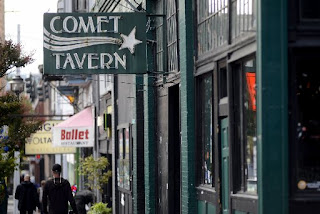
She rehearsed for a good two hours before walking over to the Comet Tavern, a block away at E. Pike and 10th Avenue.  The Comet was a local watering hole and well known as a Gits hangout, so Mia was comfortable there and with the people who frequented it.  That evening, friends and fellow musicians from the band Seven Year Bitch were drinking and remembering their former guitarist, Stefanie Sargent, who had died 13 months earlier after a night of heavy drinking and shooting up heroin.  There was some dispute as to whether Mia had been drinking on and off all day or had begun drinking once she arrived at the Comet but by the time she left that night, she was extremely intoxicated.    

Mia was no stranger to drugs, having been known to smoke pot and even to have dabbled in the harder stuff but her vice of choice was alcohol.  Her drinking had gotten so bad at one point that the other members of the Gits had threatened to kick her out of the band unless she eased up.  She had complied during the tour, not just controlling her consumption but foregoing alcohol completely.   Whether it was returning to the familiar stomping grounds of Seattle and her interactions with Robert Jenkins or remembering Stefanie Sargent or the cusp that the Gits were on, headed for success, Mia fell off the wagon on July 6.   Her friends at the Comet later recalled that she seemed agitated after the rehearsal session with Jenkins and barely let her glass get empty before having another drink.  At one point she even left the Comet briefly to walk to a nearby pizza joint, where she purchased alcohol to drink before returning to the tavern.  

While at the Comet, Mia reportedly made a phone call from the bar's payphone but it's unknown who she called.  She did not mention it to her friends, and no one came forward to say that they had spoken to her or received a call from her.  In all likelihood, she was trying to track down Jenkins.  

Mia left the Comet around 1 a.m., reportedly saying that she was going to try and locate Jenkins.  She retraced her steps from earlier, walking east on Pike for about a block, back to the Pancreas Production Studios.  Finding the studio empty and no trace of Jenkins, she went to the third floor of the adjoining Winston Apartments, where a friend of hers, "T.V.," lived.  T.V. was also a member of Jenkins' band and remembered that Mia was not only very drunk but angry because she couldn't locate Jenkins and wanted to talk to him about their relationship.  

Mia spent about an hour at T.V.'s apartment before deciding to leave.  T.V. tried to convince Mia to stay and sleep it off but Mia rejected the offer and set out, once again on foot.  Depending on the source, Mia was either going in search of Jenkins, was going to walk to a nearby gas station where she could catch a cab home or walk to a cab company to get a cab there.  (She had no driver's license and would often take cabs around the city.)  When she left T.V.'s apartment, Mia was wearing a black Gits hooded sweatshirt, cut-off jeans, black boots and carried a Walkman.    

For nearly an hour and a half, Mia's whereabouts were unknown.


At 3:20 a.m., just over two miles southeast from the Winston Apartments, a prostitute made the terrible find of a body.  Located on 24th Avenue between South Yesler and South Washington, the body was discovered in the street, next to the curb and close to a nearby field.  The sex worker immediately notified authorities.  The Seattle Fire Department arrived on the scene at 3:30 a.m. and found a young female lying on the pavement, her ankles crossed, and her arms spread in a Christ-like pose.  The sweatshirt she wore was pulled up underneath her arms with the hood tied tightly around her face and knotted under her throat.  Her underwear and torn bra were found stuffed in the pocket of her jeans.  The paramedics noted abrasions on the exposed parts of her body, including alongside her nipples.   She had no pulse and did not appear to be breathing but the paramedics did not believe she had been lying there long and attempted resuscitation, which proved unsuccessful.  She was pronounced dead and sent to the morgue as a Jane Doe, to await the medical examiner, Seattle's 33rd murder victim of 1993.    

While the fire department and paramedics had no idea who the woman was, the medical examiner had no doubt.  A fan of the underground music scene, he had attended many of The Gits' concerts and immediately recognized the body of Mia Zapata on his table.  

He determined that Mia had been strangled with a ligature and believed it to be the drawstring of her sweatshirt.  Although the strangulation had been what had killed her, she had endured a horrific beating to her abdominal area which had not only lacerated her liver but, in the medical examiner's opinion, would have resulted in her death had she not been strangled.  

Mia also had injuries to her vaginal and anal area consistent with rape, although no semen was detected.  The M.E. thought the abrasions along her nipples were caused by teeth and had taken swabs from the area.  The swabs, once analyzed, detected the presence of saliva.   As DNA testing was still in its infancy, the M.E. had the foresight to preserve the swabs for future use.   

Investigators worked hard to withhold the fact that Mia had been raped - something that did not sit well with her friends, or women in the Seattle area.  The investigators also withheld the details of Mia's torn bra, which was missing a cup, in the event a suspect was ever identified.   They wanted details that only her killer could provide.  

They felt that Mia had been walking along with her headset on, listening to music, and was ambushed.


The Investigation

The area where Mia had been discovered was well known as an area used by sex workers to conduct their business and at first, it was considered that Mia might have been a victim of the-then still unidentified Green River Killer.  However, since Mia was not a sex worker nor someone who lived on the street, as many of the Green River Killer's victims were, that idea was discounted.  

The area was thoroughly searched by detectives and nothing was uncovered that was connected to Mia.  Everything appeared to indicate that she had been killed elsewhere and where she was found was a dump site.  

Robert Jenkins, as Mia's ex, was the logical prime suspect, a theory that was firmed up by some of her friends' beliefs that Jenkins had to have been involved.  The day after Mia was killed, one of her friends had stopped by the rehearsal studio Mia had visited in her unsuccessful quest to find Jenkins and discovered a Gits demo tape and Mia's personal microphone.  The friend claimed that Mia rarely left her microphone out of her sight.  

Jenkins, however, had a solid alibi and the police felt he had no real reason to harm Mia.  They found no evidence that a crime had taken place in the studio and assumed that Mia had left the tape and mic there after searching for Jenkins or had even returned after leaving T.V.'s apartment and had simply forgotten to take them with her. 

Police received a tip from a man who reported hearing a terrifying scream in the early morning hours of July 7.  It had bothered him so much that he had gone outside to see what was going on but had discovered nothing in the darkness.  He was three miles from where Mia's body was found.   

Another tip came in from a woman who stated that there had been a group of people outside the back of the Pancreas Production Studios on Pike Street doing cocaine.  Her statement could not be verified and the people she alleged to have seen were never located.  

As Mia did not have a driver's license and would make liberal use of the cabs around Seattle, police worked on a theory that had a cab driver as their perpetrator.  Her friends said that Mia would never have gotten into the vehicle of someone she didn't know, but she would have gotten into a cab.  She knew a great many of the cab drivers around the city and would have had no reason to fear getting into their vehicles. Police were aware that cabbies would not only be familiar with the less traveled, or even deserted, areas of town but their vehicles could be moving crime locations with which to assault and kill.    

Detectives checked with the local cabbies, as well as the cab companies, and none of them reported picking Mia up in the early morning of July 7 or even seeing her.  

The investigation turned to Mia's friends, bandmates and the Seattle music scene.  Detectives wondered if an obsessed fan or a jealous musician could have set out to harm her.  Although Mia had traveled in circles with some questionable people and was known to be extremely outspoken, no one had an unkind word to say about her, seeing her almost as the glue that held their community together.  


In August, the same month that she would have turned 28, a group of Mia's friends, frustrated that the police seemed to be making little headway, hired a private investigator.  The money to pay the P.I. came from a few concerts the surviving Gits put on, with Joan Jett stepping into Mia's shoes, as well as donations from Nirvana, Pearl Jam, Soundgarden, Sonic Youth, Hootie and the Blowfish and Jett and her band, the Blackhearts.  The funds would last more than two years after which Leigh Hearon, the P.I., would continue to work Mia's case on her own time and on her own dime.  

In 1994, Joan Jett and the Blackhearts released their album "Pure and Simple" with the moving track "Go Home," which was dedicated to Mia.  Jett joined The Gits in 1995 for live shows, using the moniker "Evil Stig," which was "Gits Live" spelled backwards.  

In 1996, the benefit album "Home Alive: The Art of Self-Defense" was released, featuring Nirvana, Pearl Jam, and Soundgarden, among others, with the proceeds to benefit Home Alive, a self-defense program for women was that founded and funded, in part, by members of Seven Year Bitch, Joan Jett and singer Kathleen Hannah following Mia's murder.  


"I want more than anything for them to be able to find out what happened so there could be some resolution for everybody, because everyone's been working real hard trying to find the person who did this."  - Joan Jett

Time marched on.  Mia's death had affected the tightknit community she had been part of.  Some left Seattle, never to return.  Kurt Cobain's suicide nine months after Mia's murder only seemed to solidify the opinion that the grunge rock scene was an unhealthy, dangerous one.  

Fliers that Mia's friends had put up requesting information on her case remained at the Comet Tavern and were still up and about Seattle years after her murder.  Even in death, Mia Zapata remainder a powerful force in Seattle.  

Jesus Mezquia (photo source)


A Killer Is Identified

In 2001, Seattle police reopened Mia's case.  DNA evidence had come a long way since July of 1993 and the decision was made to pull the small saliva sample out of deep freeze and submit it for testing to try and obtain a DNA sample. 

The Washington State Crime Lab was able to pull two profiles, Mia's and an unknown male.  

That same year, although Washington State would have had no idea how it would impact them, Florida passed a new law that expanded their DNA database to include felons who had been convicted of burglary and robbery.  

In June of 2002, the DNA profile of the unknown male was entered into the FBI database.  No matches or hits were made at that time, but Detectives Richard Gagnon and Gregg Mixsell, the cold case detectives assigned to Mia's case, hoped that with the profile now in the system, they would eventually get a hit.  

They wouldn't have to wait long.  

In December, Gagnon and Mixsell were notified there had been a match.    The hit came not from the Seattle area but Miami, Florida and a 48-year-old fisherman by the name of Jesus Mezquia.  Mezquia was a Cuban native who had come to the United States in the Mariel boatlift of 1980 and his criminal record in the States had started almost as soon as he set foot in the country.  Over the years he had accumulated acts of kidnapping, false imprisonment, indecent exposure, aggravated battery (both of a spouse and of a pregnant woman), assault to commit rape, and robbery across multiple states.  His most recent conviction had been for possession of burglary tools, and he completed probation for that conviction in December.  As a condition of his probation, Mezquia provided two cheek swabs that would be entered into the DNA database, resulting in the match that lab techs said was one in 1.5 trillion.  

On January 10, 2003, Gagnon and Mixsell arrested Jesus Mezquia in Miami.  Mezquia denied knowing Mia or having any kind of sexual contact with her.  

Detectives found that since Mezquia had come to the United States, he had lived in Florida and California - and also Washington, where he had relocated in 1992 to be with a girlfriend who moved to the area.  The couple first lived in the Beacon Hill neighborhood with the girlfriend's mother before moving into an apartment in the Leschi area, not far from the Comet Tavern - and the area where Mia's body had been discarded.  Their relationship had been tempestuous and abusive, as had all of Mezquia's past and future relationships with women.  The girlfriend had told neighbors of Mezquia's abusive treatment of her and wanting to distance herself from him.  She and Mezquia had broken up in the summer of 1993 but continued to live together.  She had been out of town on the night of July 6-7, 1993, the night Mia was murdered.  Eventually, she got a car for Mezquia and he moved to southern California for a time before returning to Florida. 

Incredulously, five weeks after Mia was murdered, a young woman walking along 10th Avenue near Union Street, only a block from the Comet Tavern, noticed a car following her.  She assumed the driver wanted to offer her a ride - until she realized the driver was masturbating.  She wrote down the license plate number and quickly made her escape.  When Seattle police checked the license number, they found it was for Jesus Mezquia.  Law enforcement never made a connection between Mezquia's indecent exposure and Mia Zapata.  


(photo source)


"After 11 years of waiting for this moment, it is hard to believe some semblance of justice may be achieved."  - Steve Moriarty, former Gits drummer


Mezquia was extradited to Seattle three months after his arrest and arraigned.  Opening arguments in his trial began on Monday, March 15, 2004.  Following the month-long trial in which Mezquia did not testify in his own defense, the jury found him guilty of first-degree felony murder.  Based on the aggravating circumstances of deliberate cruelty and finding the injuries Mia suffered "extreme," Judge Sharon Armstrong sentenced Mezquia to 37 years. 

In 2005, Mezquia filed an appeal against his sentence, arguing in part that he should have been allowed to present other suspects, including Mia's former boyfriend, Robert Jenkins and a cab driver by the name of Scott MacFarlane, as part of his defense.  He also argued that DNA evidence obtained from Florida should not have been admitted in a Washington case.  

In Mezquia's brief, he sought to present evidence that Jenkins had actually committed the murder, citing that Mia had been searching for Jenkins the night of her death, Jenkins had called Mia's apartment the following morning and when told by one of her roommates that she was in the shower, responded that it probably wasn't Mia.  Mezquia also claimed that a friend of Mia's had said that Jenkins had sometimes gone "crazy" in the past and had attacked Mia.   

The appeals court denied his request on Jenkins, stating that there was no physical evidence connecting Jenkins to the scene (a DNA test had excluded him) and Mezquia had not offered evidence that clearly pointed to Jenkins. 

Mezquia additionally argued that Scott MacFarlane committed the murder.  A cab driver, MacFarlane claimed to have had a relationship with Mia and was driving a cab in the Capitol Hill area of Seattle on the night she was killed.  A year after her death, MacFarlane apparently made some odd and incriminating statements about her murder. 

The trial court had agreed that there had been sufficient evidence to introduce MacFarlane.  However, during the initial trial, after the prosecution had rested its case, a woman by the name of Valentina Dececco came foward to allege that Mezquia assaulted her six months after Mia's homicide.  She did not report the incident at the time it happened but when she saw Mezquia's photograph in the newspaper after he was charged, she called the police.  According to Dececco, in January of 1994 around 4:30 a.m., she was leaving her downtown Seattle apartment for a morning jog when Mezquia approached her.  He knocked her to her knees and Dececco felt "pain at her throat."  She managed to rise to her feet and ran away.  Just a short time later, upon returning to her apartment building, she saw Mezquia standing at one corner of her building, staring at her and masturbating.  

The prosecution had notified the trial court that it intended to introduce this evidence in rebuttal, but it would only come in if the defense raised the issue of identity.  If the defense chose to present its "other suspect" evidence related to MacFarlane, the prosecution would be able to call Dececco in rebuttal.  The defense chose not to introduce the MacFarlane evidence and Dececco never testified in court. 

Mezquia argued to the appeals court that the trial court erred in ruling that evidence of the prior assault on Dececco was admissible.  The appeals court disagreed, stating that there had been no offer of proof of what MacFarlane's testimony would have been nor was there any evidence that the state would have indeed chosen to present Dececco's testimony. 

With regard to Mezquia's argument of the Florida DNA sample, the appeals court denied the motion to suppress that evidence, citing that a cheek swab is a "minimally invasive search," the DNA was obtained lawfully and there was no inappropriate cooperation between Washington and Florida.

Mezquia's final appeals argument was that his Sixth Amendment right to a jury trial was violated when the trial court imposed an "exceptional sentence" without submission to the jury.  On this point, the appeals court sided with Mezquia, finding that the jury did not determine whether the prosecution proved the factual basis for the exceptional sentence beyond a reasonable doubt. 

While Mezquia's conviction was affirmed, his sentence was reversed, and the case was remanded for sentencing. 

Jesus Mezquia convicted again, in front of Mia's portrait
(photo source)


On January 29, 2009, after inexplicably waiving his right to a jury trial, Judge Sharon Armstrong once against sentenced Jesus Mezquia for raping and murdering Mia Zapata, this time for 36 years.  


(photo source)


Mia's Legacy

Prosecutors believed that in the early morning hours of July 7, 1993, with his girlfriend out of town and the relationship on its last legs, the violent and simmering Mezquia went on the prowl for a victim.  With no evidence that he and Mia had ever met before, it is believed that Mezquia drove by the Winston Apartments/Pancreas Production Studios as Mia was leaving on foot around 2 a.m. and followed her until he could attack her, possibly very much like Valentina Dececco was attacked.  With her headphones on, she would not have heard him approaching and would not have been aware of his presence until it was too late.  In her intoxicated state, she had no real chance against the six-foot-four, 235-pound Mezquia.  Prosecutors theorized that Mezquia beat Mia and placed her in the back seat of his car or beat her after putting her in the car.  The sexual assault happened either in his car or his apartment.  He then strangled her with the cord of her hooded sweatshirt, dumped her body in an area well-known for its sex and drug trafficking, and went home. 

Jesus Mezquia maintained his innocence in the rape and murder of Mia from the time he was arrested until he died in a Washington prison on January 21, 2021.  He went to his grave having never spoken about the attack on Mia nor taking any responsibility for his actions, despite what the DNA evidence revealed.    

Home Again, the self-defense program started in Mia's memory, still runs today.  
 

"Her legacy should be beautiful, strong punk-rock music coming from a woman's perspective, because that's who she was."  - Joan Jett


(photo source)


Sources:

CNN (March 9, 2004)  Ten Years On, Trial Begins for Man Accused of Punk Icon's Murder.  

Front Page Detectives (August 13, 2021).  The Brutal Slaying of a Rock Star on the Rise.

Grunge (March 11, 2021).  The Tragic Murder of Punk Rock Singer Mia Zapata. 

Musicoholics (2021)  That One Fateful Night: What Happened to Mia Zapata? 

Rolling Stone (May 23, 2021).  Mia Zapata's Killer Has Died. 

The Seattle Times (August 23, 1998). Who Murdered Mia Zapata? 

The Seattle Times (January 30, 2009).  Singer's Killer Sentenced to 36 Years in Prison Again.     

State v. Mezquia, Court of Appeals, Washington Division 1, No. 54246-0-1. 

The Stranger (January 16, 2003).  Finally, DNA Evidence Leads to Arrest of Mia Zapata's Suspected Killer.

Unsolved Mysteries (2021).  Mia Zapata. 


November 29, 2021

The Texas Cadet Murder

Victim Adrianne Jones (photo source


"There are not any winners in this case."

Judge Joe Drago

The field (photo source

The Body in the Field

It was around 7 a.m. on the morning of Monday, December 4, 1995, just light outside, when Gary Foster left his home, headed to a row of mailboxes to deposit an envelope before starting his day.  Foster was a farmer and made daily checks on the southern edge of his property on Seeton Road, where dilapidated buildings were.  He stored tools there and made it a practice to watch for vandals.  

Foster's farm was located on the outskirts of Cedar Hills, a suburb of Dallas, 16 miles and seemingly a world away.  Often called the "hill country of Dallas," its nearly 36 square miles is dotted with native evergreen trees and antennas - its elevation makes it a prime location for the antennas of local television and radio stations.  Boasting a much slower pace of life than Dallas, Cedar Hills was known for a deadly 1856 tornado and a 1932 bank robbery committed by a sidekick of the infamous Bonnie and Clyde.  

December 4 was just another day for Foster as he drove by the outer edges of the Joe Pool Lake recreation area which was ringed by barbed wire in an effort to keep trespassers out.  His own property, which abutted Joe Pool Lake, had a barbed-wire gate which Foster was certain he had secured the night before.  This morning, however, it was askew.  Believing that his land was visited by late-night loiterers, he headed toward the gate to fix it before he lost some of his cattle.  He was nearly at the gate when he saw what he took at first to be a lump in the grass.  The more he focused, the clearer the image became and Foster realized he was looking at a human body.  

Only when he drove closer and pulled up even with the gate was he able to tell that it was a young woman.  She wore a white sweatshirt, blue and green plaid flannel shorts and white socks - no shoes.  Her arms were at her side and the toe of one of her socks was snagged on a single barb of wire, giving the appearance that it was holding her somehow.  She had blonde hair which was bloody from the horrific injuries she had sustained to her face and head.  A bullet wound was visible on her left cheek and another to her forehead, almost between the eyes.  As if that wasn't enough, she had been hit so hard on the left side of her head that her skull directly above her left ear was nearly caved in.  The combined damage of the gunshots and the bludgeoning made her nearly unrecognizable.  

Gary Foster raced back home to yell to his wife that someone had dumped a body on their property and then promptly called 911.

Adrianne in a glamour shot weeks before her murder (photo source)


Adrianne

Twelve miles from the Foster farm, in the suburb of Mansfield, Linda Jones awoke around 6 a.m. to the ringing sound of an alarm clock coming from her daughter Adrianne's bedroom.  

The Jones family -  Linda, husband Bill, Adrianne and her two younger brothers - had moved from Dallas to Mansfield in 1984 in search of a safer place for Linda and Bill to bring up their children.  Mansfield fit the bill.  A former farming community, in 1984 it was home to an indoor rodeo and antique stores that ran along Main Street.  The majority of the families who lived on the street the Joneses bought on also had children and they fit right in.  It was peaceful and livable with relatively low crime and close enough to the Dallas-Fort Worth area for work or other big city needs.   

With Adrianne as their oldest child and only daughter, they had been fortunate.  She was an honors student, popular and outgoing, and at sixteen years old, her teenaged rebellions had been mostly minor.  Like most kids her age, her desire to assert her growing independence countered Bill and Linda's parenting decisions.  Only a few months earlier, at the start of her sophomore year at Mansfield High, was Adrianne allowed to stay out past nine o'clock on the weekends.  The fact that Adrianne was very pretty and boys were quickly noticing her, attention that Adrianne enjoyed, did not alleviate Bill's watchful eye.   During that autumn of 1995, she had snuck out of the house at night a few times to visit friends, including her best friend, who lived next door, leading Bill - who had caught her -  to, at least temporarily, nail her window shut.  Bill was strict, oftentimes requesting that Adrianne produce the ticket stub for the movie she said she was going out to see, or the ticket from Six Flags Over Texas in nearby Arlington.  

Although rambunctious and spirited, Adrianne was a hard worker.  She studied two hours a night for her honors and advanced courses and already had her college of choice - Texas A&M, where she wanted to study to become a behavioral analyst. She also had an after-school job (around 20 hours a week) at the Golden Fried Chicken fast food restaurant, where her perky personality and sense of humor made her coworkers laugh and pegged her as the manager's favorite employee.  

She was also an athlete who would often get up in the morning to run or jog before school.  Adrianne had previously played for Mansfield High's soccer team but a knee injury benched her and so she moved over to the cross-country team where, in November, she helped them qualify for a regional meet in Lubbock.  By December, she was excitedly waiting for her letterman's jacket.  


When Linda went into Adrianne's room, with the alarm clock still insistently buzzing, she noted the usual jumble of activity in a teenage girl's room: soccer posters on the wall, a Mickey Mouse phone, a bookcase with a smattering of Stephen King novels, and a stereo that was almost always belting out Pearl Jam and Annie Lennox.  Linda noted that Adrianne's waterbed was made and her running shoes were there on the floor.  Still, she figured her daughter must have gotten up early to go jog or run and had forgotten to turn off the alarm.  

One by one, other members of the Jones household woke and began their day.  Adrianne did not return or appear.  Linda got worried enough to call the police after 8 a.m. when Adrianne's ride to school showed up and left without her.  She knew Adrianne would never miss school.  

Linda also called Adrianne's cross-country coach, Lee Ann Burke, as the night before the teen had received a call past her normal telephone curfew time from a "David from cross-country."  Burke confirmed that there was indeed a David on the cross-country team but she was puzzled that he would even be friends with Adrianne, much less call her.  His name was David Graham and he was a senior,  a uniformed member of the honor guard, battalion commander of the Junior ROTC program and an honors student that was headed to the Air Force Academy following graduation.  

David was found in his second-period math class and asked if he had called Adrianne the previous night.  He said no and questioned as to why he would call her and that appeared to be that.  

The Mansfield police, as part of their investigation into the missing girl, had contacted the principal of Mansfield High, who recruited the two associate principals to begin making calls in an effort to locate Adrianne.  Kids being reported missing was not completely unusual and everyone thought that Adrianne would be safely back at home that day.


By 8:30 over by Joe Pool Lake, it was 63 degrees and the area was buzzing with police from the nearby Grand Prairie, detectives, patrol units and a crime scene unit.   The victim was still unidentified but they were fairly certain she was a teenager.  Detectives noted that a clump of blonde hair was on a rusty barb a few feet above the ground, likely from the victim.  Given that, and the fact that her foot was still dangling from a barb, they believed she had fallen over the barbed wire fence.  The absence of any shoes made them question if she had been killed elsewhere and dumped by Gary Foster's field but the bloody scratch marks to her legs, and a blood smear on her left thigh, almost certainly made by the barbed wire indicated that she was very much alive, with her heart pumping, when she made contact with the fence.  

They also noted that she had bruises around her neck, suggesting that someone had held her by the neck and the girl had struggled mightily for her life.  Additionally, the knuckles of her left hand were bruised and bloodied, as if she had deflected a blow or hit something.   Her right hand, resting on the ground at her side, was clenching the grass.  The back of it was smeared with blood, as if she had attempted to wipe it away as it was streaming from her head before collapsing.

The girl had not died an easy nor a painless death.  She was tagged Jane Doe and taken to the Tarrant County Medical Examiner's Office to await an examination and, hopefully, a quick identification.


Dr. Marc Krouse began his preliminary examination around one o'clock that afternoon.  He noted that body was that of a well-nourished and normally developed Caucasian female who stood 5'3" and weighed 116 pounds.  He found no evidence of sexual assault or genital trauma but she had suffered extensive injuries elsewhere.  

She had bruises and scrapes around her neck and bruises around her jaw that were consistent with strangulation, although she had fought her way free of that.  Her left hand was bruised and the index finger was broken.  She suffered a series of abrasions and superficial puncture wounds to her legs.  Her left thigh had a long cut and her left knee had cuts and bruises.  Her right knee, shin, calf and foot also had multiple cuts.  Her face has been covered by the flowing blood and she had dried blood in her nose and mouth.  

She had suffered an inch-wide gash above her left ear, a "blunt traumatic head injury," that had shattered her skull, leaving bone fragments three-quarters of an inch deep embedded in her brain.  That blow, in Dr. Krouse's opinion, had been perimortem, occurring at or very close to her time of death.  

She had also suffered bullet wounds which in and of themselves were mortally devastating.  Faint powder stipling was found on her face by the wound to her left cheek, indicating that this shot had been delivered close-range.  It had done horrific damage to her nasal cavity, cranial cavity, and the front lobe of the brain.  This bullet had exited the back of her head, nearly two inches higher than where it had entered, and had left an inch-and-a-half hole in her skull, cracking it, and sending fracture lines in three different directions across the back of her head.  

Dr. Krouse could not say with certainty which bullet wound had been delivered first but the shot to her forehead was more vicious in its trajectory.  It too had light powder stipling but none of the soot within the wound nor the muzzle imprint that indicated the gun had been pressed to her head.  This bullet had torn through her head, destroying her brain mass and nerve tissues before exiting the back of her head explosively.       

In her hair, Dr. Krouse found a large caliber bullet.


Just before four o'clock that afternoon, the Grand Prairie forensic unit was alerted to the reports of the missing Adrianne Jones.  Using a photograph of Adrianne provided by her worried parents, Dr. Krouse compared it to the body lying on his table and gave only a grim nod as his answer.


As happens with many cases, the rumors began almost as soon as Adrianne was identified.  It was said that Adrianne was grabbed while jogging.  That she had gone to a rave in Denton and met up with the wrong person or people.  That she knew some secret that she was killed over.  That drugs were involved.  That Adrianne had ratted out a friend for getting drunk at a party and the friend had killed Adrianne in retaliation.  Even Gary Foster, who had the misfortune to discover her body, worried that Adrianne's killer or killers might assume that he and his family saw something and would return to their isolated property to tie up loose ends.  

The kids that went to school with Adrianne alternated between crying and raging.  They didn't understand why this had happened to the free-spirited Adrianne any more than the police did.


A Suspect

There was one story that continued to bubble up.  A year before Adrianne had been killed, a friend of hers by the name of Kristin Clark had been beaten with a baseball bat and nearly killed when a fourteen-year-old girl named "Tara" had suspected that Clark had slept with her boyfriend.  (The attack ended with "Tara" shooting and wounding her boyfriend.)  Adrianne had testified against "Tara" and the girl had been heard to threaten Adrianne over that testimony.  Did that girl somehow make good on her threat?  Or had Adrianne gotten herself into a similar triangle?

The police talked to "Tara" and discovered she had a solid alibi.  She also passed the polygraph test administered to her. 

Bill and Linda Jones suggested the police talk to a recent boyfriend of Adrianne's by the name of Tracy.  Bill and Linda thought it odd that Tracy had not reached out to the Jones family in any way since Adrianne's death.  Like "Tara," Tracy too passed a polygraph.

He did give police an interesting lead.  He said that he had been out of town with his folks on the weekend that Adrianne was killed.  He had been speaking to her on the night of December 3 when another call beeped in.  Adrianne clicked over to take it and when she returned, she told Tracy that it was a "Bryan" who was depressed and wanted to meet up with her that night to talk.  

The cops dug further and found a Bryan McMillen who worked at an Eckerd's drug store next to a Subway sandwich shop that Adrianne had once worked in.  According to Adrianne's friends and family, Bryan had become infatuated with Adrianne while she worked at the Subway, dropping in to see her so often that she would duck her head and hide behind the counter.  

Interest in Bryan heightened when it was discovered that the seventeen-year-old took four different kinds of medication to battle clinical depression.  When questioned, Bryan at first denied knowing anyone named Adrianne Jones.  After admitting that he had indeed known who Adrianne was, he was asked if he had spoken to her on the night she was murdered.  Bryan said it was possible but he really couldn't remember as he had been drinking that night.  Since it was the first night in six months he had drank, he had gotten intoxicated.  Asked why he had been drinking, Bryan said it was because all his friends had girlfriends, leaving him the odd man out.  The cops pushed further.  Could Bryan have gone to Adrianne's house that night?  He replied that he could have but he didn't remember.  He also volunteered that he could have taken her somewhere but he just didn't remember.

Before dawn on December 15, 1995, armed police officers arrived at the McMillen home with a search warrant.   His pickup truck was impounded and Bryan himself was arrested for murder.  

Bryan's father claimed that Bryan had been home with him all evening on December 3.  Bryan's friends were amazed that he could seriously be considered a murder suspect; he was, according to them, a gentle kid who would never resort to violence of any kind.  

Bryan McMillan spent Christmas and New Year's behind bars before anyone thought about giving him a polygraph examination, which he "passed with flying colors."  He was released and rumors about who killed Adrianne and why continued.


Life went on for Mansfield's residents.  The Jones family spent a painful Christmas, their first without Adrianne.  Not knowing how to deal with their pain, they chose different means.  Adrianne's bedroom light was often left on, as though she might return any moment.  Friends who drove by the Jones home were disconcerted seeing Adrianne's room from the street, lit up, her soccer posters clearly visible, as well as the vanity table where she would spend so much time doing her makeup.  Linda sought out psychics in an attempt to learn what had happened to Adrianne, and wore an article of her clothing or one of her belongings every day, trying to keep her daughter's memory close.  She also began driving to Joe Pool Lake, where Adrianne had taken her last breath, in hopes that the killer or killers would return.  Bill Jones refused to discuss his daughter or the murder.    

Months went by.  June 18 was Adrianne's seventeenth birthday, the same month that her classmates graduated from their sophomore year of high school.   By that summer of 1996, nearly 300 interviews had been conducted and the investigation slowed to a crawl.  It seemed that the murder of Adrianne Jones would never be solved.  


Confession

Fourteen hundred miles east of Mansfield, Texas, Annapolis, Maryland is steeped very deep in American history from being a temporary capitol of the country for a year in the late 1700s to being a port of entry and a major center of the Atlantic slave trade.  St. John's College is located in Annapolis, one of the oldest institutions of higher learning in the country.  Annapolis is also home to the United States Naval Academy, established in 1845.  The Naval Academy is for the cream of the crop academically (in 2021, it was ranked the no. 1 public school by U.S. News & World Report) and its admission requirements are strict:  candidates must be between seventeen and twenty-three years of age, unmarried, with no children, and of good moral character.  

For the fall 1996 semester, the Naval Academy received nearly 10,000 applications of which 1,212 were accepted.  Of those 1,212 acceptances, only 200 were women.  One of those women was Diane Zamora, who had been nominated by Representative Pete Geren.   

Diane Zamora (photo source

Eighteen-year-old Diane, from Crowley, Texas, was matched to room with fellow freshmen Mandy Gotch and Jennifer McKearney and it was to her two roommates that she unloaded an unbelievable tale on Saturday, August 24.  Gotch and McKearney were discussing how committed Diane and her boyfriend seemed and at point mentioned that the two would likely do anything for each other.  Diane agreed, saying that they had even killed for each other.  To her stunned roommates she said that her boyfriend had cheated on her and she had instructed him to kill that other girl, which he had.  Her boyfriend was David Graham.  

Gotch and McKearney didn't know that Diane had told the same tale multiple times to her squad leader, Jay Guild.  

The Naval Academy has a very strict honor code which requires midshipmen to immediately report another midshipman who lies, cheats, or breaks the law in any way.  Jay Guild liked Diane and didn't want to believe it and chose not to report her, an action that would eventually cause him to be forced to resign from the Academy over his silence.  McKearney and Gotch had no such qualms.  They went to a Navy chaplain the following day and the chaplain contacted a Navy attorney, who began contacting police agencies in the Dallas-Fort Worth area to see if they had an unsolved murder of a teenage girl.  On August 29, he called the Grand Prairie Police Department who confirmed they did indeed have the murder of a teenage girl on their books.  On August 30, detectives from Grand Prairie caught a flight to Annapolis.

Diane admitted nothing to the detectives, telling them she had been so insecure as a freshman over the summer that she thought her story of murder would make her look tougher.  The detectives didn't buy it but they had no evidence with which to hold her on.  The Navy suspended her, at least temporarily, until the matter could be straightened out and sent her home to Crowley.  

Detectives spoke to Jay Guild, who admitted that Diane had told him the story about killing the girl David had cheated with roughly ten different times.  According to Guild, Diane felt the girl deserved it and stated that if given the opportunity, she would do it again.   

Detectives decided to talk to David Graham.  Following his graduation from Mansfield High School, he had entered the Air Force Academy in Colorado Springs after receiving a recommendation from Congressman Martin Frost.  He successfully completed his Basic Cadet Training over the summer and kept in touch with Diane via phone calls and emails.  Rather amazingly, David had been interviewed in the early days of the investigation into Adrianne's murder, given that he was on the cross-country team with her and his name was David.  At the time he had professed no knowledge of what had happened to Adrianne and even became teary when talking about her death.  He had been such an unlikely suspect and made such little impression on the cops that they didn't even give him a polygraph exam.   

Now, detectives began digging into the backgrounds of Diane and David.  

Born in Crowley, Texas, about 45 miles southwest of Dallas, Diane was the eldest of four children and like Adrianne Jones, had been incredibly disciplined, oftentimes waking before six a.m. each morning to study before school.  As her father had difficulty keeping regular employment as an electrician and her mother worked multiple jobs to support the family, much of the responsibilities of the three younger children fell on Diane's shoulders.  The Zamora family was also very religious, beliefs which they installed in their children, one of which was to refrain from sexual activity until marriage.  These religious beliefs warred with the reality of the Zamora home, where Diane's father had affairs outside of his marriage, issues of which she was aware as she grew up.    

When Diane was in the third grade, her interest in the military sparked.  By the next year, she announced to her family that she was going to be an astronaut and sent off for information from NASA.  By high school, she kept a spiral-bound notebook with a list of achievement she had to accomplish in order to get a scholarship.  She joined clubs that would help her military aspirations, like the National Honors Society, Key Club and student council, played flute in the marching band and ran track.  But Diane was not social like Adrianne Jones nor popular.  She was too focused on her goals to work at friends or boyfriends although her classmates described her as "not unfriendly."   She carried around a knapsack with schoolbooks in it at all times in the event she had time to kill with studying.  She got a job at a local clothing store that catered to teen girls, making use of the discount in order to dress trendy.  At some point in high school, the knowledge of her father's infidelity, which clashed with lectures to be a "good girl," and combined with her self-doubt and self-loathing led Diane to begin cutting herself, slashing at her arms and repeating how much she hated her life. 

Diane had initially met David at a Civil Air Patrol Meeting when they were both around fourteen.  The Civil Air Patrol is an Air Force auxiliary organization that teaches the basics of military life, in addition to running search and rescue missions for downed aircraft.  Both teens regularly attended the weekly meetings at an airfield south of Fort Worth.  


David and Diane in June of 1996 (photo source)

Unlike Diane and Adrianne, David was the baby of his family with three older siblings.  He saw his first air show in Brownsville when he was six and it sealed his interest in the military; he was determined to become a pilot.  He wanted to join the Air Patrol immediately but had to wait until he was 12, joining immediately following his birthday.  As the child of two parents, he excelled academically.  Reportedly, he could sleep through a class and awaken to answer a teacher's question correctly.  He was perhaps best known around his school though for his unfailingly polite and courteous behavior (always addressing people as "sir" and "ma'am"), his erect stance and military haircut.  He was, fittingly, the battalion commander in his school's Junior ROTC program and joined Mansfield High's track team after a failed attempt on the football team (he reportedly didn't have the necessary "ferocity" to make it in Texas football).  He also worked on weekends at the local Winn Dixie grocery store.   Many of his female classmates thought of David as a catch but he appeared to be focused on his future - at least until he and Diane began dating.

His parents separated and divorced.  His mother reportedly moved out of the family home and to Houston because she feared David's volatile temper.  

A friend of David's revealed that David had lost his virginity to another ROTC cadet, one that was from outside of the Dallas area.  David had been determined to see the girl again and make a relationship out of what had been a fling and his friend suggested that he find someone closer to home.  Then he reconnected with Diane.  

Although Diane and David initially met in 1991, they didn't begin to date until August 1995, right before the start of their senior years.  Diane had had a boyfriend her sophomore year of high school but had dumped him when he became hell-bent on having sex with her.  Other than him, she had little experience dating, oftentimes asking to be home by 8:30 so that she could study.  With David, almost from the start their relationship was an obsessive, passionate one.   Although Diane attended Crowley High School and David, Manfield High School, he would often drive to Crowley to sit with Diane after school while she did her homework.  Many times, the Zamora household would receive a phone call from the Graham household, looking for David and requesting that he return home.  The Zamoras attended church every Sunday and when David would accompany them, he would dress in t-shirt, combat pants and boots and keep his arms firmly around Diane throughout the service.  Diane and David spoke on the phone multiple times each day, signing off with the same "Greenish-brown female sheep," which translated to Olive Ewe, or I love you.  If Diane were attending an event at school, David would call every hour until she returned.  If David were late calling her, Diane would tearfully call his house, fearful that something had happened to him.  When they were apart, Diane spoke endlessly of David.         

In September, the two announced to their families that they were engaged and planned to marry on August 13, 2000, following their college graduations.  David sold several of his hunting rifles to purchase an engagement ring for Diane.  Up until that point, the relationship had not been consummated as Diane had been firm about waiting until marriage.  Once engaged, however, she changed her mind and lost her virginity to David.  If anything, becoming sexually intimate created feelings of guilt in Diane and made both of them more possessive and jealous.  


When detectives arrived in Colorado Springs on September 4, David said he couldn't believe why Diane would tell such a story and denied having anything to do with Adrianne's murder.  He agreed to take a polygraph test, which he failed.  The detectives had spoken to a mutual friend of Diane's and David's who told them of the couple coming to his house very early on the morning of December 4, 1995.  Both appeared to be upset, with blood on their clothing.  They changed clothing and held each other, praying for forgiveness, and swore the friend to secrecy, which he kept until detectives questioned him.  When confronted with this, along with an admonition from Air Force officers that told David he had a duty to reveal the truth, he broke.  He sat at a word processor and produced a four-and-a-half-page confession that was both shocking and filled with prose more fitting to a romance novel.

In it, David alleged that in November of 1995, following a track meet in Lubbock, he had given Adrianne a ride home - only they hadn't gone straight to her house.  She had directed him to a nearby school parking lot, where he said they had sex.  Following that brief and alleged encounter, David said he was tormented with "guilt and shame."  His "perfect" and "pure" relationship with Diane was tainted and defiled by "the one girl who had stolen away from us our purity."  He confessed to Diane on December 1 (a date Diane noted her in her date book, along with November 4 for "Lubbock," and 1:38 a.m. on December 4 for "Adrianne"), who had "screamed sobs I wouldn't have thought possible" for an hour.  According to David, it wasn't just jealousy.  Diane had been "betrayed, deceived, and forgotten."  Diane had rammed her head repeatedly into the wall and floor, her violent explosion turning on herself rather than David.  She then gave him an ultimatum:  Kill Adrianne to atone for his sins.  If he did not, he would never see Diane again and she might even kill herself.  While David said he could not believe she was asking that of him, he also said that "her beautiful eyes have always played the strings of my heart effortlessly.  I couldn't imagine life without her.  Not for a second did I want to lose her."  And so he agreed, adding "I didn't have any harsh feelings for Adrianne.  But no one could stand between me and Diane."   He had, he said, "thought long and hard about how to carry out the crime.  I was stupid but I was in love."  

A Plan for Murder

The plan had been to convince Adrianne to come out to David's car and drive her out to Joe Pool Lake.  Once there, they would break Adrianne's neck and sink her body in the lake with weights.  David had called her on the night of December 3, 1995, saying he wanted to see her.   (According to Diane's confession, he suggested another hook up).  He was in a green Mazda Protege, the Zamoras' car, and Diane had hidden in the hatchback, unseen by Adrianne.  Despite her father having nailed her window shut, Adrianne had managed to sneak out of the house, dressed in a sweatshirt and flannel sleep shorts, socks and no shoes.  David drove the car out to Joe Pool Lake and at some point, Adrianne reclined the front passenger seat.  After stopping at the pre-chosen spot, David was holding Adrianne as if he was going to kiss her when Diane rose up from the back of the car.  According to Diane's confession, Adrianne "kind of freaked out" when she saw Diane and David held her down, stating that the two of them just wanted to talk to her.  Both David and Diane struggled to get ahold of the neck of the wriggling and fighting Adrianne, who proved more difficult than either had thought.  Diane claimed she asked Adrianne point blank if she had had sex with David and Adrianne admitted she had but said that she had not gotten any pleasure from it as she felt guilty, which Diane claimed led her to scream at David all over again.  After a brief struggle between David and Adrianne, in which he unsuccessfully attempted to break her neck, Diane picked up one of the two 25-pound weights they had brought along to sink the body and tried to strike Adrianne with it.  Diane missed twice before making contact and hitting Adrianne in the head.  Having seen his fair share of murders on television or on film where the victim was dealt one quick blow to the head and died, David found the reality of bludgeoning someone to be far different.  Adrianne did not die immediately, nor did she lose consciousness.  Bleeding heavily from her horrific wound, Adrianne had managed to slide herself out the open car window and in a state of shock, stumbled away from the car.  David had grabbed a Marakov 9 mm handgun he had brought along for the task and "to our relief," discovered that Adrianne was too injured from her wound to go far.  She had managed to make it into Gary Foster's field, falling over the barbed wire fence and collapsing, but still alive.  According to Diane's later statement, David had returned to the car and informed his girlfriend that Adrianne was dead.  Diane doubted it and instructed David to shoot her.  David, according to Diane was "panicky," but he hunted down Adrianne as if she were prey, and pointed the gun at her face, firing twice.   Returning to the car, he and Diane exchanged "I love yous" and drove off.  It was then that Diane said, "We shouldn't have done that, David."  


David under arrest, September 6, 1996 (photo source)

On September 6, 1996, David Graham, in Colorado, and Diane Zamora, in Texas, were arrested for capital murder and both were taken to the Tarrant County (Texas) jail to await their trials.   During the months they were held there, they wrote thousands of letters back and forth to each other and David began correspondent college courses.   Both seemed to believe that their trials were an inconvenience and that they would eventually be free and would marry.  

The gun used to shoot Adrianne, along with the two dumbbells, was recovered from the Grahams' attic.  It was when the police confronted Diane with this evidence, that she eventually confessed to the police, her story lining up with David's.   


Diane on the witness stand with the gun used to shoot Adrianne (photo source)

On Trial

Diane was tried first in February of 1998 in a Fort Worth courtroom before Judge Joe Drago III.  Before the proceedings started, Adrianne's mother Linda asked that the death penalty not be sought against Diane or David.  

In a trial that lasted two weeks, Court TV and other national media outlets showed up to broadcast the trial gavel to gavel, that included a psychiatrist who testified that Diane was "psychopathically deviant and paranoid," angry, resentful and argumentative and who had different societal views than the average person.  The prosecutors introduced David's statement from September of 1996, the one he provided after 30 hours of interrogation, as proof that Diane had some sort of control over him and was able to convince him to murder Adrianne in order not to lose her.  One of Diane's friends from high school, Kristina Mason, was called by the prosecution to testify that a week or so after Adrianne's murder Diane had told her that she had ordered David to kill Adrianne in order to prove his love for her.  Mason had neglected to contact authorities and lied in depositions in fear of what might happen to her.  Diane's former Naval Academy roommates also testified, stating that Diane had been not one bit remorseful when talking of Adrianne's death and that the teenager had deserved to die for what she had done, i.e, taking something that had belonged to someone else.   Jennifer McKearney added that Diane had told her that "anyone who got between her and David would have to die."  

The defense put on a case in which they presented Diane as a victim of the controlling and violent David, who had used his indiscretion with Adrianne as a means of manipulating Diane further.  They cast doubt on David's alleged tryst with Adrianne, suggesting instead that David had fabricated the entire event.  The defense's psychiatrist believed that Diane was a troubled young woman dominated by the authoritative David.  When cross-examining the prosecution's witness, Kristina Mason, they were able to elicit testimony from her that Diane had admitted that Adrianne's murder should not have happened.  Unsurprisingly, the defense placed the blame squarely on David and David alone for the murder, claiming that he had not only planned it but executed it with Diane as a frightened witness.   

A teary Diane took the stand, recanting her confession and claiming that David had manipulated her not only throughout their relationship but in masterminding the execution of Adrianne and solicited Diane to help him cover it up.  

The case then went to the jury, who had the choice to find Diane guilty of capital murder or on the lesser charges of kidnap, assault, and false imprisonment.  The jury deliberated for six hours over the course of two days and on February 17, 1998 returned with a verdict of guilty.  Diane was sentenced to life in prison, a mandatory sentence, eligible for parole after 40 years.  To most onlookers, Diane received her guilty verdict and sentence stoically.


David on trial (photo source

On Tuesday, July 14, 1998, David's trial began.  Due to the publicity from Diane's trial, his was moved to the very conservative New Braunfels with Judge Don Leonard of Fort Worth presiding.  Amazingly, both the prosecution and defense agreed there had been no sexual tryst between David and Adrianne in November of 1995 following the meet in Lubbock.  Wendy Bartlett, who had been on the track team with both Adrianne and David, testified that she had driven Adrianne home after the meet and David had left earlier, leaving Bartlett and Adrianne to put away equipment.  Coach Lee Ann Burke testified the same, that David had left the meet alone and before Bartlett and Adrianne.  The message was clear:  Adrianne and David did not hook up that night.  

The defense argued that David's confession had been coerced and should therefore be thrown out.  

The prosecution, naturally, pegged David as the triggerman while the defense sought to show Diane as the mastermind.  For her part, Diane followed David's trial by radio, newspapers and magazines from her prison cell.  When she took the stand, everyone, including the media, held their collective breaths for what she might say against her former fiancĂ© but she disappointed them by exercising her Fifth Amendment rights against self-incrimination. 

David's mother attended each day of the trial, holding her son's hand and sharing an embrace with him at the end of each day.  

On July 24, after more than eight hours of deliberation over two days and considering the same charges the jury for Diane had been given, the jury found David guilty of capital murder and sentenced him to life imprisonment.   Like Diane, he would be eligible for parole after 40 years.

The jury foreman later stated that David's confession was "a key piece of evidence" which led to the guilty verdict.  


Afterwards

Both Diane and David were given the option by the Naval Academy and Air Force, respectively, to resign before being forcibly removed; they reportedly did.  

Diane's former Academy squad leader, Jay Guild, whom she had not only confessed murder to but also confided that she wanted to break off her engagement to David and had asked to be her boyfriend,  suffered over his association with Diane.  Guild, an Honors student like Diane, David, and Adrianne and who had hoped to make the military his career, resigned his Academy appointment on September 8, 1996, two days after Diane was jailed, for violating the Naval Academy's honor code.   

After Diane and David were charged with Adrianne's murder, Bryan McMillen's parents sued Grand Prairie and the police department for $13 million, saying Bryan's civil rights had been violated.  In the suit, the McMillens claimed that Bryan, who had been suffering from bronchitis and the flu in December of 1995 when he was arrested and taken to jail, was put in a cell with a hole in the floor for a toilet and provided no blankets, bedding or food, was forced to look at graphic autopsy photos and promised hamburgers and fries if he would only confess.  He was also allegedly repeatedly denied an attorney, being told that if he were innocent, he didn't need one.  The suit was eventually settled for an undisclosed sum, ironically, during the first week of Diane's trial.     

Diane's attorney, following the testimony from Wendy Bartlett and Lee Ann Burke, filed an appeal on  her behalf stating the prosecution withheld this information during her trial.  In his petition, he stated that the state "knew and should have known that the testimony it [that of Bartlett and Burke] sponsored in support of a sexual encounter between Jones and Graham was probably false."    The appeal would be denied fourteen months after filing. 

In 2003, through prison mail, Diane began a relationship with Steven Mora, a fellow inmate.  Mora was incarcerated in Texas for auto theft, burglary, and threatening someone related to the cases.  Although they had never met in person, they decided to marry and petitioned Bexar County for a marriage license.  On June 17, 2003, Diane's mother and a male friend stood in for Diane and Mora, becoming the county's first proxy marriage, performed by a judge in San Antonio.  Diane and Mora divorced in 2008.

In April of 2007, Diane appeared on Dateline, where she was interviewed by Stone Phillips.  As her appeals were exhausted, her attorney allowed her to sit for polygraph examination that was administered by the television show.  She now claimed that she and David had been breaking up and David used the murder to "tie" her to him.  She admitted that she obstructed justice by cleaning the car after the murder and was an accessory after the fact but denied intending to kill Adrianne, which is what the jury convicted her for.  She displayed exaggerated breathing during the polygraph examination, a counter-measure for the test, but the administrator believed she failed the crucial question on whether she intended to kill Adrianne.  Two other independent administrators were unable to offer an opinion due to the counter-measure.  Diane claimed she was hyperventilating due to nerves, although she had been provided the questions beforehand and had reviewed them with the administrator prior to the test.     

Following her conviction, Diane had first been sent to a state prison diagnostic unit in Gatesville then moved to the Dr. Lane Murray Unit, also in Gatesville.  She then went to the Mountain View Unit, also in Gatesville before being moved to the general prison population in the William P. Hobby Unit in Marlin.  In 2018, she was sent back to the Mountain View Unit in protective custody, leading to her filing a civil rights complaint with the Court of Appeals, which was dismissed.    She is currently serving her sentence at the Dr. Lane Murray Unit in Gatesville, where she is a maintenance clerk in the unit's warehouse.  She is described as an average, quiet inmate who stays out of trouble and follows directions.    

She is eligible for parole on September 5, 2036.   


David later recanted his confession, as well as recanting his recantation.  He disputed the statement that came out during his trial that there had been no sexual encounter between him and Adrianne on November 4, 1995.  He claimed that his attorney had convinced him to lie about it and stressed that he and Adrianne did have sex.  

In 2008, he claimed that his confession the police was correct and expressed remorse over killing Adrianne.  He added that if he had to do it over again, he would have plead guilty to the crime.  He said that Diane had been the motivator behind the killing but "I went through with it and that's all that matters."  

In 2010, he started a blog to debate prison issues with another "lifer."  That same year, he announced he had gotten married.  

After earning a bachelor's degree in criminology, David began working with the Southwest Baptist Theological Seminary's inmate program to become a pastor and start his own ministry behind bars.  

Like Diane, and perhaps thanks to his military background, he adapted well to the structure of life behind bars, with no disciplinary infractions or troubles.  

Following his conviction, he was sent to the O.B. Ellis Unit in Huntsville before being transferred to the-then Darrington Unit in Rosharon.  A few years later, he was moved to the Allred Unit in Wichita Falls where he remains today.  

He is eligible for parole on September 5, 2036.


Since David's trial in July of 1998, when Diane took the stand, the former lovers have not seen each other, nor had any contact.  Reportedly, David sent her a Christmas card in 2001 and received no response.


Questions still remain.  Wendy Bartlett and Lee Ann Burke testified that David did not drive Adrianne home on the night of November 4, 1995.  Was he mistaken?  Was there ever an encounter between him and Adrianne or did he make the entire thing up?  And if he did, why?  To make Diane jealous or to push her to call off the engagement?   When Diane confessed her terrible crime to her Academy roommates, they claimed that Diane said she had been driving the car with David in the passenger seat and "the girl" crying in the back.  Their account of Diane's recounting was that she and David had told "the girl" that they were going to kill her and Diane had so much hate for the girl that it didn't bother her.  They also said that Diane admitted she had confessed the crime not only to her best friend but also to her parents, who had told her to pray and she would be forgiven, something that was confirmed by Jay Guild, who said that Diane had told him the same thing.  Adrianne's former manager at the Golden Fried Chicken claimed that not long before her death, Adrianne had taken a small black and white photo of a boy from her wallet and claimed his name was David.  The manager didn't recall this until months after Adrianne's death and when David and Diane had been arrested.  She could not say with certainty that it was David Graham's picture she saw.  None of Adrianne's friends recalled her ever speaking of David Graham and she apparently did not confide to any of them if she did have any sort of relationship with him.  All of them claimed that she was not the type of girl who would go after another girl's boyfriend and they all knew that David Graham had a girlfriend.  Adrianne's little telephone book, chock full of names of every friend and acquaintance she had - even including that of Bryan McMillen - did not have an entry for David Graham. 

What is certain is that Adrianne Jones died because of Diane Zamora and David Graham, who destroyed their own lives in the process. 

Adrianne (photo source

Sources:


CNN (July 24, 1998).  Former Air Force Cadet Gets Life in Texas Teen's Slaying.

Court TV Online, 1999.  Texas v. Zamora

Crime Library (2015).  The Texas Cadet Murder Case.

Investigation Discovery Crime Feed (December 13, 2016).  The Texas Cadet Killers:  Revisiting the Adrianne Jones Murder

Meyer, Peter.  Blind Love: The True Story of the Texas Cadet Murder.  St. Martin's True Crime, 1998.

NBC News (April 6, 2007).  Diane Zamora: 'I'm Not a Killer.'

People (December 12, 2016).  The Teenage Love Triangle Killers: Inside Their Lives Now. 

Texas Department of Criminal Justice Inmate Search

Texas Monthly (December 1996).  The Killer Cadets