July 27, 2020

Gary Hinman: The Forgotten Manson Family Victim


Gary Hinman (photo: charlesmanson.com)

On July 25, 1969, Gary Allen Hinman was 34 years old, a UCLA student who was aiming to add a PhD in Sociology to his existing degree in chemistry.  To support himself, he worked at a music shop teaching piano, drums, the trombone and the bagpipes.  He also reportedly sold relatively small amounts of mescaline and/or marijuana for extra money.  

A year earlier, he had become interested in Nichiren Shoshu Buddhism and by the summer of 1969, he was planning a religious pilgrimage to Japan with his parents, who were going to pay for the trip.  A kind and gentle soul, Gary was known to open his Topanga Canyon house to friends and acquaintances in need.  Unfortunately, this generosity would cost him his life.

He had met Bobby Beausoleil and other so-called Manson Family members through the commune scene and counterculture that enveloped Los Angeles in the late Sixties.  An open-minded man who had once played at Carnegie Hall, Gary allowed Bobby (and others) to stay in the basement of his home in 1968.    

Beausoleil was 20 years old when he met and moved in with Gary.  He was a musician and an actor, having appeared in Mondo Hollywood and Kenneth Anger's 1967 film Lucifer Rising, as well as contributing to the movie's soundtrack, which was a condition in order for him to appear in the film.  (He would eventually produce the soundtrack from prison.)   He was living with Gary when he was cast in a supporting role in  the X-rated The Ramrodder, which was filmed at Spahn Ranch in late 1968.  It was Beausoleil's first introduction to Charles Manson and his so-called "Family."   Although he would never become a full-fledged member, he did associate with them and the girls.  

At some point, an invitation to join The Family was reportedly extended to Gary, who, being devoted to Buddhism, declined.  However, he did give Beausoleil and Manson guitar lessons.  

Gary's home at 964 Old Topanga Canyon Road
(photo: cielodrive.com) 

There are conflicting accounts as to what exactly led to Gary's murder.  Some say The Family was given incorrect information that he had recently come into $30,000.  There was also the story that Manson was offended that Gary had refused to join The Family, which would have included turning over all his assets to Manson.  Beausoleil, in a 2018 interview, claimed that he had purchased 1,000 tabs of mescaline from Gary and then turned around and sold the drugs to another person, who complained of the quality.  Beausoleil went to Gary's home on July 25, 1969, looking to get his money back with two girls in tow, Mary Brunner and Susan Atkins.   Mary, a former librarian at the University of 'Wisconsin, was Manson's first follower and mother to his then 15-month old child.  When the baby had been born, it was Gary who had donated formula, baby food, and clothing for his benefit.  Susan, a former stripper and devoted Manson follower, had a nine-month old baby behind at Spahn Ranch.  Both girls were allegedly sent along as Manson felt they could help to encourage Gary to hand over money as it was said that Gary had been intimate with both at times in the past.  

The trio found that Gary did not have the money to refund Beausoleil.  Nor, apparently, did he have any recent financial gains, much less $30,000.  He showed the people he considered friends that he only had $50 in his checking account.   When threats with a gun didn't work, Beausoleil beat the peace-loving Gary, while Mary and Susan apparently looked for anything worth selling in his home.  At some point, Gary either voluntarily signed over title to his two vehicles or did so by force.  

Mary Brunner recalled later that Manson was called at the Ranch and informed that Gary was not forthcoming with any money.  Shortly afterward, Manson, armed with a Samurai sword and fellow Family member Bruce Davis, arrived at Gary's residence and after walking through the front door, without a word, slashed Gary's left ear and down the side of his face.  It bled profusely.  According to Beausoleil, Manson told him he had cut Gary to show Beausoleil "how to be a man."  Manson then left in one of Gary's vehicles, leaving the bleeding and pleading man with Beausoleil, Brunner, and Atkins.  

Over the next 24 hours, Brunner and Atkins stitched up Gary's damaged ear with dental floss while Gary chanted and prayed.  According to Mary Brunner, he told the trio he would forget what had happened and would call his wound just a scratch, so long as they just left.  

Reporting following another phone conversation with Manson, Beausoleil informed Brunner that he was going to kill Gary.  

Beausoleil said that Gary had insisted on receiving medical attention, leaving Beausoleil to realize there was no way out of the situation he had gotten himself into.  

At some point on July 27, 1969, Beausoleil stabbed Gary twice in the chest.    However, Gary lingered for hours with the wounds before Beausoleil, Brunner, and Atkins took turns holding a pillow over Gary's face to speed his death along.  It was Atkins that was holding the pillow when Gary took his last breaths.  Once he had died, they used his blood to write "Political Piggy," along with a cat's paw, on the wall, thinking it would implicate the Black Panthers.  

The three then left the home with the whopping $20 they managed to score from their crime.  They used the money to buy coffee and strawberry cake.    

On Thursday, July 31, authorities received a report of a possible homicide and found the body of Gary Hinman.  He was still clutching his prayer beads in his hand.  

A week later, on August 7, 1969, Beausoleil was found on the 101, between San Luis Obispo and Atascadero, sleeping in Gary's other vehicle, with the murder weapon secreted in the tire well.  He was arrested for the murder and on April 18, 1970 he was found guilty of first-degree murder and sentenced to death.  His sentence was commuted in 1972 to life imprisonment with the possibility of parole.

Beausoleil under arrest
(photo: thejuicyreport.com)


Over the years, it was speculated that the Tate-LaBianca murders, occurring on the evenings of August 8-9, 1969 and August 10, 1969, were committed in a haphazard attempt to free Beausoleil by showing copycat murders happening while he was in jail on charges for Gary's murder.  

Beausoleil himself would change details regarding the killing of Gary.  In 1981, he would claim that the murder was solely the result of a botched drug transaction, although a drug deal was never brought up during his trial.  He also claimed that he had unknowingly supplied members of the Straight Satans motorcycle gang with a bad batch of drugs and they had demanded their money back from Beausoleil.  In that interview, he denied that Manson had ever come to Gary's home and that it was Beausoleil himself who had cut Gary's face with a knife when the two were struggling over the gun.  

In 1998, Beausoleil reversed course again, saying that it was indeed Manson who had inflicted the facial wounds.  

Before her death in 2009, Susan Atkins said she had never heard mention that the trio went to Gary's home over drugs.  "In hindsight," she said, "the death of Gary is perhaps the hardest thing to understand or make sense of."  

Gary in life 
(screenshots from Helter Skelter: An American Myth)


Bobby Beausoleil remains incarcerated for taking the life of Gary Hinman.  He was recommended for parole on his 19th suitability hearing, in January of 2019, although the governor of California reversed that decision in April that same year.  Today, he claims to regret what he did to Gary Hinman, a man he considered a friend, and says he should have faced the music but "instead, I killed him."     

   
Gary's final resting place in Glenwood Springs, Colorado
(photo: findagrave.com) 

July 25, 2020

Marrying for Murder: Shannon Mohr and Dave Davis

Shannon Mohr and Dave Davis on their wedding day, September 24, 1979
(photo: au.news.yahoo.com)

Like many a good little Catholic girl, as a child Shannon Mohr thought she wanted to be a nun when she grew up.  A sweet and caring child who was both a daddy’s girl and a mommy’s best friend, she eventually decided that she wanted to marry and have a family.  Nursing suited her caring and compassionate nature and it was a natural fit for her. 

Shannon as a nurse (photo: imdb.com) 

By the summer of 1979, Shannon was 24 years old and while happy with her career choice, she was feeling down over her personal life.  She had recently broken up with a firefighter from her Toledo, Ohio hometown and was not looking forward to attending a friend’s August 4 wedding solo.  Her mother Lucille encouraged her to go, suggesting that perhaps she might meet someone at the wedding.  It was sadly prophetic for Shannon.

At the wedding, she met 35-year-old Dave Davis, a self-described millionaire who told Shannon he was an orphan who had recently lost his fiancĂ©e in a car wreck.  He said he owned farms all over the country.  He also claimed to be a Vietnam veteran who had been injured in the war, a football player for the University of Michigan who had played in the Rose Bowl and then graduated with a psychology degree.  Davis was so charismatic, he not only swept Shannon off her feet but charmed her parents, Lucille and Robert, as well.

David Richard Davis 
(photo: findagrave.com)
On September 1, 1979, Shannon turned 25.  Twenty-three days later, she and Dave eloped to Las Vegas, only eight weeks after meeting.  Eight days after the wedding, and two days after returning from their honeymoon, $220,000 in insurance was taken out on the new Mrs. Davis. 

Shannon left Toledo and moved to Dave’s 100-acre farm in Hillsdale County, Michigan, where he grew corn and soybeans.  She was able to find a nursing job at the nearby Flower Hospital in Sylvania.  Shannon’s salary was the only real income in the Davis household; it’s unknown what excuse Dave gave her for the lack of cash flow. 

On July 23, 1980, only 10 months into the marriage, Shannon and Dave took their Tennessee walking horses to visit their neighbor, Dick Britton.  Dave helped Dick repair some machinery and then he and Shannon trotted off for home.  Not long afterward, Dave returned alone, telling Dick that Shannon’s mare had bolted and she had hit her head on a rock.  Rushing back to the scene with Dave, Dick found Shannon lying on the ground on her back, shoes off and with her blouse unbuttoned.  A rock nearby – the only one in the area – was stained with blood.  Rushed to the nearest emergency room, Shannon was pronounced dead on arrival.      

When Lucille and Robert Mohr arrived at the hospital, they found Dave Davis in tears and with scratches on his arm.  Although apparently grief-stricken, he told his wife’s shocked parents that he wanted Shannon’s body cremated.  The Mohrs disagreed, wanting Shannon to buried back home in Toledo and Dave consented. 

The Davis farm in Michigan (photo: forensicfilesnow.com)

He told Lucille and Robert that he couldn’t afford to pay for a funeral for Shannon since his money was tied up in farm properties and he had no insurance on his wife.   

The Mohrs paid for Shannon’s funeral and were shocked when his mother and stepfather showed up for the service.  They would soon learn more about their son-in-law.  Not only was his mother still alive but so was his father. 

Shortly after Shannon’s death, Lucille and Robert were horrified to discover that Dave left for a Florida trip with a woman.  Dave would later claim that he needed to get away and regroup after his wife’s sudden death and the woman was just a friend who had invited herself along.  While he was gone, he asked Dick Britton to forward his mail – he needed copies of Shannon’s death certificate for insurance purposes.

To the local authorities, Shannon’s death looked like an accident and they closed the case. 

The Mohrs, however, weren’t so sure.  They began a letter-writing campaign to ask Michigan’s attorney general to look further into Shannon’s case.  Dick Britton also asked the authorities to take a new look at the evidence against Davis, his neighbor. 

In August of 1980, a month after Shannon died, her body was exhumed and autopsied.  A severe gash on her head was discovered, along with various bruises on her face, hand, and arm. 

Despite this, the case remained closed.

A Detroit Free Press reporter by the name of Billy Bowles entered the picture.  Having heard of the case, he began poking around David Davis.  He found that Davis wasn’t a millionaire; in fact, the only farm property he owned was the one in Hillsdale County, Michigan.  Furthermore, he hadn’t played college football (in the Rose Bowl or anywhere else), hadn’t graduated college and had never served in Vietnam.  Davis had also never told Shannon that he had been married once before and was the father of two daughters.  Dave’s first wife had resided with him on the same farm property that would be Shannon’s final home until she filed for a court protective order, alleging physical abuse. 

Bowles also discovered that Davis had profited from two separate fire incidents on his farm, as well as a workers’ compensation case in which he sustained a suspicious injury while working for a car manufacturer. 

He also found out that Davis had taken advanced courses in pharmacology at the University of Michigan.  Sharing the information with investigators, the investigators began to wonder if Davis could have used some type of drug to cause Shannon’s death.  The state finally reopened Shannon’s case.

Davis, meanwhile, sold his Michigan property and collected several smaller life insurance policies on Shannon’s life that netted him five figures.  Currently living in the Bahamas on a boat with a new girlfriend, he was awaiting the results of a second autopsy on Shannon in order to collect from the larger life insurance policies.

Shannon, during the last year of her life
(photo: au.news.yahoo.com)

It would take a third autopsy before investigators sent their findings out to a Swedish lab who found high concentrations of succinylcholine in Shannon’s body.  Succinylcholine is a medication used to cause short-term paralysis, or a skeletal muscular relaxant, during anesthesia.  It paralyzes every muscle but the heart and makes it impossible to breathe without use of a ventilator.  The drug is often used for medical procedures with horses. 

With this information, investigators determined that Davis gave Shannon two injections of succinylcholine and it was the succinylcholine that caused her death and not the blow to the head. 

The Attorney General’s office took the evidence before a grand jury in October of 1981.  The grand jury returned with a first-degree murder warrant.  Authorities moved in to arrest Dave Davis on Christmas of 1981 in Port au Prince, Haiti but he had already fled, leaving behind his sailboat.   

(Photo: shannonmohrmovie.blogspot.com)

Eight long years would pass by for Shannon’s parents, who wanted justice for their daughter.  Salvation came in the form of the television show Unsolved Mysteries.  Hosted by Robert Stack, the documentary-style show, complete with reenactments, featured cold cases, unsolved crimes, missing persons, and the paranormal.  The first episode, part of a seven-episode special, premiered on January 20, 1987; on October 5, 1988 it officially became a weekly series.  The program featured Shannon’s case on its November 29, 1987 episode.  One viewer, a Beverly Hills dentist by the name of Cheri Lewis, thought the David Richard Davis on the program resembled a man she had dated.  That man, according to Lewis, claimed his wife Shannon had drowned.  A Hollywood stuntman by the name of Beau Gibson had also caught Unsolved Mysteries and noticed an eerie resemblance between David Richard Davis and a man he knew as Rip Bell.  Bell was not only his “best buddy” but had also given Gibson flying lessons.

However, it would take a second airing of the episode, on December 28, 1988, to get the tip that would lead to the capture of David Davis.  A female viewer claimed she knew her from her visits to American Samoa and gave authorities information on where to find the man who was now going by the name of David Myer Bell. 

Under arrest (photo: mlive.com)
On January 6, 1989, Davis was arrested at Tafuna International Airport in Pago Pago by four FBI agents.  Davis was not only working as a pilot for Pacific Island Airways, he also had a 23-year-old wife whom he had met through his job as a pilot.  When asked if he was David Richard Davis, he admitted he was and surrendered. 

Davis had apparently been living in American Samoa since 1985, after stints in Florida, the Caribbean, Alaska, and Hawaii.  He had posed as a doctor, a nurse, and a harpsichord player but he was indeed an actual pilot, as he had earned his FAA certification while on the run.  He and his Samoan wife had been living in a tin-roofed shack in Tafuna.

Returned to Michigan via Hawaii, Davis’ murder trial began in November of 1989.  The formerly blond, charismatic Dave Davis that Shannon Mohr had met and married was now an overweight, gray-bearded, even slovenly, man.  His appearance had changed so much that by the time of his trial, many witnesses failed to identify him in the courtroom. 

The prosecution presented their case, theorizing that while taking the horses back to their property, Davis suggested that he and Shannon stop to have an intimate moment.  Shannon took off her shoes and began to take off her blouse and it was then that he injected her with one or two shots of the succinylcholine.  Before the drug could fully take effect, Shannon fought back, scratching him the process (he blamed those scratches on tree branches as he was desperately seeking helping for his wife).  He then staged the scene to look like an accident by striking her in the head with a rock. 

Prosecutors also showcased the character of Dave Davis by introducing evidence of his con jobs and scams.  He had been wife shopping before meeting Shannon, asking a series of women to marry him only weeks after introductions.  Kay Kendall took the stand and said that she had been briefly engaged to Davis, whom she believed to be a CIA agent but she soon backed out of their engagement.  Barbara Matthews had been another candidate for murder and had also believed that Davis worked for the government, even after learning of Shannon’s death. 

A girlfriend by the name of Jeanne Hohlman testified that Davis told her he was a CIA agent assigned to protect Shannon; after Shannon’s death, Jeanne was informed that Davis’ “mission” was over and they could resume their dating relationship. 

Cheryl Nicholaidis testified that following Shannon’s funeral, Davis had told her “you’re the most beautiful woman in my life now.”

Shannon’s cousin, Tori Abrams, testified for the prosecution that she recalled seeing drug vials in the freezer of their farm while visiting. 

Davis chose not to take the stand during his trial and the jury took only two and a half hours to find him guilty of first-degree murder.  Judge Harvey Moes, stating that Shannon’s terrifying death by suffocation was “more despicable than a contract murder”, sentenced Davis to life without parole. 

Lucille Mohr publicly said she wished that Michigan still had the death penalty while Robert Mohr believed that Davis being locked up in a cage was “100 times worse.” 

Sent to Marquette Branch Prison, Davis continued to proclaim his innocence.  In 2001, he told the Toledo Blade, “I could never have hurt her,” maintaining, still, that Shannon had fallen from her horse and hit her head. 

Incarcerated for life
(photo: mylifeofcrime.wordpress.com)
That same year of 2001, he filed an appeal with a federal court, citing the controversy over the lab work that revealed the presence of succinylcholine; a number of scientists believed the tests were “junk science.”  Not that their beliefs helped Dave Davis.  Added to the life insurance policies, which he lied about, his life, which he lied about, and the staged murder scene, he expectedly lost the appeal. 

Other than a 1993 made for television movie about the case, called Victim of Love: The Shannon Mohr Story, David Richard Davis faded into prison obscurity.

Lucille and Robert Mohr visit Shannon's gravesite
(photo: findagrave.com)

Lucille Mohr died in 2008; Robert Mohr died in 2012. 

Two years later, on November 9, 2014, David Richard Davis, who somewhat ironically acquired a neuromuscular disease, died in a prison healthcare facility at the age of 70. 

Billy Bowles, the Detroit Free Press reporter, who had started the real investigation into Davis, died the same year Davis did.

As for the insurance money that Shannon Mohr was married for and killed for?  The bulk of the payout, some $300,000, went to her parents.

Shannon's final resting place.  Her parents removed her married name from her grave marker when it was determined Dave killed her. (photo: findagrave.com)


May 10, 2020

The Tragedy of Lynyrd Skynyrd


“Angel of darkness is upon you . . . the smell of death surrounds you.”  - “That Smell” by Lynyrd Skynyrd; recorded in the summer of 1977 in Doraville, Georgia.  One of the last songs Ronnie Van Zant wrote


On October 19, 1977, Lynyrd Skynyrd finished their show at South Carolina’s Greenville Memorial Auditorium and prepared to depart for their next gig in Baton Rouge, Louisiana the following day.  This was their fourth gig into what looked to be the act’s most successful tour yet, a lineup of forty-five shows.  Two days earlier, two separate yet momentous events had occurred.


The first was that the band’s epic “Street Survivors” album, their fifth, was released and had gone gold.  It showcased the guitar and vocal talents of Steve Gaines, who had joined Skynyrd a year earlier on the suggestion of his sister, Cassie, who was a backup singer. 


The second was that 10-foot flames had been observed shooting out of the right engine of the band’s 1947 Convair 240, leading most of the band and crew to be hesitant to climb aboard it on the evening of October 19. 


The plane had been leased by Skynyrd’s manager Peter Rudge for three payments of $5,000, after the rock band Aerosmith had looked into the plane and then declined it.  They were less than satisfied with the plane’s mechanics -- and the pilots smoking and passing around a bottle of Jack Daniels in the cockpit did not please them.  Either Rudge never saw such things or wasn’t concerned by them. In any event, he reportedly always flew commercial (first class), while the band was shuttled into an aircraft 30 years old (and not properly maintained.)  (To be fair to Rudge, Skynyrd had a bad reputation on most privately chartered planes, which necessitated the loan or purchase of an aircraft.) 


Plans were made for the Convair to be looked over in Baton Rouge, as well as checking into a more-appropriate Learjet following the trip.


Cassie Gaines was so against taking the Convair out of Greenville that she purchased a ticket on a commercial airline -- but reluctantly backed out, as she didn’t want to go without her brother, Steve.  Keyboardist Billy Powell recounted later that the wives and families of the bandmates did not want them to take that final ride on the Convair.  Guitarist Allen Collins at first said he would not board the plane because it wasn’t “right.”  Only the band’s front man, Ronnie Van Zant, seemed calm, cool, and collected about the 600-mile journey.  He told guitarist Gary Rossington “If the Lord wants you to die on this plane, when it’s your time, it’s your time.”  


The plane took off at 5:02 p.m. from the Greenville Downtown Airport.  Once in the air without incident, Van Zant sprawled out on the floor, to stretch his aching back. Some of his bandmates involved themselves in a rowdy game of poker while others, knowing they would be rid of the plane in Baton Rouge, played music and danced in the aisles.


At 6:42 p.m., pilot Walter McCreary radioed Houston Air Route Traffic Control Center.  The right engine had sputtered and then died completely.  McCreary requested the nearest airport, any airport.  He was given the vectors for McComb-Pike County Airport, four miles south of the small town of McComb, Mississippi and 17 miles from their current location.  The Convair would have to bank and turn around to reach it.  Unfortunately, the plane was out of fuel and the left engine failed. 


McCreary informed his passengers to put their heads down and prepare for a crash landing.  The plane, whose steering mechanisms locked up when the left engine failed, was coasting and falling at 4,500 feet.  Billy Powell recalled hearing nothing but air and wind.


Drummer Artemis Pyle, an aviation buff who had taken flying lessons while in the Marines, was in the cockpit when the troubles started.  His own father had died in an airplane crash in 1971.  He would later say that he knew immediately how dire the situation was, based solely on the pilot’s eyes.  “I could see death in the man’s eyes,” he told the Orlando Sentinel.


The plane took roughly 10 minutes to reach the ground, with bandmates at first being incredulous and then praying.  Depending on who’s telling the story, Van Zant was either awoken from where he had fallen asleep on the floor by bodyguard Gene Odom, taken back to his seat and strapped in, complaining about being awoken, or walking on his own to the back of the plane to retrieve a pillow and shaking Pyle’s hand and exchanging a smile on the way to his seat. 


McCreary and his co-pilot, William Gray, Jr., attempted to guide the plane to an open field or highway but without success; they were surrounded by forestry.  Billy Powell remembered the trees getting bigger and bigger from the windows until it sounded as though the outside of the plane was being struck by hundreds of baseball bats. 


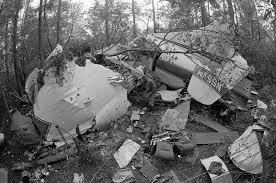
The Convair tore through the trees for 500 feet at 90 miles per hour until the pressure caused the fuselage to be torn open and the wings to break off.  Every seat, save one, in the aircraft was broken away from the floor, hurling occupants into wall panels.  Bodyguard Odom remembered that everyone but him had their seatbelts on.  What was left of the cabin, after the cockpit and tail were ripped away, came to rest in a grove of trees.  It was 6:53 p.m. 


Ronnie Van Zant died on impact from blunt trauma to the head.  Steve Gaines died on impact from a broken neck, when he was hurled face first into a bulkhead.  Assistant road manager Dean Kilpatrick also died on impact, his body being pierced by a piece of the plane.  Pilot McCready and co-pilot Gray, still strapped in their seats and hanging from a nearby tree, also died on impact.  Cassie Gaines survived the initial crash but would die before help could arrive.  Billy Powell claimed she bled to death in his arms.   


Bill Sykes, a television crewman accompanying the band, and Leslie Hawkins, one of the backup singers, survived the crash but were ten feet up in a tree, unable to move due to a large piece of sheet metal that was dangerously close to falling.


Powell had crashed headfirst into a table, his nose nearly ripped from his face.  Hearing people crying for help, trapped under the fuselage, he attempted to render aid. 


Pyle suffered broken ribs but was ambulatory.  As the plane was in its death glide, he had the foresight to look out the windows and notice the lights from a nearby farm.  Once he oriented himself, he, along with roadie Marc Frank and sound engineer Ken Peden, set off on foot to locate that farm.  It would take them nearly an hour of walking through swamps, under barbed wire fences and through a cow pasture in pain and fear before they reached that dairy farm. 


Twenty-two year-old Johnny Mote had been bailing hay when he heard the crash but had assumed it was a car skidding in gravel.  Seeing helicopter searchlights, he had changed his opinion to that of a jail break.  Telling his wife to take cover in the house, he grabbed his hunting rifle and stood guard on the front porch   When Pyle, Frank, and Peden stumbled toward the house, bloody and disoriented, Mote at first fired a warning shot in the air.  The three survivors hit the ground, yelling out that they had been in a plane crash and needed help.  Mote put the dots together and immediately organized a convoy of trucks and four-wheelers to find the crash site and rescue the victims. 


The lack of fuel in the plane was a mixed blessing.  It prevented the plane from catching fire but made it difficult to locate in the dark.   


Mote and his convoy were the first on the scene and were greeted by the site of a bloody hand stuck out of the wreckage and moans and cries from the victims.  They were soon joined by the National Guard, the Coast Guard and Forrest County General Hospital, who illuminated the site with their copters, and ferried victims to the nearby Southwest Regional Medical Center in McComb.  Two bulldozers were dispatched to plow a path from Highway 568 toward the crash site in order to assist first responders, who had no clear way through.   It meant that many of the survivors were not rescued for hours.


Dean Kilpatrick
By this time, the news had gotten out and over 3,000 people showed up at the crash site.  Some were there to lend a helping hand, some to gawk and, gallingly, some came to retrieve a morbid type of souvenir or memorial from the crash.  Gene Odom, the band’s bodyguard, recalled that as he lay bleeding and injured, unknown persons took his wallet, ring, watch and money.  The looters also took luggage, band merchandise, purses, and twisted metal from the plane.  As some of the bandmates had been playing poker when the trouble began and had their wallets out, those wallets had been strewn about the wreckage, making them easy targets for the looters and making it difficult to identify the survivors who had no ID on them. 


Guitarist Gary Rossington, who recalled hearing the sound of the trees hitting the plane before losing consciousness and awaking to find himself on the ground with the plane’s door atop him, suffered two broken arms, two broken legs, two broken wrists, two broken ankles, a broken pelvis, a punctured stomach and liver.  Guitarist Allen Collins had two cracked vertebrae and a cut to his right arm that was so bad, the doctors advised amputation; Collins’ father refused and his arm was saved.  Keyboardist Billy Powell had extensive facial damage from his seatbelt breaking, sending him face first into a table, as well as a broken right knee.  Drummer Artemis Pyle had a fractured ribcage and numerous contusions and abrasions.  Bodyguard Gene Odom had his neck broken when he was thrown from the plane, with his skin badly burned and one eye blinded by the phosphorus from a de-icing flare.  Bass player Leon Wilkeson had the worst injuries of any survivor.  He suffered massive internal injuries that included six broken ribs, one of which had punctured and deflated his left lung.  Both his left arm and left leg were broken twice.  All of his facial bones, including his nose and his jaw, were not just broken but smashed and all his teeth except for his molars were knocked out when he, like Steve Gaines, had been flung face first into a bulkhead.  His heart stopped twice while he was on the operating table. 


The survivors were not told the fates of Van Zant, Steve Gaines, Cassie Gaines and Dean Kilpatrick.  Their bodies, along with those of McCready and Gray, were taken to the gymnasium at the local high school, which was acting as a temporary morgue. 


After he recovered, Gary Rossington recalled that he sat between Steve Gaines and Ronnie Van Zant on one side of the plane while Allen Collins sat between Cassie Gaines and Dean Kilpatrick on the other.  He and Collins would wonder why they survived when Van Zant, Steve and Cassie Gaines and Kilpatrick did not.


Those who survived that 1977 plane crash would not have an easy time of it. 


Allen Collins, whose right arm was saved due to his father’s refusal to allow the doctors to amputate, continued to play music but he, like Gary Rossington, suffered with horrible nightmares and survivor’s guilt.  Both self-soothed with alcohol and drugs but managed to form a new band, the Rossington-Collins Band, and drop an album.  It was during their first tour in 1980 that Collins’ wife Kathy suffered a miscarriage while expecting their third child and bled to death from a hemorrhage.  This devastated Collins, leading to more alcohol and drugs, ended the new band’s tour and created a rift between him and Rossington.  They split and Collins formed the Allen Collins Band in 1983. 


Collins’ bad luck wasn’t over yet.  His new band only lasted a year and one album, disbanding in 1984.  In 1986, after fueling himself with alcohol and/or drugs, he crashed his car, killing his girlfriend Debra and leaving him paralyzed from the chest down.  He was given two years’ probation for vehicular manslaughter.  He would never play guitar on stage again.  He toured with the revamped Lynyrd Skynyrd in 1987, wheeled out onstage to speak of why he was in a wheelchair and advise against the dangers of alcohol and drugs.  He died in 1990 from pneumonia, a complication of his paralysis.  He was only 37 years old.


Leon Wilkeson


Leon Wilkeson, despite his heart stopping twice on the operating table, survived his surgeries and began his rehabilitation.  The swamp water that his wounds were submerged in had caused his left arm to become infected, almost necessitating the amputation of that arm.  The infection led to severe nerve damage and limited motion, which made it impossible for him to play his bass guitar unless he held it upright.   Although he did play again, he was never able to play with his original dexterity.  He played for the band Alias in 1979 and joined Rossington and Collins, along with keyboardist Billy Powell, for the Rossington-Collins Band.  Once the Rossington-Collins Band fizzled, Wilkeson joined Collins for the brief life of the Allen Collins Band.  He had a very short-lived association with the Christian rock band Vision, along with Powell, before signing on for a reunited version of Lynyrd Skynyrd in 1987 with Van Zant’s younger brother filling in for the deceased singer.  While the tour was successful (sold out), Wilkeson awakened in the tour bus in a pool of blood.  His throat had been cut by a person or persons unknown.  Guitarist Ed King (an original member of Lynyrd Skynyrd who had been replaced by the late Steve Gaines) pointed the finger at Wilkeson’s then-wife; she pointed the finger at King.  Wilkeson’s perpetrator was never identified. 


In 2001, Wilkeson was cited for driving under the influence in Florida.  He was in town to deal with that charge when he was found dead in his hotel room on July 27, 2001.  Suffering from emphysema and liver disease, his death was ruled “natural causes.”  He was 49 years old.


Billy Powell


Billy Powell, keyboardist for Lynyrd Skynyrd, had been the first to be released from the hospital and, as such, the only member of the band able to attend the funerals of his bandmates.  He was the unofficial spokesperson for Skynyrd while his bandmates recuperated in the hospital, providing updates to the press.  He recovered from his nose nearly being torn from his face, as well as his other facial lacerations, and went on to participate in the Rossington-Collins Band, the Allen Collins Band, the Christian rock group Vision and was the first bandmember to join the 1987 Lynyrd Skynyrd tribute reboot.  He would remain with the band for the remainder of his life.


In 2007, he joined Kid Rock to play piano for the singer’s “All Summer Long” hit. 


Just two years later, in the early morning hours of January 28, 2009, he called police from his home in Florida complaining of dizziness and difficulty breathing.  By the time police and paramedics arrived, he was unconscious and unresponsive.  Repeated attempts to revive him failed and he was pronounced dead of a heart attack.  It was rumored he had he had neglected to show up for a cardiologist appointment the previous day.  The man Lynyrd Skynyrd called “Gifted Hands” was 56 years old.


Artimus Pyle


Artimus Pyle, the only bandmate who could literally walk from the crash site, spent three years following the devastating crash living in Jerusalem at the Diaspora Yeshiva on Mount Zion.  On his return to the States, he worked briefly with the band Alias before joining his former bandmates in the Rossington-Collins Band.  A serious motorcycle accident in which Pyle collided with a drunk driver left his leg broken in 20 places and forced him to leave the group.    


In 1982, he formed the Artimus Pyle Group and reconvened with Lynyrd Skynyrd in 1987.  He departed in August of 1991, citing issues the other band members had with alcohol and drugs, as well as legal issues with Van Zant’s widow, Judy, who was suing the band in an attempt to have control of the name. 


In 1993, Pyle was charged with attempted capital sexual battery and lewd assault on two girls.  He denied the charges, claiming he was being set up by persons in a Jacksonville, Florida mobile home park who had a grudge against him and were looking to extort money from his Lynyrd Skynyrd association.  The same individuals, according to Pyle, were the ones who had actually abused the girls.  The trial was scheduled to start in January of 1994 but weeks ahead of opening arguments, Pyle pled no contest versus risking a mandatory sentence of life imprisonment if convicted.  He was sentenced to probation and required to register as a sex offender.  In 2007 he was charged for failure to register as a sex offender after officials lost his change of address form he sent in when he and his family moved to North Carolina.  Pyle rejected a plea bargain and was acquitted by a jury in 2009. 


In 2017 he faced new legal issues due to his involvement in a biopic called “Street Survivor: The True Story of the Lynyrd Skynyrd Plane Crash,” in which he was sued by Judy Van Zant, Gary Rossington, Johnny Van Zant (Ronnie’s brother and current lead singer of Lynyrd Skynyrd) and representatives for Allen Collins and Steve Gaines.  Production on the biopic was halted permanently after a U.S. district judge found that it was in violation of a 1987 consent order which prohibited anyone from participating in a band-related project without the participation of at least three surviving members from Skynyrd’s pre-crash era.  Pyle’s memoir, which had been scheduled for publication in October of 2017, was also indefinitely postponed due to the lawsuit.  In October of 2018, the injunction was overturned; the biopic was released in February of 2020.


He continues to live in Asheville, North Carolina.  He has two sons, three daughters and two grandchildren.


Gary Rossington


Gary Rossington, whose drug and alcohol addiction was memorialized in Skynyrd’s song “That Smell,” suffered a severe addiction to pain medication necessitated by his injuries from the plane crash.  He sobered up and continued playing music, with steel rods in his right arm and right leg. 


Following the dissolution of the Rossington-Collins Band in 1982, he formed the Rossington Band with his wife Dale, leading to an album in 1986 and 1988.  In 1987, he rejoined Lynyrd Skynyrd, where he has remained.  In recent years, he has suffered health issues.  A heart attack on October 8, 2015 led to the cancellation of concerts.  The following year he had surgery to repair a blocked artery -- the same year he revived the Rossington Band. 


Rossington continues to perform and with the October 6, 2019 death of original bassist Larry Junstrom, became the lone survivor of the original Lynyrd Skynyrd lineup. 


He and Dale are still married and have two daughters together.         


Steve and Cassie Gaines


The Gaines family was devastated when the 1977 plane crash took away both Steve and Cassie.  Brother and sister were both laid to rest at the Jacksonville Memory Gardens.  On February 15, 1979, their mother, Cassie LaRue Gaines, was killed in an automobile accident by the cemetery that was the final resting place of Steve and Cassie.  She was 52 years old.  She was buried by her children.


On June 29, 2000, vandals broke into the tombs of Ronnie Van Zant and Steve Gaines in Orange Park, Florida.  Two above-ground marble memorials were smashed.  Van Zant’s casket was removed from its tomb but apparently not opened.  Gaines’ ashes, contained in a plastic bag, had been removed from a metal urn; a small tear in the bag led to roughly one percent of his ashes being spilled.  The vandals, apparently, were looking to find out whether it was true that Van Zant had been buried with his signature black hat and his favorite fishing pole. 


Van Zant was reinterred at a different cemetery, this one in Jacksonville, with a massive underground concrete burial vault to prevent any further disturbances.  The memorial at the Orange Park cemetery remains, however, for fans to visit and pay their respects. 


Ronnie Van Zant


During his lifetime, Ronnie Van Zant was notorious for talking about his mortality and how he would never live to see 30.  When he died on October 20, 1977, he was just under three months shy of turning 30.  

In 2003, bodyguard Gene Odom published "Lynyrd Skynyrd: Remembering the Free Birds of Southern Rock."  In it he stated that pilot Gray was potentially impaired and had been observed using cocaine the previous evening (despite what the toxicology reports showed).  


So what caused the plane crash that stopped Lynyrd Skynyrd for a decade and forever stilled the voice that drove the original band?  Officially it was fuel exhaustion and total loss of power from both engines due to crew inattention and fuel supply.  The National Transportation Safety Board stated that the engine malfunction itself should not have been catastrophic.  So clearly, and obviously, the loss of fuel led to the plane crashing.  Pilot McCreary, when radioing for assistance, mentioned that the plane was low on fuel, not out of fuel so what happened?  The aircraft had been refueled upon its arrival in Greenville, South Carolina with 400 gallons of fuel.  While there is no record of how much fuel was in the tanks of the aircraft when refueling began, the NTSB found that a 240 Convair’s average fuel consumption was about 183 gallons per hour.  The flight plan that was filed by the flight crew from Greenville to Baton Rouge listed a planned two hours and 45 minutes of flight time for the journey and with an expected five hours’ worth of fuel on board.  Even if the plane had been dry of any fuel at the time of refueling, the plane should have been able to make it to Baton Rouge. 


The NTSB found that the plane had been running on “auto-rich,” which would have burned about 70 gallons more fuel beyond normal consumption.  Taking off at 5:02 p.m. EST, 4:02 p.m. CST, and with the emergency call coming in at 6:42 p.m. CST meant the plane had been airborne for nearly two hours and 45 minutes.  Yet the plane had not yet arrived in Baton Rouge and was roughly twenty minutes’ flight time outside of it.  As there were no crosswinds reported that night that would slow the craft down, it stands to reason that either the flight crew had no idea how long it would take them to get to Baton Rouge or something slowed them down to a serious degree during the flight.  Regardless, the NTSB decided that the crew was negligent and/or ignorant of the increased fuel consumption and failed to monitor the engine instruments during the flight, which would have alerted them to the fuel consumption. 


Both pilots were experienced so why on earth would they not be monitoring their instruments?   Toxicological reports done during their autopsies showed no signs of impairment; no alcohol, drugs or carbon monoxide in the blood detected.  Additionally, as no survivors mentioned either pilot appearing impaired in any way, that should be ruled out.


It was also rumored and/or suggested that perhaps one of the pilots, in error, may have jettisoned the fuel supply while attempting to transfer fuel from one engine to another.  As the Convair had no black box, or voice recorder, on board, there is no way to know for certain.   


Could the aircraft have been overloaded?  The Convair could take off with 42,000 pounds.  With the passengers, luggage, some equipment and the fuel on board, the weight would have come in around 37,000 pounds.  So overloading doesn’t seem to have been the cause.  And again, the pilots were experienced and should have been well aware what the plane could have handled.


While there is no direct and determined answer, it seems that the flight crew of the Lynyrd Skynyrd plane, for whatever reason, neglected to monitor their instrument panels during the flight until it was too late.  At the very least, it seems it should have been noted that the flight was taking longer than anticipated and the “auto-rich” setting was consuming more fuel.  If the remaining fuel was accidentally jettisoned, it’s something we will never know.  What’s truly sad is that the flight crew flew the aircraft past numerous airports and runways where they could have safely landed the plane versus the freefall outside of McComb, Mississippi that stole six lives and impacted countless others.

Remembering the victims of the 1977 plane crash:


Sources:  Wikipedia; NTSB Aircraft Accident Report; Ultimate Classic Rock; Rolling Stone