The Killing of the Lead Singer of the Punk Rock Band The Gits Goes Cold For a Decade Before Justice is Served
 |
| Mia performing (photo source) |
"Mia Zapata was an extraordinary human being. She was a beloved friend, a gifted songwriter, musician, visual artist and performer. . . . We prefer to remember her friendship, talent, humor, and the incredible art and music she left to the world." - Andy Kessler, Matt Dresdner, and Steve Moriarty of The Gits
In the 1990s, Seattle was Ground Zero for the grunge genre of rock. Pearl Jam, Alice in Chains, Soundgarden, Mother Love Bone, Mudhoney and Candlebox were all leading the music movement from underground to prominence, but none was as big or as influential as Nirvana, who (the band and lead singer, Kurt Cobain) perfectly captured the sound, essence and angst of a generation. Diverse and trendy, Seattle was the perfect city to spawn these bands, as well as many others who were verging on mainstream success.
The Gits was one of those bands. Formed in 1986 at Antioch College in Yellow Springs, Ohio, they took their name from a Monty Python skit and soon became known for the fiery performances of Andy Kessler on guitar, Matt Dresdner on bass, Steve Moriarty on drums and Mia Zapata singing.
Brought up in Kentucky, Mia, the third child and second daughter in her family, was a born performer and from her youth, she seemed to know that she was destined for a musical future. She began singing at an early age, often astounding listeners with her throaty voice, reminiscent of Janis Joplin, one of Mia's idols. By the time she was nine, she had taught herself how to play the piano and the guitar. As a teen, she kept a notebook into which she wrote poetry that eventually became song lyrics.
Although her family was considered well off, Mia cared little for material things and focused instead on creative expression. Antioch, therefore, was a perfect college for her and one that not only enabled her to express herself but allowed her to find a musical community that she quickly affiliated herself with.
Two years after the Gits formed, they recorded and self-released an unofficial debut album. The following year, in 1989, they moved to Seattle to join the growing underground rock movement.
The band moved into an abandoned house in the Capitol Hill district they dubbed "The Rathouse," where they would live and rehearse. When she wasn't performing, Mia washed dishes at a local bar in order to make ends meet, until the Gits made it big. The band played many venues in the Seattle area and quickly gained a devout fan following, particularly with the punk rock community. Mia's magnetic personality and energy pushed her to the forefront of the Gits.
The Gits embarked on a successful international tour in 1990, without support of a record label. Two years later, in 1992, they released their first official album independently.
It seemed that 1993 might finally bring the Gits the mainstream success they craved. By that summer, they were recording their second album and were being seriously courted by various mainstream labels.
 |
| The Gits (photo source) |
July of 1993
On July 4, the band returned to Seattle from a successful tour of the West Coast. Steve Moriarity would later recall that Mia had not wanted to go back to Seattle, that she feared something bad was going to happen there. It seemed an innocuous comment at the time and one that Dresdner associated with Robert Jenkins, Mia's former boyfriend who had recently broken up with her. Their stay wouldn't be long before they would again leave for another tour, this one scheduled to start in New York.
On Tuesday, July 6, Mia rose around 11 a.m. and had lunch with her father, Richard, who drove in from Yakima, where he had relocated with his second wife. Father and daughter routinely had these types of get-togethers once or twice a month when Mia was in Seattle. Richard did not like or approve of Mia's career choice or her lifestyle. He worried about her safety in a city like Seattle, where she lived and moved among a sometimes drug-riddled scene and was often out late at night. These get-togethers allowed him to both keep his bond with Mia tight and to check up on her.
Following lunch at a local Indian restaurant, Mia and Richard visited Tower Records and the Seattle Art Museum before Richard dropped Mia off back at her apartment around 3 p.m., promising to call her in a few days. At that time, only one of her roommates was home. Richard later remembered that Mia had looked satisfied, content and at ease with herself.
Mia walked the dog and did some laundry after Richard departed before heading to Capitol Hill, for the Pancreas Production Studio, around 6:30, where she rehearsed with Hells Smells, the band that her ex, Robert Jenkins, was a member of and where she often sang back-up vocals. She and Jenkins had, at one time, discussed marriage and while he had apparently moved on and had begun dating someone else, Mia was said to still be hurting over the break-up and was stung by the fact that he was dating.
 |
| (photo source) |
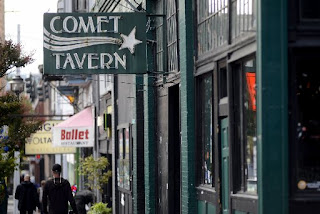
She rehearsed for a good two hours before walking over to the Comet Tavern, a block away at E. Pike and 10th Avenue. The Comet was a local watering hole and well known as a Gits hangout, so Mia was comfortable there and with the people who frequented it. That evening, friends and fellow musicians from the band Seven Year Bitch were drinking and remembering their former guitarist, Stefanie Sargent, who had died 13 months earlier after a night of heavy drinking and shooting up heroin. There was some dispute as to whether Mia had been drinking on and off all day or had begun drinking once she arrived at the Comet but by the time she left that night, she was extremely intoxicated.
Mia was no stranger to drugs, having been known to smoke pot and even to have dabbled in the harder stuff but her vice of choice was alcohol. Her drinking had gotten so bad at one point that the other members of the Gits had threatened to kick her out of the band unless she eased up. She had complied during the tour, not just controlling her consumption but foregoing alcohol completely. Whether it was returning to the familiar stomping grounds of Seattle and her interactions with Robert Jenkins or remembering Stefanie Sargent or the cusp that the Gits were on, headed for success, Mia fell off the wagon on July 6. Her friends at the Comet later recalled that she seemed agitated after the rehearsal session with Jenkins and barely let her glass get empty before having another drink. At one point she even left the Comet briefly to walk to a nearby pizza joint, where she purchased alcohol to drink before returning to the tavern.
While at the Comet, Mia reportedly made a phone call from the bar's payphone but it's unknown who she called. She did not mention it to her friends, and no one came forward to say that they had spoken to her or received a call from her. In all likelihood, she was trying to track down Jenkins.
Mia left the Comet around 1 a.m., reportedly saying that she was going to try and locate Jenkins. She retraced her steps from earlier, walking east on Pike for about a block, back to the Pancreas Production Studios. Finding the studio empty and no trace of Jenkins, she went to the third floor of the adjoining Winston Apartments, where a friend of hers, "T.V.," lived. T.V. was also a member of Jenkins' band and remembered that Mia was not only very drunk but angry because she couldn't locate Jenkins and wanted to talk to him about their relationship.
Mia spent about an hour at T.V.'s apartment before deciding to leave. T.V. tried to convince Mia to stay and sleep it off but Mia rejected the offer and set out, once again on foot. Depending on the source, Mia was either going in search of Jenkins, was going to walk to a nearby gas station where she could catch a cab home or walk to a cab company to get a cab there. (She had no driver's license and would often take cabs around the city.) When she left T.V.'s apartment, Mia was wearing a black Gits hooded sweatshirt, cut-off jeans, black boots and carried a Walkman.
For nearly an hour and a half, Mia's whereabouts were unknown.
At 3:20 a.m., just over two miles southeast from the Winston Apartments, a prostitute made the terrible find of a body. Located on 24th Avenue between South Yesler and South Washington, the body was discovered in the street, next to the curb and close to a nearby field. The sex worker immediately notified authorities. The Seattle Fire Department arrived on the scene at 3:30 a.m. and found a young female lying on the pavement, her ankles crossed, and her arms spread in a Christ-like pose. The sweatshirt she wore was pulled up underneath her arms with the hood tied tightly around her face and knotted under her throat. Her underwear and torn bra were found stuffed in the pocket of her jeans. The paramedics noted abrasions on the exposed parts of her body, including alongside her nipples. She had no pulse and did not appear to be breathing but the paramedics did not believe she had been lying there long and attempted resuscitation, which proved unsuccessful. She was pronounced dead and sent to the morgue as a Jane Doe, to await the medical examiner, Seattle's 33rd murder victim of 1993.
While the fire department and paramedics had no idea who the woman was, the medical examiner had no doubt. A fan of the underground music scene, he had attended many of The Gits' concerts and immediately recognized the body of Mia Zapata on his table.
He determined that Mia had been strangled with a ligature and believed it to be the drawstring of her sweatshirt. Although the strangulation had been what had killed her, she had endured a horrific beating to her abdominal area which had not only lacerated her liver but, in the medical examiner's opinion, would have resulted in her death had she not been strangled.
Mia also had injuries to her vaginal and anal area consistent with rape, although no semen was detected. The M.E. thought the abrasions along her nipples were caused by teeth and had taken swabs from the area. The swabs, once analyzed, detected the presence of saliva. As DNA testing was still in its infancy, the M.E. had the foresight to preserve the swabs for future use.
Investigators worked hard to withhold the fact that Mia had been raped - something that did not sit well with her friends, or women in the Seattle area. The investigators also withheld the details of Mia's torn bra, which was missing a cup, in the event a suspect was ever identified. They wanted details that only her killer could provide.
They felt that Mia had been walking along with her headset on, listening to music, and was ambushed.
The Investigation
The area where Mia had been discovered was well known as an area used by sex workers to conduct their business and at first, it was considered that Mia might have been a victim of the-then still unidentified Green River Killer. However, since Mia was not a sex worker nor someone who lived on the street, as many of the Green River Killer's victims were, that idea was discounted.
The area was thoroughly searched by detectives and nothing was uncovered that was connected to Mia. Everything appeared to indicate that she had been killed elsewhere and where she was found was a dump site.
Robert Jenkins, as Mia's ex, was the logical prime suspect, a theory that was firmed up by some of her friends' beliefs that Jenkins had to have been involved. The day after Mia was killed, one of her friends had stopped by the rehearsal studio Mia had visited in her unsuccessful quest to find Jenkins and discovered a Gits demo tape and Mia's personal microphone. The friend claimed that Mia rarely left her microphone out of her sight.
Jenkins, however, had a solid alibi and the police felt he had no real reason to harm Mia. They found no evidence that a crime had taken place in the studio and assumed that Mia had left the tape and mic there after searching for Jenkins or had even returned after leaving T.V.'s apartment and had simply forgotten to take them with her.
Police received a tip from a man who reported hearing a terrifying scream in the early morning hours of July 7. It had bothered him so much that he had gone outside to see what was going on but had discovered nothing in the darkness. He was three miles from where Mia's body was found.
Another tip came in from a woman who stated that there had been a group of people outside the back of the Pancreas Production Studios on Pike Street doing cocaine. Her statement could not be verified and the people she alleged to have seen were never located.
As Mia did not have a driver's license and would make liberal use of the cabs around Seattle, police worked on a theory that had a cab driver as their perpetrator. Her friends said that Mia would never have gotten into the vehicle of someone she didn't know, but she would have gotten into a cab. She knew a great many of the cab drivers around the city and would have had no reason to fear getting into their vehicles. Police were aware that cabbies would not only be familiar with the less traveled, or even deserted, areas of town but their vehicles could be moving crime locations with which to assault and kill.
Detectives checked with the local cabbies, as well as the cab companies, and none of them reported picking Mia up in the early morning of July 7 or even seeing her.
The investigation turned to Mia's friends, bandmates and the Seattle music scene. Detectives wondered if an obsessed fan or a jealous musician could have set out to harm her. Although Mia had traveled in circles with some questionable people and was known to be extremely outspoken, no one had an unkind word to say about her, seeing her almost as the glue that held their community together.
In August, the same month that she would have turned 28, a group of Mia's friends, frustrated that the police seemed to be making little headway, hired a private investigator. The money to pay the P.I. came from a few concerts the surviving Gits put on, with Joan Jett stepping into Mia's shoes, as well as donations from Nirvana, Pearl Jam, Soundgarden, Sonic Youth, Hootie and the Blowfish and Jett and her band, the Blackhearts. The funds would last more than two years after which Leigh Hearon, the P.I., would continue to work Mia's case on her own time and on her own dime.
In 1994, Joan Jett and the Blackhearts released their album "Pure and Simple" with the moving track "Go Home," which was dedicated to Mia. Jett joined The Gits in 1995 for live shows, using the moniker "Evil Stig," which was "Gits Live" spelled backwards.
In 1996, the benefit album "Home Alive: The Art of Self-Defense" was released, featuring Nirvana, Pearl Jam, and Soundgarden, among others, with the proceeds to benefit Home Alive, a self-defense program for women was that founded and funded, in part, by members of Seven Year Bitch, Joan Jett and singer Kathleen Hannah following Mia's murder.
"I want more than anything for them to be able to find out what happened so there could be some resolution for everybody, because everyone's been working real hard trying to find the person who did this." - Joan Jett
Time marched on. Mia's death had affected the tightknit community she had been part of. Some left Seattle, never to return. Kurt Cobain's suicide nine months after Mia's murder only seemed to solidify the opinion that the grunge rock scene was an unhealthy, dangerous one.
Fliers that Mia's friends had put up requesting information on her case remained at the Comet Tavern and were still up and about Seattle years after her murder. Even in death, Mia Zapata remainder a powerful force in Seattle.
 |
| Jesus Mezquia (photo source) |
A Killer Is Identified
In 2001, Seattle police reopened Mia's case. DNA evidence had come a long way since July of 1993 and the decision was made to pull the small saliva sample out of deep freeze and submit it for testing to try and obtain a DNA sample.
The Washington State Crime Lab was able to pull two profiles, Mia's and an unknown male.In June of 2002, the DNA profile of the unknown male was entered into the FBI database. No matches or hits were made at that time, but Detectives Richard Gagnon and Gregg Mixsell, the cold case detectives assigned to Mia's case, hoped that with the profile now in the system, they would eventually get a hit.
They wouldn't have to wait long.
In December, Gagnon and Mixsell were notified there had been a match. The hit came not from the Seattle area but Miami, Florida and a 48-year-old fisherman by the name of Jesus Mezquia. Mezquia was a Cuban native who had come to the United States in the Mariel boatlift of 1980 and his criminal record in the States had started almost as soon as he set foot in the country. Over the years he had accumulated acts of kidnapping, false imprisonment, indecent exposure, aggravated battery (both of a spouse and of a pregnant woman), assault to commit rape, and robbery across multiple states. His most recent conviction had been for possession of burglary tools, and he completed probation for that conviction in December. As a condition of his probation, Mezquia provided two cheek swabs that would be entered into the DNA database, resulting in the match that lab techs said was one in 1.5 trillion.
On January 10, 2003, Gagnon and Mixsell arrested Jesus Mezquia in Miami. Mezquia denied knowing Mia or having any kind of sexual contact with her.
Detectives found that since Mezquia had come to the United States, he had lived in Florida and California - and also Washington, where he had relocated in 1992 to be with a girlfriend who moved to the area. The couple first lived in the Beacon Hill neighborhood with the girlfriend's mother before moving into an apartment in the Leschi area, not far from the Comet Tavern - and the area where Mia's body had been discarded. Their relationship had been tempestuous and abusive, as had all of Mezquia's past and future relationships with women. The girlfriend had told neighbors of Mezquia's abusive treatment of her and wanting to distance herself from him. She and Mezquia had broken up in the summer of 1993 but continued to live together. She had been out of town on the night of July 6-7, 1993, the night Mia was murdered. Eventually, she got a car for Mezquia and he moved to southern California for a time before returning to Florida.
Incredulously, five weeks after Mia was murdered, a young woman walking along 10th Avenue near Union Street, only a block from the Comet Tavern, noticed a car following her. She assumed the driver wanted to offer her a ride - until she realized the driver was masturbating. She wrote down the license plate number and quickly made her escape. When Seattle police checked the license number, they found it was for Jesus Mezquia. Law enforcement never made a connection between Mezquia's indecent exposure and Mia Zapata.
 |
| (photo source) |
"After 11 years of waiting for this moment, it is hard to believe some semblance of justice may be achieved." - Steve Moriarty, former Gits drummer
Mezquia was extradited to Seattle three months after his arrest and arraigned. Opening arguments in his trial began on Monday, March 15, 2004. Following the month-long trial in which Mezquia did not testify in his own defense, the jury found him guilty of first-degree felony murder. Based on the aggravating circumstances of deliberate cruelty and finding the injuries Mia suffered "extreme," Judge Sharon Armstrong sentenced Mezquia to 37 years.
In 2005, Mezquia filed an appeal against his sentence, arguing in part that he should have been allowed to present other suspects, including Mia's former boyfriend, Robert Jenkins and a cab driver by the name of Scott MacFarlane, as part of his defense. He also argued that DNA evidence obtained from Florida should not have been admitted in a Washington case.
In Mezquia's brief, he sought to present evidence that Jenkins had actually committed the murder, citing that Mia had been searching for Jenkins the night of her death, Jenkins had called Mia's apartment the following morning and when told by one of her roommates that she was in the shower, responded that it probably wasn't Mia. Mezquia also claimed that a friend of Mia's had said that Jenkins had sometimes gone "crazy" in the past and had attacked Mia.
The appeals court denied his request on Jenkins, stating that there was no physical evidence connecting Jenkins to the scene (a DNA test had excluded him) and Mezquia had not offered evidence that clearly pointed to Jenkins.
Mezquia additionally argued that Scott MacFarlane committed the murder. A cab driver, MacFarlane claimed to have had a relationship with Mia and was driving a cab in the Capitol Hill area of Seattle on the night she was killed. A year after her death, MacFarlane apparently made some odd and incriminating statements about her murder.
The trial court had agreed that there had been sufficient evidence to introduce MacFarlane. However, during the initial trial, after the prosecution had rested its case, a woman by the name of Valentina Dececco came foward to allege that Mezquia assaulted her six months after Mia's homicide. She did not report the incident at the time it happened but when she saw Mezquia's photograph in the newspaper after he was charged, she called the police. According to Dececco, in January of 1994 around 4:30 a.m., she was leaving her downtown Seattle apartment for a morning jog when Mezquia approached her. He knocked her to her knees and Dececco felt "pain at her throat." She managed to rise to her feet and ran away. Just a short time later, upon returning to her apartment building, she saw Mezquia standing at one corner of her building, staring at her and masturbating.
The prosecution had notified the trial court that it intended to introduce this evidence in rebuttal, but it would only come in if the defense raised the issue of identity. If the defense chose to present its "other suspect" evidence related to MacFarlane, the prosecution would be able to call Dececco in rebuttal. The defense chose not to introduce the MacFarlane evidence and Dececco never testified in court.
Mezquia argued to the appeals court that the trial court erred in ruling that evidence of the prior assault on Dececco was admissible. The appeals court disagreed, stating that there had been no offer of proof of what MacFarlane's testimony would have been nor was there any evidence that the state would have indeed chosen to present Dececco's testimony.
With regard to Mezquia's argument of the Florida DNA sample, the appeals court denied the motion to suppress that evidence, citing that a cheek swab is a "minimally invasive search," the DNA was obtained lawfully and there was no inappropriate cooperation between Washington and Florida.
Mezquia's final appeals argument was that his Sixth Amendment right to a jury trial was violated when the trial court imposed an "exceptional sentence" without submission to the jury. On this point, the appeals court sided with Mezquia, finding that the jury did not determine whether the prosecution proved the factual basis for the exceptional sentence beyond a reasonable doubt.
While Mezquia's conviction was affirmed, his sentence was reversed, and the case was remanded for sentencing.
 |
| Jesus Mezquia convicted again, in front of Mia's portrait (photo source) |
On January 29, 2009, after inexplicably waiving his right to a jury trial, Judge Sharon Armstrong once against sentenced Jesus Mezquia for raping and murdering Mia Zapata, this time for 36 years.
 |
| (photo source) |
Mia's Legacy
Prosecutors believed that in the early morning hours of July 7, 1993, with his girlfriend out of town and the relationship on its last legs, the violent and simmering Mezquia went on the prowl for a victim. With no evidence that he and Mia had ever met before, it is believed that Mezquia drove by the Winston Apartments/Pancreas Production Studios as Mia was leaving on foot around 2 a.m. and followed her until he could attack her, possibly very much like Valentina Dececco was attacked. With her headphones on, she would not have heard him approaching and would not have been aware of his presence until it was too late. In her intoxicated state, she had no real chance against the six-foot-four, 235-pound Mezquia. Prosecutors theorized that Mezquia beat Mia and placed her in the back seat of his car or beat her after putting her in the car. The sexual assault happened either in his car or his apartment. He then strangled her with the cord of her hooded sweatshirt, dumped her body in an area well-known for its sex and drug trafficking, and went home.
Jesus Mezquia maintained his innocence in the rape and murder of Mia from the time he was arrested until he died in a Washington prison on January 21, 2021. He went to his grave having never spoken about the attack on Mia nor taking any responsibility for his actions, despite what the DNA evidence revealed.
Home Again, the self-defense program started in Mia's memory, still runs today.
"Her legacy should be beautiful, strong punk-rock music coming from a woman's perspective, because that's who she was." - Joan Jett
 |
| (photo source) |
Sources:
CNN (March 9, 2004) Ten Years On, Trial Begins for Man Accused of Punk Icon's Murder.
Front Page Detectives (August 13, 2021). The Brutal Slaying of a Rock Star on the Rise.
Grunge (March 11, 2021). The Tragic Murder of Punk Rock Singer Mia Zapata.
Musicoholics (2021) That One Fateful Night: What Happened to Mia Zapata?
Rolling Stone (May 23, 2021). Mia Zapata's Killer Has Died.
The Seattle Times (August 23, 1998). Who Murdered Mia Zapata?
The Seattle Times (January 30, 2009). Singer's Killer Sentenced to 36 Years in Prison Again.
State v. Mezquia, Court of Appeals, Washington Division 1, No. 54246-0-1.
The Stranger (January 16, 2003). Finally, DNA Evidence Leads to Arrest of Mia Zapata's Suspected Killer.
Unsolved Mysteries (2021). Mia Zapata.


