Showing posts with label Washington. Show all posts

December 16, 2021

The Murder of Mia Zapata

The Killing of the Lead Singer of the Punk Rock Band The Gits Goes Cold For a Decade Before Justice is Served

Mia performing (photo source)


"Mia Zapata was an extraordinary human being.  She was a beloved friend, a gifted songwriter, musician, visual artist and performer. . . .  We prefer to remember her friendship, talent, humor, and the incredible art and music she left to the world." - Andy Kessler, Matt Dresdner, and Steve Moriarty of The Gits 


In the 1990s, Seattle was Ground Zero for the grunge genre of rock.  Pearl Jam, Alice in Chains, Soundgarden, Mother Love Bone, Mudhoney and Candlebox were all leading the music movement from underground to prominence, but none was as big or as influential as Nirvana, who (the band and lead singer, Kurt Cobain) perfectly captured the sound, essence and angst of a generation.  Diverse and trendy, Seattle was the perfect city to spawn these bands, as well as many others who were verging on mainstream success.

The Gits was one of those bands.  Formed in 1986 at Antioch College in Yellow Springs, Ohio, they took their name from a Monty Python skit and soon became known for the fiery performances of Andy Kessler on guitar, Matt Dresdner on bass, Steve Moriarty on drums and Mia Zapata singing. 

Brought up in Kentucky, Mia, the third child and second daughter in her family, was a born performer and from her youth, she seemed to know that she was destined for a musical future.  She began singing at an early age, often astounding listeners with her throaty voice, reminiscent of Janis Joplin, one of Mia's idols.  By the time she was nine, she had taught herself how to play the piano and the guitar.  As a teen, she kept a notebook into which she wrote poetry that eventually became song lyrics.    

Although her family was considered well off, Mia cared little for material things and focused instead on creative expression. Antioch, therefore, was a perfect college for her and one that not only enabled her to express herself but allowed her to find a musical community that she quickly affiliated herself with.  

Two years after the Gits formed, they recorded and self-released an unofficial debut album.  The following year, in 1989, they moved to Seattle to join the growing underground rock movement.  

The band moved into an abandoned house in the Capitol Hill district they dubbed "The Rathouse," where they would live and rehearse.  When she wasn't performing, Mia washed dishes at a local bar in order to make ends meet, until the Gits made it big.  The band played many venues in the Seattle area and quickly gained a devout fan following, particularly with the punk rock community.  Mia's magnetic personality and energy pushed her to the forefront of the Gits.    

The Gits embarked on a successful international tour in 1990, without support of a record label.  Two years later, in 1992, they released their first official album independently.  

It seemed that 1993 might finally bring the Gits the mainstream success they craved.  By that summer, they were recording their second album and were being seriously courted by various mainstream labels.  

The Gits (photo source)

July of 1993

On July 4, the band returned to Seattle from a successful tour of the West Coast.  Steve Moriarity would later recall that Mia had not wanted to go back to Seattle, that she feared something bad was going to happen there.  It seemed an innocuous comment at the time and one that Dresdner associated with Robert Jenkins, Mia's former boyfriend who had recently broken up with her.  Their stay wouldn't be long before they would again leave for another tour, this one scheduled to start in New York.  

On Tuesday, July 6, Mia rose around 11 a.m. and had lunch with her father, Richard, who drove in from Yakima, where he had relocated with his second wife.  Father and daughter routinely had these types of get-togethers once or twice a month when Mia was in Seattle.  Richard did not like or approve of Mia's career choice or her lifestyle.  He worried about her safety in a city like Seattle, where she lived and moved among a sometimes drug-riddled scene and was often out late at night.  These get-togethers allowed him to both keep his bond with Mia tight and to check up on her.   

Following lunch at a local Indian restaurant, Mia and Richard visited Tower Records and the Seattle Art Museum before Richard dropped Mia off back at her apartment around 3 p.m., promising to call her in a few days.  At that time, only one of her roommates was home.   Richard later remembered that Mia had looked satisfied, content and at ease with herself.  

Mia walked the dog and did some laundry after Richard departed before heading to Capitol Hill, for the Pancreas Production Studio, around 6:30, where she rehearsed with Hells Smells, the band that her ex, Robert Jenkins, was a member of and where she often sang back-up vocals.  She and Jenkins had, at one time, discussed marriage and while he had apparently moved on and had begun dating someone else, Mia was said to still be hurting over the break-up and was stung by the fact that he was dating.
(photo source)


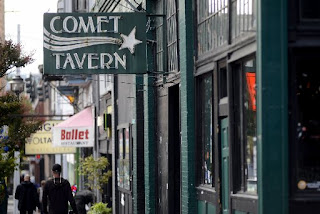
She rehearsed for a good two hours before walking over to the Comet Tavern, a block away at E. Pike and 10th Avenue.  The Comet was a local watering hole and well known as a Gits hangout, so Mia was comfortable there and with the people who frequented it.  That evening, friends and fellow musicians from the band Seven Year Bitch were drinking and remembering their former guitarist, Stefanie Sargent, who had died 13 months earlier after a night of heavy drinking and shooting up heroin.  There was some dispute as to whether Mia had been drinking on and off all day or had begun drinking once she arrived at the Comet but by the time she left that night, she was extremely intoxicated.    

Mia was no stranger to drugs, having been known to smoke pot and even to have dabbled in the harder stuff but her vice of choice was alcohol.  Her drinking had gotten so bad at one point that the other members of the Gits had threatened to kick her out of the band unless she eased up.  She had complied during the tour, not just controlling her consumption but foregoing alcohol completely.   Whether it was returning to the familiar stomping grounds of Seattle and her interactions with Robert Jenkins or remembering Stefanie Sargent or the cusp that the Gits were on, headed for success, Mia fell off the wagon on July 6.   Her friends at the Comet later recalled that she seemed agitated after the rehearsal session with Jenkins and barely let her glass get empty before having another drink.  At one point she even left the Comet briefly to walk to a nearby pizza joint, where she purchased alcohol to drink before returning to the tavern.  

While at the Comet, Mia reportedly made a phone call from the bar's payphone but it's unknown who she called.  She did not mention it to her friends, and no one came forward to say that they had spoken to her or received a call from her.  In all likelihood, she was trying to track down Jenkins.  

Mia left the Comet around 1 a.m., reportedly saying that she was going to try and locate Jenkins.  She retraced her steps from earlier, walking east on Pike for about a block, back to the Pancreas Production Studios.  Finding the studio empty and no trace of Jenkins, she went to the third floor of the adjoining Winston Apartments, where a friend of hers, "T.V.," lived.  T.V. was also a member of Jenkins' band and remembered that Mia was not only very drunk but angry because she couldn't locate Jenkins and wanted to talk to him about their relationship.  

Mia spent about an hour at T.V.'s apartment before deciding to leave.  T.V. tried to convince Mia to stay and sleep it off but Mia rejected the offer and set out, once again on foot.  Depending on the source, Mia was either going in search of Jenkins, was going to walk to a nearby gas station where she could catch a cab home or walk to a cab company to get a cab there.  (She had no driver's license and would often take cabs around the city.)  When she left T.V.'s apartment, Mia was wearing a black Gits hooded sweatshirt, cut-off jeans, black boots and carried a Walkman.    

For nearly an hour and a half, Mia's whereabouts were unknown.


At 3:20 a.m., just over two miles southeast from the Winston Apartments, a prostitute made the terrible find of a body.  Located on 24th Avenue between South Yesler and South Washington, the body was discovered in the street, next to the curb and close to a nearby field.  The sex worker immediately notified authorities.  The Seattle Fire Department arrived on the scene at 3:30 a.m. and found a young female lying on the pavement, her ankles crossed, and her arms spread in a Christ-like pose.  The sweatshirt she wore was pulled up underneath her arms with the hood tied tightly around her face and knotted under her throat.  Her underwear and torn bra were found stuffed in the pocket of her jeans.  The paramedics noted abrasions on the exposed parts of her body, including alongside her nipples.   She had no pulse and did not appear to be breathing but the paramedics did not believe she had been lying there long and attempted resuscitation, which proved unsuccessful.  She was pronounced dead and sent to the morgue as a Jane Doe, to await the medical examiner, Seattle's 33rd murder victim of 1993.    

While the fire department and paramedics had no idea who the woman was, the medical examiner had no doubt.  A fan of the underground music scene, he had attended many of The Gits' concerts and immediately recognized the body of Mia Zapata on his table.  

He determined that Mia had been strangled with a ligature and believed it to be the drawstring of her sweatshirt.  Although the strangulation had been what had killed her, she had endured a horrific beating to her abdominal area which had not only lacerated her liver but, in the medical examiner's opinion, would have resulted in her death had she not been strangled.  

Mia also had injuries to her vaginal and anal area consistent with rape, although no semen was detected.  The M.E. thought the abrasions along her nipples were caused by teeth and had taken swabs from the area.  The swabs, once analyzed, detected the presence of saliva.   As DNA testing was still in its infancy, the M.E. had the foresight to preserve the swabs for future use.   

Investigators worked hard to withhold the fact that Mia had been raped - something that did not sit well with her friends, or women in the Seattle area.  The investigators also withheld the details of Mia's torn bra, which was missing a cup, in the event a suspect was ever identified.   They wanted details that only her killer could provide.  

They felt that Mia had been walking along with her headset on, listening to music, and was ambushed.


The Investigation

The area where Mia had been discovered was well known as an area used by sex workers to conduct their business and at first, it was considered that Mia might have been a victim of the-then still unidentified Green River Killer.  However, since Mia was not a sex worker nor someone who lived on the street, as many of the Green River Killer's victims were, that idea was discounted.  

The area was thoroughly searched by detectives and nothing was uncovered that was connected to Mia.  Everything appeared to indicate that she had been killed elsewhere and where she was found was a dump site.  

Robert Jenkins, as Mia's ex, was the logical prime suspect, a theory that was firmed up by some of her friends' beliefs that Jenkins had to have been involved.  The day after Mia was killed, one of her friends had stopped by the rehearsal studio Mia had visited in her unsuccessful quest to find Jenkins and discovered a Gits demo tape and Mia's personal microphone.  The friend claimed that Mia rarely left her microphone out of her sight.  

Jenkins, however, had a solid alibi and the police felt he had no real reason to harm Mia.  They found no evidence that a crime had taken place in the studio and assumed that Mia had left the tape and mic there after searching for Jenkins or had even returned after leaving T.V.'s apartment and had simply forgotten to take them with her. 

Police received a tip from a man who reported hearing a terrifying scream in the early morning hours of July 7.  It had bothered him so much that he had gone outside to see what was going on but had discovered nothing in the darkness.  He was three miles from where Mia's body was found.   

Another tip came in from a woman who stated that there had been a group of people outside the back of the Pancreas Production Studios on Pike Street doing cocaine.  Her statement could not be verified and the people she alleged to have seen were never located.  

As Mia did not have a driver's license and would make liberal use of the cabs around Seattle, police worked on a theory that had a cab driver as their perpetrator.  Her friends said that Mia would never have gotten into the vehicle of someone she didn't know, but she would have gotten into a cab.  She knew a great many of the cab drivers around the city and would have had no reason to fear getting into their vehicles. Police were aware that cabbies would not only be familiar with the less traveled, or even deserted, areas of town but their vehicles could be moving crime locations with which to assault and kill.    

Detectives checked with the local cabbies, as well as the cab companies, and none of them reported picking Mia up in the early morning of July 7 or even seeing her.  

The investigation turned to Mia's friends, bandmates and the Seattle music scene.  Detectives wondered if an obsessed fan or a jealous musician could have set out to harm her.  Although Mia had traveled in circles with some questionable people and was known to be extremely outspoken, no one had an unkind word to say about her, seeing her almost as the glue that held their community together.  


In August, the same month that she would have turned 28, a group of Mia's friends, frustrated that the police seemed to be making little headway, hired a private investigator.  The money to pay the P.I. came from a few concerts the surviving Gits put on, with Joan Jett stepping into Mia's shoes, as well as donations from Nirvana, Pearl Jam, Soundgarden, Sonic Youth, Hootie and the Blowfish and Jett and her band, the Blackhearts.  The funds would last more than two years after which Leigh Hearon, the P.I., would continue to work Mia's case on her own time and on her own dime.  

In 1994, Joan Jett and the Blackhearts released their album "Pure and Simple" with the moving track "Go Home," which was dedicated to Mia.  Jett joined The Gits in 1995 for live shows, using the moniker "Evil Stig," which was "Gits Live" spelled backwards.  

In 1996, the benefit album "Home Alive: The Art of Self-Defense" was released, featuring Nirvana, Pearl Jam, and Soundgarden, among others, with the proceeds to benefit Home Alive, a self-defense program for women was that founded and funded, in part, by members of Seven Year Bitch, Joan Jett and singer Kathleen Hannah following Mia's murder.  


"I want more than anything for them to be able to find out what happened so there could be some resolution for everybody, because everyone's been working real hard trying to find the person who did this."  - Joan Jett

Time marched on.  Mia's death had affected the tightknit community she had been part of.  Some left Seattle, never to return.  Kurt Cobain's suicide nine months after Mia's murder only seemed to solidify the opinion that the grunge rock scene was an unhealthy, dangerous one.  

Fliers that Mia's friends had put up requesting information on her case remained at the Comet Tavern and were still up and about Seattle years after her murder.  Even in death, Mia Zapata remainder a powerful force in Seattle.  

Jesus Mezquia (photo source)


A Killer Is Identified

In 2001, Seattle police reopened Mia's case.  DNA evidence had come a long way since July of 1993 and the decision was made to pull the small saliva sample out of deep freeze and submit it for testing to try and obtain a DNA sample. 

The Washington State Crime Lab was able to pull two profiles, Mia's and an unknown male.  

That same year, although Washington State would have had no idea how it would impact them, Florida passed a new law that expanded their DNA database to include felons who had been convicted of burglary and robbery.  

In June of 2002, the DNA profile of the unknown male was entered into the FBI database.  No matches or hits were made at that time, but Detectives Richard Gagnon and Gregg Mixsell, the cold case detectives assigned to Mia's case, hoped that with the profile now in the system, they would eventually get a hit.  

They wouldn't have to wait long.  

In December, Gagnon and Mixsell were notified there had been a match.    The hit came not from the Seattle area but Miami, Florida and a 48-year-old fisherman by the name of Jesus Mezquia.  Mezquia was a Cuban native who had come to the United States in the Mariel boatlift of 1980 and his criminal record in the States had started almost as soon as he set foot in the country.  Over the years he had accumulated acts of kidnapping, false imprisonment, indecent exposure, aggravated battery (both of a spouse and of a pregnant woman), assault to commit rape, and robbery across multiple states.  His most recent conviction had been for possession of burglary tools, and he completed probation for that conviction in December.  As a condition of his probation, Mezquia provided two cheek swabs that would be entered into the DNA database, resulting in the match that lab techs said was one in 1.5 trillion.  

On January 10, 2003, Gagnon and Mixsell arrested Jesus Mezquia in Miami.  Mezquia denied knowing Mia or having any kind of sexual contact with her.  

Detectives found that since Mezquia had come to the United States, he had lived in Florida and California - and also Washington, where he had relocated in 1992 to be with a girlfriend who moved to the area.  The couple first lived in the Beacon Hill neighborhood with the girlfriend's mother before moving into an apartment in the Leschi area, not far from the Comet Tavern - and the area where Mia's body had been discarded.  Their relationship had been tempestuous and abusive, as had all of Mezquia's past and future relationships with women.  The girlfriend had told neighbors of Mezquia's abusive treatment of her and wanting to distance herself from him.  She and Mezquia had broken up in the summer of 1993 but continued to live together.  She had been out of town on the night of July 6-7, 1993, the night Mia was murdered.  Eventually, she got a car for Mezquia and he moved to southern California for a time before returning to Florida. 

Incredulously, five weeks after Mia was murdered, a young woman walking along 10th Avenue near Union Street, only a block from the Comet Tavern, noticed a car following her.  She assumed the driver wanted to offer her a ride - until she realized the driver was masturbating.  She wrote down the license plate number and quickly made her escape.  When Seattle police checked the license number, they found it was for Jesus Mezquia.  Law enforcement never made a connection between Mezquia's indecent exposure and Mia Zapata.  


(photo source)


"After 11 years of waiting for this moment, it is hard to believe some semblance of justice may be achieved."  - Steve Moriarty, former Gits drummer


Mezquia was extradited to Seattle three months after his arrest and arraigned.  Opening arguments in his trial began on Monday, March 15, 2004.  Following the month-long trial in which Mezquia did not testify in his own defense, the jury found him guilty of first-degree felony murder.  Based on the aggravating circumstances of deliberate cruelty and finding the injuries Mia suffered "extreme," Judge Sharon Armstrong sentenced Mezquia to 37 years. 

In 2005, Mezquia filed an appeal against his sentence, arguing in part that he should have been allowed to present other suspects, including Mia's former boyfriend, Robert Jenkins and a cab driver by the name of Scott MacFarlane, as part of his defense.  He also argued that DNA evidence obtained from Florida should not have been admitted in a Washington case.  

In Mezquia's brief, he sought to present evidence that Jenkins had actually committed the murder, citing that Mia had been searching for Jenkins the night of her death, Jenkins had called Mia's apartment the following morning and when told by one of her roommates that she was in the shower, responded that it probably wasn't Mia.  Mezquia also claimed that a friend of Mia's had said that Jenkins had sometimes gone "crazy" in the past and had attacked Mia.   

The appeals court denied his request on Jenkins, stating that there was no physical evidence connecting Jenkins to the scene (a DNA test had excluded him) and Mezquia had not offered evidence that clearly pointed to Jenkins. 

Mezquia additionally argued that Scott MacFarlane committed the murder.  A cab driver, MacFarlane claimed to have had a relationship with Mia and was driving a cab in the Capitol Hill area of Seattle on the night she was killed.  A year after her death, MacFarlane apparently made some odd and incriminating statements about her murder. 

The trial court had agreed that there had been sufficient evidence to introduce MacFarlane.  However, during the initial trial, after the prosecution had rested its case, a woman by the name of Valentina Dececco came foward to allege that Mezquia assaulted her six months after Mia's homicide.  She did not report the incident at the time it happened but when she saw Mezquia's photograph in the newspaper after he was charged, she called the police.  According to Dececco, in January of 1994 around 4:30 a.m., she was leaving her downtown Seattle apartment for a morning jog when Mezquia approached her.  He knocked her to her knees and Dececco felt "pain at her throat."  She managed to rise to her feet and ran away.  Just a short time later, upon returning to her apartment building, she saw Mezquia standing at one corner of her building, staring at her and masturbating.  

The prosecution had notified the trial court that it intended to introduce this evidence in rebuttal, but it would only come in if the defense raised the issue of identity.  If the defense chose to present its "other suspect" evidence related to MacFarlane, the prosecution would be able to call Dececco in rebuttal.  The defense chose not to introduce the MacFarlane evidence and Dececco never testified in court. 

Mezquia argued to the appeals court that the trial court erred in ruling that evidence of the prior assault on Dececco was admissible.  The appeals court disagreed, stating that there had been no offer of proof of what MacFarlane's testimony would have been nor was there any evidence that the state would have indeed chosen to present Dececco's testimony. 

With regard to Mezquia's argument of the Florida DNA sample, the appeals court denied the motion to suppress that evidence, citing that a cheek swab is a "minimally invasive search," the DNA was obtained lawfully and there was no inappropriate cooperation between Washington and Florida.

Mezquia's final appeals argument was that his Sixth Amendment right to a jury trial was violated when the trial court imposed an "exceptional sentence" without submission to the jury.  On this point, the appeals court sided with Mezquia, finding that the jury did not determine whether the prosecution proved the factual basis for the exceptional sentence beyond a reasonable doubt. 

While Mezquia's conviction was affirmed, his sentence was reversed, and the case was remanded for sentencing. 

Jesus Mezquia convicted again, in front of Mia's portrait
(photo source)


On January 29, 2009, after inexplicably waiving his right to a jury trial, Judge Sharon Armstrong once against sentenced Jesus Mezquia for raping and murdering Mia Zapata, this time for 36 years.  


(photo source)


Mia's Legacy

Prosecutors believed that in the early morning hours of July 7, 1993, with his girlfriend out of town and the relationship on its last legs, the violent and simmering Mezquia went on the prowl for a victim.  With no evidence that he and Mia had ever met before, it is believed that Mezquia drove by the Winston Apartments/Pancreas Production Studios as Mia was leaving on foot around 2 a.m. and followed her until he could attack her, possibly very much like Valentina Dececco was attacked.  With her headphones on, she would not have heard him approaching and would not have been aware of his presence until it was too late.  In her intoxicated state, she had no real chance against the six-foot-four, 235-pound Mezquia.  Prosecutors theorized that Mezquia beat Mia and placed her in the back seat of his car or beat her after putting her in the car.  The sexual assault happened either in his car or his apartment.  He then strangled her with the cord of her hooded sweatshirt, dumped her body in an area well-known for its sex and drug trafficking, and went home. 

Jesus Mezquia maintained his innocence in the rape and murder of Mia from the time he was arrested until he died in a Washington prison on January 21, 2021.  He went to his grave having never spoken about the attack on Mia nor taking any responsibility for his actions, despite what the DNA evidence revealed.    

Home Again, the self-defense program started in Mia's memory, still runs today.  
 

"Her legacy should be beautiful, strong punk-rock music coming from a woman's perspective, because that's who she was."  - Joan Jett


(photo source)


Sources:

CNN (March 9, 2004)  Ten Years On, Trial Begins for Man Accused of Punk Icon's Murder.  

Front Page Detectives (August 13, 2021).  The Brutal Slaying of a Rock Star on the Rise.

Grunge (March 11, 2021).  The Tragic Murder of Punk Rock Singer Mia Zapata. 

Musicoholics (2021)  That One Fateful Night: What Happened to Mia Zapata? 

Rolling Stone (May 23, 2021).  Mia Zapata's Killer Has Died. 

The Seattle Times (August 23, 1998). Who Murdered Mia Zapata? 

The Seattle Times (January 30, 2009).  Singer's Killer Sentenced to 36 Years in Prison Again.     

State v. Mezquia, Court of Appeals, Washington Division 1, No. 54246-0-1. 

The Stranger (January 16, 2003).  Finally, DNA Evidence Leads to Arrest of Mia Zapata's Suspected Killer.

Unsolved Mysteries (2021).  Mia Zapata. 


February 19, 2021

The Disappearance of Jami Hagel Sherer


Jami (photo source: imdb)

Jami

Jami Hagel was a pretty, outgoing 22-year old in 1986 when she first met Steven Sherer.  Unfailingly happy and never moody, the only daughter of a family with three sons, she had been a feisty tomboy in her childhood and teens who had loved horses, baseball and climbing trees and was fearless.  She delighted in her younger twin brothers and had a very close relationship with her mother, Judy, which never wavered, even into adolescence and adulthood.  

The energetic girl matured into a caring and compassionate young woman who retained the bubbly, outgoing, and friendly nature of her youth.  She had a serious high school boyfriend, one she began dating during her sophomore years and with for five or six years, remaining friendly with him thereafter.  Jami not only kept her bonds with her school friends but with her family as well.  Even after moving out of the family home and into, first, an apartment she shared with a roommate and then into her own apartment in Redmond, Washington, less than ten miles from the Hagels' home in Bellevue, she called Judy four or five times a week and spent most weekends with her parents and siblings.  She had a secure job with a computer company and her life was just beginning to blossom in front of her when Steven Sherer entered her world.

The first time that Jami's parents saw Steve Sherer, he rode up on a motorcycle with Jami.  He was proud of the motorcycle as he had bought it from his winnings at the racetrack, as Judy Hagel recalled.  The Hagels were less than impressed with Steve.  While Jami had previously brought home boyfriends that were polite and took every opportunity to be friendly, Steve Sherer was completely uninterested in Judy and Jerry Hagel and anxious to leave their home.  At that time, neither Jami's family nor friends were overly concerned, feeling that she couldn't seriously be interested in someone like him.

Steve (photo source: CrimeMysteryandMayhem)

Steve

Steve had been born in California to a 22-year-old father and 17-year-old mother.  Like Jami's parents, Steve's father David originally came from North Dakota.  David was a bricklayer but he possessed business savvy and wasn't afraid of hard work.  He moved his young family that included Steve's mother Sherri, Steve and Saundra to Washington (youngest daughter Laura would be born there) as the building boom was happening.  Thanks to fortuitous timing and drive, David David started a construction company and bought cheap acreage in what would end up being the Seattle suburb of Mill Creek.  Although Steve physically resembled his father, he possessed none of David Sherer's drive and ambition.  They did, however, share a love of alcohol which caused many problems in his marriage with Sherri.  In an attempt to wean himself off alcohol and get himself together, in November of 1983 he left their Washington home to head for their Palm Desert, California home (the Sherers also owned homes in Rancho Mirage, California and Scottsdale, Arizona).  David was reportedly distraught over the state of his marriage, a fact that was certainly not helped by being alone around the Thanksgiving holidays.  

He was apparently intoxicated when Sherri called him on  Thanksgiving evening and again, several hours later.  David reportedly told her he would be better off without him and stated he had a gun and was going to do something about it.  The comment apparently didn't worry Sherri enough to contact law enforcement; she later said she didn't believe him.  Despite that, she got on a plane to California, arriving around 11 p.m. on Friday, November 25.  Arriving at their Palm Desert house, she found David sitting on the sofa, a wound from the blast of a .32 caliber automatic gun in his right temple.  The gun was found on the carpet next to the sofa.  An empty shell casing was beside it.  Forty-four year old David was already in rigor mortis and his body showed signs of lividity, indicating he had been dead for some time.  Investigators from the Riverside County Coroner's Office discovered a bullet hole in the north wall of the den with blood spatter and what appeared to be bone fragments staining the nearby wall.  Other than that, the house was neat and clean.  David himself had been full dressed and had no defensive wounds on his hands.  Although he had left no suicide note, his blood alcohol level was .10 percent, legally intoxicated.  His death was classified a suicide and his body was sent back to Washington for burial.   Although there was no evidence that Steve accompanied his mother to California, rumors would remain that Steve had killed his father.         

When he met Jami, Steve was twenty-four, only two years older than Jami, but he seemed completely unlikely to be her type.  He stood only five-foot-seven, but still towered over the tiny Jami, who was five feet tall and not even a hundred pounds.  What he lacked in height, though, he made up for in personality, which could alternate between charming and abrasive.  On first meeting Jami, he turned on the charm, telling her that he was the son of a very wealthy family and his being flush with money seemed to support that.  Not that she cared about the money; she was attracted to Steve's strong personality.

Jami, surrounded by her family on her wedding day
(photo source: tvnow.de)

Jami and Steve

What Jami's family and friends didn't know was that Steve Sherer had a lengthy rap sheet, a nasty temper and an addiction to gambling, alcohol and drugs.  He had little respect for women, jumping from girl to girl, much as he jumped from job to job.  

Shortly after beginning to date her, he questioned Jami about men she had known before him.  He called Jami's high school boyfriend and threatened to kill him, only stopping once Jami got on the line to apologize for Steve's behavior.  Jami was so young that she believed Steve's controlling and possessing ways were a sign that he was in love with her.  His jealousy, at least then, made her feel secure.     

Steve's run-ins with law enforcement ranged from assault to resisting arrest to malicious mischief and always seemed to stem from alcohol and women.  He had a type - pretty, petite blondes with big breasts - and never seemed to be without them, although the relationships would burn out due to his emotional, verbal, and physical abuse, not to mention threats and stalking.  Many of the women were smart, educated and confident, like Jami - at least before they got involved with him.  He seemed to have a power over them, controlling them and keeping them close long after they should have left.  

Even after he started dating Jami Hagel, Steve continued to harass, threaten and physically assault his previous girlfriend, who had gotten a restraining order against him.  Unbelievably, both his ex-girlfriend and Jami lived in the same apartment building, something Steve had arranged to make everything more convenient for him.  Both women knew about the other and both thought the other was the true problem; neither seemed to realize that Steve Sherer was the real problem.  The other woman finally left the triangle after Steve threw a shot glass at her, causing a concussion and deep gash in her scalp, and threatened to kill her in front of law enforcement.  He was convicted of second-degree assault.  The other woman's freedom, however, meant that Steve transferred all of his attention to Jami Hagel.  

For her part, Jami was determined to marry Steve.  As he liked his women very thin, she gave up her favorite candy, M&Ms, to fit his ideal.  He liked blonde women and so she dyed her pretty brunette hair blonde to satisfy him.  Her personality also shifted, taking her from one a confident and zealous young woman to a nervous, submissive one.  A true abuser, Steve systematically distanced Jami from her friends and family, even going so far as to move them to California.  (The move also had to do with a residential burglary he had committed in which stereo equipment, jewelry and a handgun were stolen.)  Soon, Jami's entire world was Steve and about making him happy.   Judy Hagel had seen purpling bruises on Jami's arms and legs and she, along with Jami's other loved ones, hoped that the two would never marry.


Jami as a bride (photo source: Charley Project)

Marital Ties and Arrests

In November of 1986, however, the two were engaged, with Steve giving Jami a diamond engagement ring appraised at $13,500.  On his suggestion, the couple had the ring insured, along with their other possessions. That same month, Steve called the Riverside County Sheriff's Department to report that someone had broken into their mobile home and stolen a number of their possessions, including Jami's engagement ring, valued at over $32,000.  Despite their uneasiness over the timing of the policy and then alleged burglary, the insurance company paid the claim.  Steve had expensive tastes, however, and the money did not last long, sending the couple back to Washington.  While the Hagels were happy that Jami was back in Washington, they were distressed by her appearance -- very blonde and very, very thin.  Steve had also decided that Jami needed bigger breasts and so she agreed to get implants, a surgery that turned out to be very painful for her.  The implants left her very top-heavy and out of proportion for her petite size; Jami soon regretted the decision but Steve was thrilled with the results.  

Before their marriage in July of 1987, the two separated several times but always got back together.  Steve served a 60-day sentence in the county lock-up in May of 1987 for residential burglary but that didn't dissuade Jami.  Rather than realizing her freedom and regaining her spirit, she was miserable while he was gone and filled with anxiety and terror at the thought that he might break up with her. 

Jami had started a new job with Microsoft, something she thrived at and loved.  Steve too had found a new love:  cocaine.  Cocaine fueled many of their fights, particularly when Jami would hide some of his stash from him.  Steve would eventually draw Jami's brothers and Jami herself into addiction as well, although not nearly as deep as his own.  

Their wedding was a lovely one and although the Hagels were not happy with their daughter's choice, they determined to give her the best wedding they could.  Steve, only two months out of jail, wore a white tux and had bleached his hair very, very blonde.  Although traditional in her choice of china patterns, wedding showers, invitations and all other things bridal, Jami chose a low-cut dress that  showed off her enhanced breasts, much to Steve's approval.    

Within months of their marriage and while still in their honeymoon period, Steve was once again arrested, this time for drunk driving.  While under arrest and at the Bellevue police station, he leapt at an officer, attempting to choke him with both hands and threatening to kill him.  The officer later remembered Steve Sherer's eyes and the look in them, convincing him that he would have died had another officer not intervened.  

Despite being convicted of felonious assault, Steve served little time and walked away with community supervision.  He always seemed to have incredible luck in avoiding spending much time incarcerated or serving an appropriate sentence for his crimes.

When Steve wasn't sober, he was increasingly derisive and cruel to Jami.  She knew his faults but she loved him and shifted the blame to others.  When confronted by her mother over the insurance fraud they had committed in California, Jami claimed she had not known what was going on until it was too late.  She made excuses for Steve when he insisted on Jami accounting for every minute of her day and even called her repeatedly, sometimes as often as every 15 minutes, while she was visiting her parents in Bellevue.  

The only area that Jami stood firm on was her job.  Steve had cost her jobs before she was hired at Microsoft and joining that company, Jami worked her way up to the human resources department, where she was considered a valuable employee.  At work, unlike at home, Jami was confident, outgoing and friendly; none of her coworkers guessed how dire her home life was.   She had carefully compartmentalized her professional and private life.

It was around this time she found out she was pregnant.  Jami was thrilled at the prospect of being a mother.  While Steve was impressed with his own virility, he had little to no interest in putting family first; he was still most interested in gambling, drinking and doing cocaine.  When Jami went into false labor at work one day, Steve told her coworker that he was watching something on TV and would come to the hospital when it was over.  Although Jami wanted her mother in the delivery room with her when she gave birth, Steve wouldn't allow it.  He told Jami that if Judy Hagel were there, he wouldn't be.  He eventually relented when Jami was in hard labor and did allow Judy to be present for the birth of their son, Tyler.  

While Tyler instantly became the center of Jami's world, Steve proved to be as indifferent a father as he was a husband.  If Jami were at work and he had somewhere to go (as he rarely managed to hold down a job for long) and Jami's parents weren't available, he would simply take the child with him, even if it were to the racetrack.  He also threatened Jami's parents, telling them if they interfered with the marriage, he would take Jami and Tyler and move out of state.  His verbal and emotional outbursts became more frequent and physical, ending in him hitting and punching Jami and even pulling her around by the hair.   

On November 5, 1989, police were called to their Bothell, Washington home on a domestic dispute call.  The responding officer found Jami, hysterical and holding Tyler, with red blotches on her face and a bloody spot on her scalp where her hair had been pulled out.  A long lock of her hair, with the scalp attached, was lying on the kitchen table.  Although Jami called her parents to come and get her and Tyler, after several days of phone calls and flower deliveries, she once again returned to her husband.  Jami refused to testify against Steve, thinking she was saving their marriage and providing Tyler with both a mother and a father, and so the charges against him were dismissed.   

Like many couples on the brink of collapse, the Sherers thought that buying a house would fix their problems.  With stock Jami now had at Microsoft as collateral, Steve's mother agreed to loan the couple the money to purchase a split-level home with a yard in Redmond.  Although Jami had initially wanted the house, she told friends that she probably wouldn't stay with her husband after they moved into it.  She seemed to finally realize, in 1990, that neither her marriage nor Steve was going to change.  If not for herself, she wanted to change things for her son.  In May, they closed on the house; Jami still wasn't quite ready to leave.  

She had suspected that Steve had been unfaithful but there could have been no doubt when, after moving into their new home, he urged her to join him in "swinging."  Although impotent due to the quantities of drugs and alcohol he was consuming, he took ads out in swingers' magazines without telling Jami.  During one of his sporadic periods of work, he had little discretion in talking about his sex life with his wife, even claiming that they hosted orgies at their home.  

Even while working, he still managed to call Jami continuously while she was working and even went so far as to show up on the Microsoft campus and stand outside, watching her windows, as if he sensed that she was slowly inching away from him. 

Jami, around the time of her disappearance (photo source: Charley Project)

Missing

Ironically, it was Steve that put the catalyst into place.  Joe Graham*, like Steve, was a cocaine addict; in fact, he was one of Steve's sources to score the drug and had been for a number of years.  He was married but had separated from his wife and so spent many nights sleeping on the Sherers' sofa.  Steve suggested that Joe make up a sexual threesome with himself and Jami, something that embarrassed both Joe and Jami.  As Steve was often impotent due to his excessive drug and alcohol consumption, his suggested threesome because a twosome between Joe and Jami that Steve not only watched but filmed.  One thing he didn't consider was Joe forming a relationship with Jami that didn't include him.  Jami eventually confessed to Joe the abuse Steve subjected her to and Joe was disgusted.  

By September of 1990, Jami seemed to be optimistic over a new life with Joe and was finally ready to leave Steve.  Joe Graham was certainly no catch but he gave her the strength to face Steve and take her life back.

On Friday night, September 28, 1990, Jami visited her parents and left Tyler with her mother.  On Saturday, September 29, she spent the day with Joe.  She lied to her parents and to Steve about where she was, saying that she was going to a promotional event in nearby Tacoma with a girlfriend.  Steve spent part of that Saturday with Jami's twin brothers, Rich and Rob, who later remembered how angry Steve seemed and how he commented of what he would do to Jami if he ever caught her cheating on him.

Judy Hagel spoke to Jami around seven that night, when Jami called to say she would be a little late in picking Tyler up.  Around two a.m., Steve called Judy to ask if Jami was at the Hagel house.  Judy answered in the negative but was concerned.  It wasn't like Jami to stay out that late but Judy tried to rationalize that Jami must have stayed the night with the girlfriend she had spent the day with.

At 7:30 on the morning of Sunday, September 30, Steve called Judy once again to say that Jami had come home and was on her way over to pick up Tyler.  Judy's relief turned to elation when Jami showed up and announced to her parents that she wanted to move home.  Jami confessed to her mother that she had spent the previous day with Joe, something that Judy did not approve of.  Then the phone calls from Steve started.  Jami took one of the calls and at last told Steve that the marriage was over, she no longer loved him and wanted a divorce.  Steve begged her to speak to him face to face and she eventually agreed, over Judy's protestations, and left for their arranged meeting.  She soon called to say that she was at her Redmond home as Steve had taken her purse from her and gone to their house; she had driven there to retrieve it and pack some clothes for herself and Tyler.  She was going to take a shower and then return to Bellevue.  Three hours later, at 11:45, Jami called once again to say she was on her way and would be stopping at Taco Time, her favorite fast food restaurant, to bring food.  It was the last time Judy Hagel ever spoke to Jami.

The calls from Steve began at 12:15.  Told Jami was not there, he called again at 12:30.  However, he broke with his usual pattern of calling every 15 minutes and went silent until 6:30 that evening.  Judy assumed that Jami must have been with Steve and might have gone back on her decision to leave him.  Steve showed up at the Hagel home, picked up Tyler and took him home.  By 9:30, though, he called Judy and asked if he and Tyler could return.  Arriving back, he told Judy that he hadn't heard from Jami all day.  

The following day, Monday, October 1, 1990, Judy began calling Jami's office at Microsoft at 7:30 in the morning.  Her concern became full-fledged terror when her daughter did not answer and never showed up for work.  She was so frightened that she called Joe Graham's wife in her search for Jami.  Joe's wife had Joe call Judy; Joe was as unnerved as Jami's mother.  He said he had begged her not to go back to the Redmond house.   Judy called the Redmond Police Department and reported Jami Hagel Sherer as a missing person.

Jami's friends launched searches of their own, with the Hagels' Bellevue home as grand zero.  Microsoft printed up thousands of flyers with pictures of a smiling Jami on them and gave many of their employees paid leave to join in the search for her.  Although Steve was staying at the Hagel home, he didn't join in the search for his wife or distribute the flyers.  He played the victim, speaking of how terrible things were for him and how Jami's disappearance could happen to him.   From the start, Steve was the prime suspect but he repeatedly denied any involvement in his wife's disappearance and unlike Joe Graham, was less than willing to speak to the police.   

Steve cashed out Jami's Microsoft stocks (stocks that would have made her a millionaire had she lived) and began going out to bars with her undergarments tied around his arm and her diamond necklace around his neck, claiming they made him feel closer to her.  His sister noticed a red spot on the carpet in the Redmond house and notified the police.  A friend of the Sherers said that he saw a shovel in Steve's truck on October 1, the day after Jami disappeared.  It stuck out in  his mind because he had never noticed a shovel in Steve's truck before.  

On October 5,  police found Jami's 1980 Mazda RX-7 in a church parking lot in Shoreline, a community just over 20 miles from her home in Redmond.  In the car was a suitcase containing some of her clothing but, interestingly, only sports clothes and no underwear.  The driver's seat of the car had been pushed far back, as if a tall person had last been driving.  The tiny Jami would not have been able to reach the pedals with the seat in that position.   Perhaps coincidentally, perhaps not, it was Steve's maternal uncle, a King County sheriff's deputy, who responded to a call about the abandoned car.  The deputy said that Steve had called him and asked him to search for Jami's car in his patrol area.   A rescue bloodhound, after picking up a scent from the headrest of the driver's seat, tracked it along the I-5 to a bus stop on the off-ramp and then lost it, suggesting the person whose scent the dog picked up got on a bus.  At the Sherer home, different bloodhounds were given scent from Jami's clothing; they were unable to track it.  However, when given a scent from Steve's pants, they tracked the exact same route the first bloodhound had tracked to the bus station.  

When Jami's car was processed, it was found the car alarm had not been set and keys to the car were found in the pocket of the ladies' leather coat found on the passenger seat.  In a small manila envelope secreted under the driver's side of the console were Jami's diamond wedding ring and a diamond-studded wristwatch.    There was no blood and no fingerprints that might give police any idea what might have happened to Jami and where she might be.    

On October 8, Steve allowed police to walk through his house, where they noted the red stain Steve's sister had been concerned about, as well as a stain near the downstairs door to the garage.  A day later, he had the carpets in the home professionally cleaned.  He told patrons at a bar later that afternoon that he was happy and "the bitch is gone," despite having told police the day before he missed Jami.

The Redmond house (photo source: FindAGrave)

On October 10, just before two p.m., a 911 operator received an emergency call from the Sherers' Redmond home.  Steve had apparently attempted to kill himself in the garage with carbon monoxide poisoning.  Found semiconscious, he had trouble speaking and moving and his condition was determined to be critical.  He was airlifted to a hospital in Seattle while detectives determined that Steve had placed a picture of Jami on their wedding day on the seat next to him and had used a cordless phone to call 911 himself.  He left a note apologizing for what he was supposedly planning to do and saying that he could not live without Jami.   Although he was placed on a respirator, Steve Sherer survived.  Detectives doubted he had any true intention of killing himself, as he had called 911 in plenty of time to be rescued.  

The following month, in November of 1990, Steve went on a date with a woman, informing her he was a recent widower who had lost his wife in a car accident.  Eventually he would tell others that Jami had fallen victim to the Green River Killer or she had been taken away by another man.   

Reinvestigation 

Time went on.  Jami did not contact her family, she did not use her credit cards or her bank account, nor did she apply for new ones.  The flyers throughout the city, tacked on telephone poles and taped to windows, began to fade.  Other cases took priority over hers.  In June of 1991, Steve got into a fight outside a bar with a man who pulled a pistol and shot him in the forearm.  In 1992, he was back in jail for using cocaine and failing to meet with his probation officer, violations of his probation.  That same year, he sold the Redmond house, which led to him being sued by his mother for return of the money she had loaned him and Jami toward the purchase.

The Hagels hired private detectives, none of whom could deliver on their promises of finding Jami.  They were awarded custody of Tyler and raised him in a loving environment, accepting that Jami was dead.   Steve saw his son infrequently and when he did, Tyler was hardly a priority.  

In May of 1997, Jami was declared legally dead.  A few months before that, a new investigation was begun into her disappearance.  Detectives followed leads that led them to California, Arizona, Hawaii, Wisconsin, North Carolina, British Columbia, Germany and even Colombia and spoke to hundreds of people.    

In the fall of 1998,  Steve, who had moved to Arizona, returned to Washington to surrender on his multitude of drunk-driving warrants and was sentenced to eight months in the King County Jail.  Detectives continued investigating him; many people, including his ex-girlfriends of more than a decade, who had been afraid to speak out against him when he was free became more willing when he was behind bars.  By October, prosecutors began presenting evidence and witnesses before an inquiry judge, including Joe Graham, who had moved to Idaho.  Steve Sherer was presented as a mean, sadistic individual who had been in run-ins with the law since he was 18 and routinely flouted not only the law but had regularly humiliated women, including his wife.   By the time he was released from jail in late May of 1999, Steve knew the clock was ticking on him.

He was arrested once more, in June of 1999 for threatening a police officer and a senior deputy prosecutor, for which he was bailed out, before the end finally came.  On January 8, 2000, eight months shy of a decade after Jami disappeared into oblivion, Steve Sherer was arrested on the charge of first-degree murder.  His bail was set a a million dollars. 

Guilty (photo source: seattlepi.com)

Trial and Conviction

His trial was scheduled to begin on April 17, 2000 but it would take until May 3 before a jury was chosen and seated.  

Among the witnesses for the prosecution was a former girlfriend of Steve's, one who was only sixteen or seventeen when she dated him after Jami's disappearance.  She testified that he admitted to her that he had gotten in a physical altercation with Jami at the Redmond house and had given her a bloody nose.  He also told her about the insurance scam in California, where he had taken things from the house he shared with Jami and pretended they were stolen.  According to her, he used part of the insurance proceeds to pay for Jami's breast augmentation.  It did not go unnoticed by the jury, when shown photos of how she looked back in 1991, that she bore an eerie resemblance to Jami.  

Another witness testified that he had cleaned the carpet in the Redmond home after Jami's disappearance (and after the police had done a search).  He said that an area in the basement by the door to the garage had urine and fecal stains, where somebody or something had evacuated.  Steve had blamed it on the dog and eventually had that patch of carpet replaced and primer put down on the flooring underneath.  After multiple cleanings and treatments with Kilz, no criminologist could say exactly who or what had lost bodily fluids there.

Compared to the prosecution, the defense had much fewer witnesses to call - Steve had never had many true friends.  And so they attempted to besmirch Jami's image as a loving mother and daughter.  Their first motion was to enter into evidence a videotape of Jami having sex with both Steve and Joe Graham, filmed and directed by Steve.  With the threat of many court watchers vowing to leave the courtroom if the video was shown, the judge refused to allow it.  The defense still did their best to make Jami out to be a woman of little or no morals who had left her life of her own accord.  

Most court watchers were waiting to see if Steve would take the stand in his own defense - and were disappointed when the defense rested without the jury hearing from him.  Given that Steve was a loose cannon, given to furious outbursts, his attorneys couldn't afford to subject him to cross-examination. 

The case went to the jury on June 1, 2000.  The eight women and four men spent nearly seven full days deliberating and examining the evidence.  Even without her body, they were all in agreement that Jami was dead.  They needed to decide if Steve was responsible for her death.  Normally, the longer a jury stays out, the better for the defense.  Not so in this case.

On Thursday, June 8, the jury reached its verdict.  Steve Sherer was found guilty of first-degree premeditated murder and guilty of second-degree felony murder.  It was one of the only times in Washington's history that a conviction was won without a body.  He was shocked, as he had told several people he expected to be going home that day.  He told the jurors that when Jami came back, they could "rot in hell."   The jurors had already been excused when he made his next outburst, this time to Judy Hagel, to whom he yelled "Fuck you, Judy!" 

On July 22, 2000, Steve was sentenced to sixty years in prison.  The judge said he based his decision on the emotional scars Tyler Sherer, then 12 years old, would have throughout his life, thanks to his father killing his mother.  He also cited how much planning Steve likely had done to murder Jami and then prolong her family's suffering by continuing to insist she was alive and not letting them know where her body was.  His lack of remorse also did him no favors.  Always a classic abuser, when leaving the courtroom after sentencing, Steve faced Judy Hagel once again and this time, he blew her a kiss.  

Steve's mother told the gathered reporters that she did not believe her son was guilty and the "injustice" would be appealed, at which time "it will all come out then." 

Life Following Lockup

Like Mark Winger, Steve Sherer's story did not end with his incarceration.    He was sent to the Washington State Prison near Walla Walla to serve his sentence.  In May of 2001, he paid $80 for a "pen-pal" ad on prisonpals.com, submitting three studio portraits of himself from 1998.  He claimed "my main goal for doing this is to meet a companion or very close friend."  Adding he's "a sun and outdoor type of guy" who loves sports and his son, he was seeking "an attractive and honest woman who isn't very religious" and with "no sexual hang-ups."   If such a woman was "willing to take a chance and look past the charge I'm being held for, which I did not do," Steve was happy to have this woman write to him and see "where this goes."  

As his mother had promised, he filed an appeal, stating that the evidence presented against him was insufficient to warrant a claim of premeditated first-degree murder.  He also claimed that the jury should not have heard self-incriminating statements that were provided by witnesses, nor his history of violence against Jami; he had attempted to block those during the trial but the trial court had denied his motions.  He also felt the trial court had erred in allowing witnesses to testify they had seen him assault Jami.  The appeals court sided with the trial court in all matters and denied his appeal.

News broke in the spring of 2003 that in December of 2001, while he was preparing his appeal, Steve had approached a cellmate and asked him to set fire to a house in Bellevue - the home where Jami's mother and Steve's own son lived.   The cellmate would be paid for the arson with $17,000 in jewels that Steve said were buried beneath a Mill Creek house.  The motive seemed to be revenge for Judy Hagel's testimony during his trial.  Police had received a tip on the arson plot at the end of 2001 and found it credible enough to begin listening to Steve's prison phone calls and bugging his cell.  When the cellmate was released in February of 2002, police searched him and found a book with Judy Hagel's address and driving directions.  He admitted he had agreed to burn down the house in exchange for the jewelry and cooperated with police rather than be returned to prison.  He told law enforcement the entire arson plan, as well as Steve wanting him to show proof that he had burned down the house. 

Even more amazing was that arson wasn't the only thing on Steve's mind.  He had wanted the people in the house killed, although he never disclosed to his cellmate who the people were who lived in the house.  His former mother-in-law and his own son weren't the only people he wished to eliminate.  Steve also wanted his cellmate to kill Marilyn Brenneman, the attorney who had prosecuted him, and her four children.  He had offered the Brenneman hit to a former cellmate but that cellmate had wisely chosen not to accept.  

The Bellevue Fire Department, working with the police, staged a fire at the Hagel home, generating enough smoke to make it look like the house was burning.  A local newspaper, who also was lending a helping hand, reported that the house could have been targeted.  That article was then mailed to Steve, who responded by mailing his former cellmate directions to his mother's previous house in Mill Creek.  At that location, according to Steve, the cellmate would find jewelry buried in a crawl space. The property was searched but no jewelry (or cash) was found.

Steve was charged and convicted of solicitation to commit arson; that jury needed less than two hours to find him guilty.  As it was his third conviction under Washington's persistent offender law (the other two being his conviction for Jami's murder and a 1987 felony assault charge), Steve was automatically sentenced to life in prison.  

Inmates at Washington State Prison have reported that Steve Sherer repeatedly told them that he strangled Jami because she was going to leave him and he hid her body.   Judy Hagel believes that Steve did indeed strangle her daughter at the top of the stairs and Jami fell down them, leaving the stains on the carpet below.  

Steven Sherer is currently incarcerated at the Clallam Bay Corrections Center on the Olympic Peninsula in the western part of Washington, where he serves his sentences alongside nearly 900 other inmates.   

Jami and her father Jerry (photo source: Dignity Memorial)

Jami's father Jerry died in 2016 at the age of 75, following a battle with cancer.  A memorial to his daughter was added to his headstone, complete with Jami's picture, which reads:  "Deeply missed, forever loved."  

Tyler Sherer, who was two years old when his mother vanished, is today 33 years old, older than his mother was when she died.  She has been gone more years than she lived.  

Jami Hagel Sherer's body has never been found.

*pseudonym  

(photo source: FindAGrave)


December 9, 2018

The Murders of Renae and Shannah Wicklund and Barbara Hendrickson


April 16, 1982 edition of the Walla Walla Union Bulletin
with news of the murders on the bottom of the first page


Renae Wicklund was 23 years old in December of 1974, married not quite three years and a devoted mother to her nearly 2-year-old daughter, Shannah.  The Wicklund family, which included Renae's husband and Shannah's father Jack, lived in Clearview, Washington, a community about half an hour northeast of Seattle, nestled between Woodinville and Snohomish.  Although the Seattle area had been devastated through more than half of 1974 by missing and murdered women (crimes eventually attributed to Ted Bundy), crime had not touched the small hamlet of Clearview or the Wicklund family.

Not until the afternoon of December 11.    It was unseasonably warm and sunny that day, a time of year when it was normally rainy.  Renae decided to take advantage of the good weather and give herself and Shannah some fresh air and time out of the house, while Jack was working, and wash the family home's windows.  While the Wicklund's one-story rambler style home sat on a good acre or so of property surrounded by fir trees, it was a Wednesday afternoon and Renae had little cause to be concerned or worry about her safety or that of her daughter.  Clearview was safe; nothing ever happened there.  Besides, the Wicklunds' closest neighbors, Don and Barbara Hendrickson, were within shouting distance across the street.

Renae first saw the man coming up the driveway.  He was young, very tall and had reddish hair.  She looked him the eye and he turned and headed back toward the road, leaving her to assume he had been lost or chosen the wrong house.  She had gone back into her home, to grab more rags to use to wipe down the windows, when she saw him approaching again, this time much faster.  Thinking that he was after Shannah, who was on the lawn, Renae ran back outside to grab the baby and flee back to the house and its safety.  She was no match for the big man, who forced the door before she could fully close and lock it.   Armed with a knife, the intruder demanded Renae disrobe and perform oral sex on him or he would kill her and her baby.  To prove his point, he held the knife against Shannah's throat.  Renae complied and once finished, her attacker left with a "Thanks."   She quickly got redressed, grabbed her crying baby, and ran across the street, where Barbara Hendrickson let the pair in and locked the house up tight.  Armed with a shotgun, she called the Snohomish County Sheriff's Office.

Renae
Renae Wicklund proved to be an excellent witness.  She gave a thorough and detailed description of her attacker, including that she had detected a faint odor of alcohol on his breath.    Based on her description, the detectives quickly narrowed in on Charles Rodman Campbell, who had been in trouble most of his life.

Born in Hawaii, Campbell was uprooted to Snohomish along with his sister, who was crippled.  Both Campbell children were taunted and teased at school; their parents, never much for the responsibility of children, soon left them in the care of their grandparents.  The grandparents, however, appeared to have little idea how to handle the children and Charles grew up to be a very angry individual.

School had little priority for him; he was more interested in drugs and alcohol.  His first arrest came when he was sixteen, after he stole a car.  The authorities, however, had known of him since before he began junior high.  His juvenile record was dotted with auto thefts, burglaries, and resisting arrest and he had spent time in a juvenile detention facility.

At 19, he married a 22 year old woman; they would divorce only 10 months later, one month after she gave birth to a child.   She would claim that Campbell both physically abused her and the child and neglected them.  She was awarded $75 a month in child support with no visitation rights for Campbell,.  By that point, Campbell had been charged with defrauding an innkeeper.  The following year, in 1974, he would be arrested for allegedly possessing amphetamines and in the fall, before he attacked Renae Wicklund, he would be charged with violation of the federal firearms act, criminal trespass, burglary, grand larceny, carrying a concealed weapon, assault and resisting arrest.

The charges from the fall of 1974 were still pending when Renae Wicklund was attacked and raped that December.

Shannah
Although she had provided a detailed description of Campbell, it would be March of 1976 before he was arrested and charged with one count of first degree assault with intent to kill and one count of sodomy.  Renae, along with Barbara Hendrickson, testified against Campbell during his trial.  He was found guilty of both the assault and sodomy charges and was sentenced to 30 years, with a 7 year minimum for his attack on Renae.  He plead guilty to his outstanding burglary charge and was given up to 15 years, with a 7 year minimum.  It seemed that Charles Campbell would not be free for a very long time.

Renae's marriage to Jack Wicklund suffered in the aftermath of her attack; the couple separated and eventually divorced but remained friendly, with Renae and Shannah remaining in the Clearview house.  Renae worked as both a beautician and accountant for beauty salons.  Whatever help she needed, whether it be with Shannah or with household chores, was gladly assisted by Don and Barbara Hendrickson.

In December of 1977, Jack Wicklund became the victim of a bizarre attack in his home.  He recalled that a man walked into his home carrying a package, wished him a Merry Christmas and then tied him to a chair, poured gasoline over him and struck a match.  It was a miracle that he survived.  The incident left him burned and scarred over most of his body, suffering with excruciating pain and requiring that he wear a rubber body suit in order to protect his skin and minimize the formation of scar tissue.  He told authorities that the man who had attacked him was a stranger.

Only four months later, in April of 1978, the car in which Jack Wicklund was driving crashed into a tree, killing him instantly.  There were no witnesses and it appeared there was no other vehicle involved.  There was a dangerous curve on the road he crashed on, and it was where his vehicle had left the road, but Jack had traveled the road many times before and knew the curve was there.  Authorities never determined who had set Jack on fire in December 1977 or if the April 1978 car accident was indeed an accident, suicide, or the completion of the prior assault.

Barbara 
The terrible fate that befell her ex-husband left Renae with a constant sense of anxiety.  Her friends reported that she told them she lived in constant fear that something would, again, happen to her.

Renae had figured that when Charles Campbell was sentenced to a total of 45 years, he would actually serve every one of those 45 years.  She certainly didn't realize that his sentences were running concurrently and not consecutively, meaning the most time he would spend behind bars would be the 30 years for her assault and that he could actually be free after serving the minimum of 7 years.

Campbell was only 25 miles away, incarcerated at the Monroe Reformatory, a mid-level penal institution.  He had acquired a  nickname while there - - "One Punch," on account of his strength.  He bullied fellow prisoners and trafficked drugs while behind bars, something that the guards were allegedly well aware of.  Despite this, he would be granted work release, beginning in 1981, for good behavior.

He had apparently spent his years in prison not only continuing with his criminal activities but simmering with anger against the person he felt was responsible for his incarceration -- Renae Wicklund.

Tragically, Renae was never informed that her rapist had furloughs from prison and was, effectively, free.  She also had no idea that he had acquired copies of his trial transcripts that had her name and address, as well as Barbara Hendrickson's.

In early January of 1982, it had snowed in Clearview and both Don Hendrickson and Renae had noticed large footprints outside their homes.  Since her home sat off the road, the footprints frightened Renae.   Her dog, a large Afghan hound she had acquired after her divorce, had gone crazy, barking wildly around that same time.  As the dog rarely barked, it was upsetting.

As the authorities had not informed Renae, or the Hendricksons, of Campbell's work release, they also chose not to share the fact that he had been transferred to a work-release facility less than ten miles from Clearview.

On Easter Sunday of 1982, Renae was sick with what was diagnosed as strep throat.  Given medication and told to stay in bed, she was doing just that on Wednesday, April 14.  Barbara dropped by that morning, to check in on her, and found Renae watching t.v. and attempting to read a book.  She promised to return that afternoon.

Don Hendrickson remembered that his wife went to collect the afternoon mail and saw Shannah returning home from school.  She told the little girl to tell her mother Barbara would be over shortly to make Jell-O, as it would be easy for Renae to swallow.  It was 4:20 p.m. when Barbara asked Don if she could borrow his wristwatch so that she might take Renae's pulse and then left to head across the street to the Wicklund residence.

Don thought nothing of his wife being gone a little while; she and Renae were friends and probably got to chatting.  But by 6 p.m., when she had been gone for an hour and a half, he put on a jacket and went to the Wicklunds' to fetch her.  Seeing the sliding glass doors that led into the kitchen, where he would normally enter, partially open was the first sign that not all was right.  Entering the kitchen, he noticed a dining chair knocked over and heard the sound of running water, which was coming from the kitchen faucet.  Other than the water, the house was overwhelmingly silent.

He found his wife first.  Barbara lay in the hallway that led to the bedrooms, blood spreading out around and on her head in an eerie halo effect.  Her throat had been slashed so viciously she likely would have died from blood less within a moment or two.

Don found Shannah's bedroom empty but any relief he may have felt was quickly dashed when he entered Renae's bedroom.  Shannah, only 8 years old, had been killed as Barbara had.  The wound to her throat was so severe, she was nearly decapitated.  Her mother lay across the room, on the floor, nude and beaten.  She too had suffered a fatal knife wound to the neck.

The Snohomish County deputies that responded to Don Hendrickson's 911 call, as well as the city of Clearview as a whole, were horrified.  Brutal, gruesome killings were not the norm, and especially not to people like Renae and Shannah Wicklund and Barbara Hendrickson and not in the middle of a sunny Wednesday in April.

The investigators very quickly honed in on Charles Campbell.  Neither of the Wicklunds nor Barbara Hendrickson had any enemies and certainly no one that would wish such violence upon them.  Don Hendrickson informed authorities that the man who had attacked Renae back in 1974 was the only person he could think of that would do such a thing; Renae's other friends and neighbors recalled that she had been attacked eight years earlier and that she had lived in fear ever since.

The sheriff's office in Snohomish County was shocked when they discovered that not only had Charles Campbell been living in a work-release facility with little supervision located only two blocks from the county courthouse, and no more than a dozen miles from the Wicklund and Hendrickson residences, but the sheriff's office had not been notified that a convicted felon had been released to their jurisdiction.

On the evening of April 14, 1982 - - only hours after Renae, Shannah, and Barbara met violent
ends -- Charles Campbell returned to the halfway house clearly under the influence of alcohol.  When tested, his blood alcohol was nearly three times the legal limit and he tested positive for morphine, codeine, quinine, methadone, and cocaine.  As one of the ground rules for living in the residence was no alcohol or drug consumption, Campbell was carted back off to the Monroe Reformatory.

Having him returned to the facility made it easier for cops to arrest him for the murders, which they did on April 19.  Although Renae's assault back in 1974 had created little news, her murder in 1982 did.  Never a state known for its propensity for the death penalty, many residents in Clearview signed a petition at Rick's Clearview Foods, where both Renae and Barbara shopped, demanding that Campbell be given the death penalty if he were found guilty.  People reportedly traveled from all over the state to Clearview to sign the petition.

In May of 1982, Charles Campbell entered a plea of innocent in the three charges of first degree murder leveled against him.  His trial began in November.  The case against him was rock-solid.  A bloody hand print found in the Wicklund residence was identified as his.  He had allegedly stolen some of Renae's jewelry from the home, which he then attempted to sell.  His ex-wife told authorities that during the Christmas holiday of 1981, as well as the few months following, she had been repeatedly raped by Campbell.  When she had gone to swear out a complaint against him, the authorities told her the case would be too weak to bring before a court.  That had been in March of 1982, the month before the murders.

Perhaps most galling was the knowledge gleaned just before the trial about Campbell's prison record.  Rather than the "good behavior" he had been cited with, and the three minor infractions the parole board had been informed of, this "model prisoner" had been anything but.  In addition to the drug trafficking, he had also used drugs while incarcerated, had regularly gotten into beefs with other inmates, was known to carry a club under his clothing, had attempted to assault a female nurse when she refused him medication, had broken a lunch tray in two with his bare hands after cutting in the food line and had been cited multiple times for contraband.  Smaller, weaker inmates were forced to sell drugs for Campbell and often raped by him.  The guards at Monroe were known to be afraid of Campbell and had requested that he be transferred to the more secure state pen at Walla Walla.  Apparently nothing came of this request.

He had begun seeing a drug and alcohol counselor in 1980, while still at Monroe.  This female counselor had developed a close, personal relationship with Campbell that resulted in not only her quitting her job but becoming pregnant with Campbell's child.

The Washington State parole board discovered that, much to their horror, it was not only Charles Campbell's records they had not been provided with by Monroe.  Literally hundreds of prisoners had been paroled without their prison behavior being properly evaluated.

Campbell requested a change of venue before his trial started, wanting to move the case out of state, as he believed he could not get a fair trial in Washington due to all the publicity.  His request was denied.

Other than his desire for a change of venue, Campbell participated very little in his trial.  He refused to entertain the idea of testifying in his own defense and would not talk about the murders.   He did, however, according to Peggi Hendrickson, Don and Barbara's daughter, draw pictures of gravestones and hangman's nooses and hold them up so the galley could see them.

Neighbors of the Wicklunds and the Hendricksons testified that they remembered seeing the very tall man with a shock of red hair close to the Wicklund house on the day of the crimes.  Campbell's girlfriend testified that the day after the killings, she had noticed one of her kitchen knives missing.  She also said that he had "considerable resentment" toward Renae and had driven by her home several times while on work release.

The horrors inflicted on the victims was publicly heard for the first time.  Jurors and spectators heard of Renae's broken jaw, broken nose, broken ribs and a body terribly bruised, on top of being raped with a blunt instrument, being strangled and having her throat cut.  Shannah had lost so much blood from her wound, samples had to be collected from the floor.  Barbara's throat wound was so deep, her carotid artery had been severed.

The defense called no witnesses and presented no evidence.  They only characterized the case as a miscarriage of justice and stated their belief that the investigators had tunnel vision with the case and had not investigated anyone else after hearing Campbell's name.

His case went to the jury on November 26, 1982, the day after Thanksgiving.  The jury needed only four hours to find him guilty.  His detached and aloof demeanor, coupled with his absolute lack of remorse, helped to secure not only the conviction but the recommendation to fix the penalty at death. Campbell, during the penalty phase, had reportedly grinned at the jury while asking his attorney if they had to "go through all that crap again."

The killer 
Campbell was officially sentenced to death in December 1984.  For the next decade, the man who had no regard for the lives of the people he had killed, who believed he had the right to do what he wanted, to whomever he wanted, fought to save his.  In Washington, inmates on death row have the right to choose their method of execution from either legal injection or hanging; if no choice is made, hanging is used.  Campbell refused to choose, stating that it was akin to suicide and went against his religion.  That set off debate over whether hanging, given Campbell's huge size, would be cruel and unusual punishment as decapitation could very well be the end result.

The following year, allegations were made against Monroe Reformatory counselor Roger Button that he covered up certain inmates' infractions in exchange for sex and drugs.  Charles Campbell was reportedly one of those inmates who curried favor with Button.  These favored inmates also reportedly collected debts for Button, protected those prisoners Button liked, and beat up those prisoners that Button did not like.  Roger Button denied the allegations.

On April 14, 1994, 12 years to the day that he had killed Renae, Shannah, and Barbara, the state of Washington lifted its stay of execution on Campbell and set his execution for May
27.   Mike Lowry, then governor of Washington, was opposed to the death penalty but after hearing the details of Campbell's crimes, and meeting with the killer face to face, he refused to consider commuting his sentence to that of life imprisonment.  By that point, the remorseless Campbell had gone through some 15 attorneys and cost the state of Washington more than $775,000 in legal fees and care.

When time for his execution arrived, Campbell refused his last meal and would not get off the floor of his cell, necessitating the use of pepper spray.  He would not walk to or stand on the execution platform and so had to be carried and then strapped to a board.  He would not remain still so the noose and hood could be placed easily on his head.   He died roughly within two minutes after the trap was opened and offered no final words.  It has been reported in some outlets that the drop and/or Campbell's weight was misjudged, resulting in the prisoner nearly being decapitated.  Campbell was only the second person in the United States to be executed by hanging since 1965, when the infamous Clutter family killers of "In Cold Blood" infamy were executed.

New York Times, May 28, 1994
Family members of the victims had requested to view Campbell's execution but were denied.  However, Don Hendrickson, along with the son he had with Barbara', were there even though they couldn't see Campbell and Campbell couldn't see them.

After his execution and while cleaning out Campbell's holding cell, authorities found a four-inch piece of metal that Campbell had been sharpening into a knife.

Following his trial and before his execution, Campbell's ex-wife sued the State of Washington for negligence in allowing Campbell to roam freely and thus for him to rape her.  Renae's mother and Don Hendrickson filed a lawsuit seeking damages for the same negligence that led to the deaths of Renae, Shannah, and Barbara.  They were awarded $2.3 million in damages.


No one can say with absolute certainty what happened that April day in 1982 since none of his victims survived and Campbell chose never to speak of it.  Investigators believe that Campbell entered the home and attacked Renae, beating and raping her, before killing her.  When Shannah returned home from school, he dragged the child into the bedroom, forcing her to look at the remains of her mother, before he killed her as well.  He then apparently sat the in kitchen and ate a sandwich.  Either Renae may have told him about Shannah and Barbara expected at the home in an attempt to get him to leave, or he could have heard Barbara speaking to Shannah, or he just happened to be in the home when Barbara dropped by.  It appeared that Barbara may have attempted to escape, based on the knocked over dinette chair, but Campbell caught her and dragged her to the hallway, where he killed her.

The fear Renae must have felt is unimaginable.  She had lived with this terror since 1974, worried that someone else may harm her or Shannah.  But she surely never expected to see Charles Campbell again; she thought he would be locked up for at least another 30 years.  Did she know immediately he was there to permanently silence her?   Did she think he would assault her once again and then leave?  We will never know.

Renae Wicklund was a fighter.  She fought to the death, as evidenced by her battered and bruised knuckles.  She identified Charles Campbell after her assault and testified against him in court at a time when victims didn't always do that.  She did the right thing and the State of Washington failed her miserably when they should have been protecting her.  

After the slayings of Renae, Shannah, and Barbara, Washington enacted a law which would grant violent crime victims the right to know when their attackers are released.  Renae's mother Hilda was a driving force behind the law and she became an advocate for victims' rights.

Renae and Shannah were laid to rest in Renae's home state of North Dakota.  When Renae's mother Hilda passed away in October of 2005, she was laid to rest beside her daughter and granddaughter.


Barbara Hendrickson was interred in Lynwood, Washington.  Following her murder, Don Hendrickson became active in a victims' support group.  While there, he met Doreen Hanson, whose daughter Janna had been murdered in December of 1974.  The two married but would divorce only a few years later, as there was too much grief between the two of them.  According to Peggi Hendrickson, her father had begun drinking as a way of coping with his wife's murder and finding the bodies of the three victims and it was that drinking that led to his death.  Don died in January of 1999 and was interred next to Barbara.

Peggi Hendrickson's marriage ended in divorce, another ripple-effect casualty of murder.    

The little white house that Renae and Shannah lived, and died, in was reportedly torn down.