Showing posts with label Rape. Show all posts

April 2, 2022

Girl 27: The Brutal Assault of Patricia Douglas

 An MGM Extra Makes Rape a Federal Case

Patricia Douglas (photo source)


I wasn't trying to get anything.  I just wanted someone to believe me. - Patricia Douglas

Hollywood and MGM


Located at 8439 Sunset Boulevard, on the Sunset Strip in trendy West Hollywood, the Hacienda Park Apartments was home to many Hollywood notables of the late 1920s and early 1930s.  Built in 1927 as luxury apartments, the 54,000 square foot space was relatively close to the studios, as well as next door to the famed nightclub Ciro's, making it a prime location for, at times, Marie Dressler, Loretta Young, Grant Withers, Jeanette MacDonald, and others.  In 1935, dress designer Paul Ivar Wharton not only lived and worked at the Hacienda Park but was also murdered there. 

During the 1930s, a woman by the name of Lee Francis also moved in. 

April 22, 1927 rendering of The Hacienda Park Apartments (photo source)


Francis had worked out of brothels in San Francisco and Reno before arriving in Los Angeles in 1920 at the age of 25.  Soon after she arrived in town, she caught crime kingpin Charlie Crawford's eye.  Crawford not only gifted her with a small house on Norton Avenue in West Hollywood but set her up to run the high-class brothels she became infamous for.  By 1936, she was running brothels from a house on Bedford Drive in Beverly Hills, a location on Kings Road in West Hollywood, and an apartment building on the Westside.  Her clientele included leaders in the downtown establishment, studio executives, and movie stars.  Clark Gable, Errol Flynn, John Gilbert, and Spencer Tracy were reported to regulars, enjoying the swimming, billiards, drinks, fine food, and a variety of women at Francis' establishments.  MGM was said to keep a standing business charge account with Francis, albeit under an assumed name.  

Although flush with business, Francis did not -- could not -- own the properties she ran her businesses out of.  Once neighbors realized that a brothel was operating out of their neighborhood and notified law enforcement, she would often have to move overnight.  

That said, the LAPD were well aware of what went on and around town with Lee Francis and her businesses -- and who frequented them.  She allegedly paid 40 percent of her profits to first, Charlie Crawford and his network of corrupt cops and politicians, who graciously looked the other way.  After Crawford was murdered in 1931, the payouts would have continued - possibly to Bugsy Siegel, once he arrived from the east.

The "girls" who worked for Francis made around $1000 per week -- much more than the contract starlets of the studios, the goal of many Francis girls when they first arrived in Hollywood.  Believing their beauty alone would score them film work and stardom, when it did not, they chose prostitution over accepting jobs as salesclerks, secretaries or waitresses -- or worse, returning home with their dreams of Hollywood defeated.  

Some of Francis' girls came to her by way of the studios themselves, where they had managed to score short-term contracts (usually six months) that had not been picked up or optioned.  If they had been "favorites" of studio executives, meaning they did not spark enough interest as an actress but were appropriate to entertain in other ways, working for Lee Francis was suggested.  

In May of 1937, MGM had planned for its annual sales convention to be held for the first time in its history in Culver City.  Although the studio had been in mourning since producer Irving Thalberg (considered MGM's "Boy Wonder") had died suddenly in September of 1936, it had also been a banner year for MGM financially.  The coffers were full and shareholders and employees alike were flush -- this at a time when other studios were struggling to stay afloat (some of the less fortunate studios had gone into receivership and/or bankruptcy).  A proper celebration had to be planned.  

At the end of April, nearly 300 men from the Midwest and the East Coast boarded a private MGM railway car to spend three days aboard "pregaming" for the five-day conference in Culver City.  Louis B. Mayer himself was at the station in Pasadena on Sunday, May 2 to greet them, a bevy of "starlets" in tow.  By that point, the men were good and soused.  Mayer, ever the accommodating host, promised them a good time, complete with anything they wanted.  

Over the next few days, they were treated to dinner at the Ambassador Hotel and luncheons with stars like Jean Harlow, Clark Gable, Joan Crawford, Norma Shearer, Charles Boyer, and Rosalind Russell.  The big finale, planned for Wednesday, May 5, was a Wild West Party at producer Hal Roach's ranch which was touted to be "a stag affair out in the wild and wooly West where men are men."  

David Ross (circled) at MGM's May 3, 1937 luncheon (photo source)

Girls brought in from Lee Francis would have been very aware of what was up, and what would go down, at such a party.  Girls like Patricia Douglas would not.


Patricia Douglas, a Missouri native, was a dancer and movie extra.  Only 20 years old that spring of 1937, she had chestnut hair, beautiful porcelain skin, and movie-screen perfect teeth.  She had migrated west with her mother, Mildred, who wanted to design gowns for motion picture stars.  Instead, Mildred ended up designing wears for high-end call girls.  Patricia dropped out of school at fourteen, but she didn't run wild.  Unlike other teenagers in the Los Angeles area, she did not drink, smoke, or date.  Despite her proximity to Hollywood, she was not impressed by fame, nor have any desire for it.  Dancing was her main passion in life.  She drifted into the movies, as she later recalled, "for something to do."  She counted as friends George Raft, Jimmy Durante, Dick Powell, Bing Crosby, and Bill Frawley (before his I Love Lucy days), who treated her as kid sister and would buy her a Coke while they vented on their career issues and personal lives.  By the time she was fifteen, she was dancing behind Ginger Rogers in Gold Diggers of 1933.  

    
Patricia was told about the casting call on Sunday, May 2, 1937 -- the same day the drunken entourage was disembarking the train in Pasadena.  Initially, she turned it down as she had no need for work.  Later, she agreed to show up, believing she was being hired as an extra in a western film.  Later, she said that had she known it was for a party, she never would have gone.  


May 5, 1937

At 4 p.m. on Wednesday, May 5, Patricia, along with nearly 120 other young women, reported to the Hal Roach Studio on Washington Boulevard in Culver City, just blocks from MGM.  The young women, most of whom were either dancers or considered themselves to be dancers, were outfitted in short suede skirts, bolero jackets, cowboy hats and boots.  As payment, they were promised a hot meal and $7.50 ($150 in 2022 dollars) -- standard for extras.  

After thick camera make-up was applied, the group of young women was bussed several miles away to "Rancho Roachero," where Hal Roach filmed his Our Gang comedy shorts.  The changing of location would not have given off any red flags to Patricia or the other girls as many movies, particularly Westerns, were shot on location.  What would, however -- at least for some of the girls -- were the 300 drunken men en route to the festivities.  

Upon arrival, the girls were herded into a large banquet room and instructed to sit down and wait.  Two hours passed, during which time an orchestra and bar were assembled, but not a single light, camera, or movie crew.  

It was seven o'clock before the MGM businessman, along with Mayer, Roach, and studio "fixer" Eddie Mannix, showed up.  The very intoxicated and revved up salesmen immediately took the real dancers of the group as nothing more than party favors and treated them as such.  With no telephones or transportation at their disposal, the young women were literally trapped with the men, the majority of whom were not only inebriated but sexually aroused, and left to fend for themselves.  

Although there was a proliferation of alcohol -- 500 cases of scotch and champagne -- there were other, more innocent diversions in connecting tents.  Barbecue was served while Laurel and Hardy spoke about the upcoming Kentucky Derby.  The Dandridge Sisters, including a 13-year-old pre-fame Dorothy, performed a live revue, while exhibition boxing matches took place in an arena set up for the event.  

Patricia Douglas, tricked into the job as doubtless, others had, did her best to endure it by dancing with some of the attendees.  It was while she was on the dance floor that David Ross spotted her.  Ross was 36 years old, a somewhat dumpy bachelor from the Chicago sales office.  He approached Patricia and demanded a dance lesson, to which she obliged.  He attempted to cop a feel and, as soon as she could politely get away, she hightailed it to the ladies' room, where she told the attendant that the handsy Ross was all over her and "sticking" to her.

By 10 p.m., the party had lost any attempt it may have had at a decent presentation.  Henry Schulte and Oscar Boudin, both waiters, later swore in affidavits that "there was filth in conversation," that men were "attempting to molest girls at the tables," "trying to force liquor on the girls," and "running their hands over the girls' bodies," and that "the party was the worst, the wildest, the rottenest I have ever seen."  

One 18-year-old, a former Miss Wichita, begged actor Wallace Beery, in attendance, for help, stating she was tired of being mauled.  Beery, gruff and one of MGM's biggest stars of the time, escorted the young lady from the premises but true to his reputation of being a brawler with a fiery temper, socked a few men on the way out.

Patricia was not so lucky.  David Ross, having been spurned by "a nobody," decided to retaliate.  He recruited another man to help him hold Patricia down and pinched her nose, forcing her to open her mouth to the scotch and champagne they plied her with.  They laughed as she gagged on the liquor and rushed to the bathroom to vomit.  Wanting, and needing, fresh air, she stepped outside the banquet hall and a hand clamped down over her mouth.

Ross told her that if she made a sound, she would never breathe again.  He dragged her to one of the many sedans parked in the lot, shoved her inside, and boasted that he was going to "destroy" her.  During the assault, when Patricia began to pass out, he smacked her in the face with an order to cooperate.  "I want you awake!" she later recalled him saying.

It was 11:30 p.m. when parking attendant Clement Soth heard screams and then saw Patricia staggering toward him, both of her eyes swollen shut from the hits she'd taken.  As Soth approached her to help, he saw David Ross running away. 


The Cover Up Begins

Patricia, in a state of hysterics, was taken to Culver City Community Hospital, across the street from MGM, accompanied by a Culver City motorcycle cop.  Upon admission to the facility, more like an urgent care center than a hospital, Patricia vomited once again.  The shy, immensely private young woman was then given a cold-water douche, followed by a pelvic examination that she found embarrassing and shameful. The doctor who performed the examination, Edward Lindquist, could find no evidence of a sexual assault, not surprising given that a douche was administered prior to the exam.  He also apparently had no concerns over any bruising Patricia had or the clear violence that had been done to her face.  He said that while he could not prove it, he did not believe intercourse had occurred, consensual or otherwise.  

Lindquist was co-owner of the hospital and very well aware the hospital depended on MGM's business. 

Patricia was then driven home in a studio car, with no apologies or sympathy.  Nor was she given empathy from Mildred, who had never spoken to her daughter about sex or given her any type of warning about what could, and did, happen in the industry.  Mildred's preferred method of dealing with Patricia's rape was to pretend as though nothing had happened. 

Despite being accompanied to the hospital by a police officer, as well as the presence of 11 officers from three different police precincts and MGM's own "police" department at the party, no criminal report was ever written or filed.

Patricia stayed home for two days, nursing her swollen face and body that was sore from David Ross' attack, before she picked herself up and returned to the Roach Studios.  She told the studio cashier, "You ought to know what happened to me so it doesn't happen to anyone else."  Instead of compassion, she was merely handed her $7.50 pay.  MGM never contacted her and David Ross returned untethered to Chicago.

If all parties concerned had thought Patricia Douglas would merely go away, or accept a payout for her silence, they were soon to be sorely mistaken.


Taking Action

Accompanied by her mother, Patricia swore out a complaint against David Ross at the Los Angeles County District Attorney's office.  Since she was still a minor (the age of majority being twenty-one), Mildred was forced to sign the complaint.  

Patricia's actions were unique and groundbreaking for the day.  Assaulted women were considered "damaged" and to blame for their assault and resulting injuries.  Not only was Patricia standing up for herself, insisting that her rapist be held accountable, she was taking a stand against the studio system whose first rodeo this surely was not.  She cared little about the stigma that would be attached to her or what the lawsuit might do to any future career she might have.

Unfortunately for Patricia, the D.A. was Buron Fitts, not the most upstanding of politicians.  Fitts was reportedly on the take not only for businesses like Lee Francis' but was also rumored to be taking a payout to keep any action brought in the murder of director William Desmond Taylor, which had happened in February of 1922.  He  considered Louis B. Mayer a close personal friend and was completely in the pocket of the studios.  MGM had been the major contributor of Fitts' most recent campaign six months earlier.  In fact, Fitts himself had been indicted for perjury in a rape case involving a 16-year-old girl and had ultimately been acquitted, something that caused outrage in the Los Angeles community.  Despite this, he had still been reelected as D.A. 

(photo source

Fitts wasn't likely to take action against MGM or David Ross. 

Patricia waited for several weeks and, with no response from Fitts, was put in touch with attorney William J.F. Brown.  Brown was considered a "dandy" in his day, with his custom suits, splashy Packard automobiles, and love of courtroom theatrics.  He saved his own ex-wife from the gallows with a passionate appeal after she shot her new husband four times.  If any attorney was a perfect fit to take on the studio system and a D.A. like Fitts, it was Brown. 

Brown represented Patricia pro bono -- the publicity would be worth it -- and immediately fired off correspondence to Fitts in which he threatened to have Patricia go public with her accusations if no thorough investigation was performed.  True to his nature, Fitts considered that Brown was bluffing and did nothing.

The L.A. Examiner, owned and run by the fearless (and feared) William Randolph Hearst, broke the story on June 4, 1937, taking leads away from Jean Harlow's fatal illness (she would succumb three days later) and the Duke of Windsor's wedding to the American divorcee Wallis Simpson.  The word "rape" was never mentioned, as it was considered too salacious, but the story referenced Patricia being "attacked" and "outraged."  Readers knew what the euphemisms meant.  MGM itself went unnamed in the story, called only a "local studio."  Hearst had no desire to sink the industry in which his mistress, actress Marion Davies, made her living and into which he himself had invested (he formed Cosmopolitan Pictures after United Artists rebuffed him).  Patricia was not only named but her photograph was featured and her home address was published as well.

The article did get Buron Fitts on the case, at least somewhat.  He showed Patricia a photo lineup of two dozen men and without hesitation, she picked out David Ross.

(photo source)

MGM, still publicly unidentified, released a statement as "the local film company" in which it said, among other things, it had read "with astonishment" the claims made by Patricia and that it was difficult for them to make a statement about a situation to which not only appeared "impossible" but about which they "know nothing." 


Damage Control


Behind the scenes, MGM was in full-on damage control.  Perhaps not since producer Paul Bern's death in 1932 had an event occurred that could so harm the studio, its shareholders, and its employees.  Even if Patricia's allegations of a stag party costing $35,000 (nearly $700,000 in 2022 dollars) with a boatload of alcohol and teen girls could be refuted, it would leave a very, very bad taste in the mouth of MGM"s stockholders and worse, the moviegoing public who assumed that MGM did indeed have the squeaky-clean image Louis B. Mayer so desired.  It was therefore decided the best course of action was to smear the victim.

MGM's "fixer," Eddie Mannix in 1935 (photo source)


MGM put its fixer, Eddie Mannix (a thoroughly reprehensible human being who broke his wife's back during an argument and beat his mistress, actress Mary Nolan, so badly she required 15 surgeries) to work by hiring the Pinkerton Detective Agency.  Pinkerton was instructed to track down every single girl that showed up for the "casting call" that night and persuade each one by whatever means necessary (i.e., financial incentives or coercion) that there had been no groping, molesting, or anything untoward going on at Rancho Roachero.  

Sugar Geise, a 27-year-old chorus girl whose family was tight with Buron Fitts, suddenly recalled seeing Patricia passed out at the Knickerbocker Hotel bar.  Two other party attendees remembered that on the night of May 5, Patricia was chugging liquor from a quart bottle all night; the alleged orgy, they said, was just a jolly old party, full of good, clean fun.

Patricia was indignant, claiming that anyone who knew her was well aware that she did not drink.  She also wanted to know exactly when rape began being considered good, clean fun.  She wasn't about to throw in the towel.  Not yet.

The detectives at Pinkerton shadowed Patricia in an attempt to dig up dirt on her.  An internal memo indicated they were instructed to find attempts where she had propositioned men, while taking personal digs at her by suggesting that "many men," who surely turned her down, would recall being solicited by her.  Even Patricia's urologist, Dr. Wirt Dakin, had gotten a request from Hal Roach himself to state that treatment for a cyst on Patricia's bladder was actually a "genital urinary infection," a euphemism for gonorrhea.  Dr. Dakin, one of the few decent characters involved in this tragedy, stood firm and refused. 

The agency had the truth soon enough.  Patricia Douglas had been a teetotaling virgin on the night of May 5.  She had no dirt to dig up, nothing to use against her.  The lack of any dirt was horrifying to MGM, whose own stars had plenty of skeletons in their closets.       

Hal Roach's note on Dr. Dakin and the "G.U." (photo source)

With the resulting scandal, Patricia was all but abandoned by her celebrity pals.  Terrified that any association with her would result in career suicide, they turned their backs on her.  She was going to stand alone.

The Legal Fight

Her identification of David Ross led to a grand jury hearing, with Ross being summoned from Chicago.  He labeled such accusations "absurd" and "ridiculous" but upon his arrival in Los Angeles, he was taken immediately into a meeting with Louis B. Mayer's personal attorney.  

The hearing, held on June 16, 1937, was nothing more than Patricia being traumatized all over again.  Only two of the 120 girls in attendance at the party testified on her behalf, one of them being the 18-year-old who fled to Wallace Beery for help.  Beery, in a studio-approved statement, denied the incident entirely.  Parking attendant Clement Soth, who had responded to Patricia's screams and assisted her immediately following the attack, and who had said he saw David Ross fleeing, testified that the man he saw that night was much thinner than the plump Ross and denied that he had seen Ross running from the scene. 

Patricia was forced to recount her rape and then watch as Ross' attorney, an associate of Louis B. Mayer's attorney, pointed at her and scathingly asked the grand jury, "Who would want herLook at her!" 

To add further insult to injury, when leaving the courtroom, Patricia encountered Ross, who calmly smoked, while photographers pushed her close to him in order to capture a shot for their evening editions.

Patricia forced to confront Ross, June 16, 1937 (photo source)

The grand jury did not indict David Ross.  

"I just wanted to be vindicated, to hear someone say, 'You can't do that to a woman.'" - Patricia Douglas

MGM, Eddie Mannix, and David Ross likely considered the case closed at that point.  But Patricia was a scrapper.  She was not going quietly.

A month later, in July, she filed a civil suit against Ross, Mannix, Hal Roach, casting assistant Vincent Conniff, and John Doe 1 to 50 for their "unlawful conspiracy to defile, debauch, and seduce" her and other dancers "for the immoral and sensual gratification of male guests."  She sought $500,000 (nearly $10 million in 2022) in damages.  

MGM's lawyers stalled the case until the new year of 1938, while the studio itself continued to bestow jobs, favors, and other rewards upon perjurers and those who were suffering from sudden memory problems.  

On February 9, 1938, a superior court judge dismissed the case.  David Ross, the principal defendant, was never even served.

Twenty-four hours after the dismissal, Patricia, again with her mother acting on her behalf, filed an identical suit in the U.S. District Court, the first of its kind.  In a trailblazing move, Patricia became the first woman to make rape a federal case, based on a violation of her civil rights.  

Patricia and her mother, Mildred (photo source)

They had been lucky up to this point but Mayer and Mannix were terrified as to what this newest case might mean to MGM and by extension, themselves.  Both were guaranteed a percentage of MGM's profits and both worried that bad publicity would affect the bottom line.  Since defaming Patricia had not worked, they were ready to go after her attorney with enticements. 

William J.F. Brown was not entertained by slander or outlandish accusations.  He did, however, have political aspirations and Fitts' mishandling of Patricia's case incited him to challenge Fitts as D.A. in the next election.  It was made clear to Brown that no one in opposition with MGM would ever win such an election and so Brown sacrificed his client.  He neglected to appear in court on three consecutive occasions, forcing a federal judge to dismiss the case for "want of prosecution."  The defense counsel also neglected to appear, which almost certainly guaranteed that MGM and Brown were in tandem over the non-appearances.  Patricia's mother Mildred neglected or refused to expose Brown's blatant malpractice and misconduct, which would have gotten Patricia not only another attorney but another attempt at legal justice.

Out of legal options and drained, both emotionally and physically, Patricia finally gave up the fight.  For its part, MGM whitewashed most of its records to avoid any mention of Patricia Douglas or the Wild West Party in May of 1937.  

The newspapers and general public quickly forgot about Patricia and her story.  There was other news to be had.

Afterward

Following his grand jury testimony, parking attendant Clement Soth was bestowed with a promised lifetime job as a driver for MGM.  He held the position until his death.  His daughters later publicly admitted that Soth had committed perjury in exchange for the cushy position during those Depression-era years.

In the 1940 primary election, William J.F. Brown was thoroughly trounced by Buron Fitts (who would lose in the general election).  

Patricia's mother Mildred purchased a liquor store and some horses after the case dismissals, most probably thanks to hush money she received in exchange for her willingness to look the other way at Brown's malpractice.  She married an alcoholic gambler who went through all of her money before leaving her.  Mildred lived into her nineties, residing with her daughter in both a hostile and caregiver-type environment.  Only during the last ten years of her mother's life was Patricia able to say she felt any love at all for Mildred.

Eddie Mannix told people years after the rape that "we had her [Patricia] killed," but they did not.  They may have damaged her spirit and buried her name and story, leaving it to languish for decades, but Patricia Douglas survived.

A young Patricia before May of 1937 (photo source)

Mannix died in 1963, six years after Louis B. Mayer, and still on the studio payroll.

Around the same time, David Ross died of rectal cancer.  He never married nor had children.  He left no family to remember him, much less mourn his passing.

In March of 1937, two months before Patricia was raped, Buron Fitts was wounded after shots were fired through his windshield by an unknown person or persons.  Three years later, he was defeated in his attempt at a fourth term as D.A.  A veteran of World War I, he joined the Army Air Corps at the rank of major in 1942.  He dropped out of public sight for the next 30 years until he put a bullet in his head in 1973, a week after his 78th birthday.

Lee Francis, the madam at the Hacienda, attempted to go legit in 1937/1938 by opening a nightclub at 8588 Sunset, a block or so west of the Hacienda.  After spending the equivalent of $800,000 in 2022 dollars, she encountered difficulties when a "crimp was put in the deal" by "an owner of a nearby night rendezvous with powerful newspaper and political affiliations," as Francis recounted later.  This was almost certainly Billy Wilkerson, owner of the nearby Cafe Trocadero and publisher of The Hollywood Reporter.  Ultimately, Francis was bought out by a "well-known personality from the East" (thought by many to be Bugsy Siegel) who reneged on the deal to pay her.

Having lost her legitimate business, Francis returned to her tried and true business and was pinched in January of 1940 after a raid.  Francis was arrested for suspicion of moral offenses, along with two other women in her employ.  In March, she was found guilty, sentenced to 30 days in jail, and fined $250 (nearly $5,100 in 2022).  As an interesting sidenote, one of the women arrested with her, Simone King, would marry mobster Mickey Cohen ten months later, becoming the prim and proper LaVonne Cohen.)

Lee Francis and Judge Cecil Holland, 1940 (photo source)

Following her jail stint, Francis returned to business, keeping a very low profile, but not at the Hacienda.  In 1959, she attended the closing night party for the Garden of Allah hotel accompanied by an entourage of her call girls.  Six years later, she published an account of her life as a madam before disappearing from public view.

The former Hacienda Park Apartments went through several name changes through the years, including Hacienda Arms and Coronet.  It is currently known as the Piazza del Sol, where the Italian Renaissance architecture is host to a variety of business offices, including small production companies, and a Japanese restaurant.       

Redux

Following her failed legal attempts, Patricia and her mother left Los Angeles.  They stayed in Bakersfield, north of L.A., for a while before heading to Las Vegas.  Patricia married three times in five years, with two of her husbands exposed as bigamists.  At 37, she decided she was done with men and sex, declaring that she had never been in love with anyone.  Other than her mother, no one else in her family knew of her brutal rape in 1937 -- not her husbands or her children.  Thanks to a decision to keep herself from getting close to anyone, including her children or grandchildren, she had no friends to talk to or lean on.  Her story remained lost and forgotten for six decades.

David Stenn had started his writing career on television, with Hill Street Blues, 21 Jump Street, and Beverly Hills, 90210.  He wrote a well-received biography of 1920s actress Clara Bow in 1988 and chose to follow it up by focusing on another Hollywood icon, Jean Harlow.  It was while he was on deadline for the Harlow book in 1993 that he stumbled across a relatively obscure notation on Patricia and the infamous stag party.  Initially skeptical about Patricia's allegations, he was nonetheless intrigued that such a scandalous story had not been reported by any Hollywood historians and eventually spent the better part of a decade tirelessly digging into the story.  Five or six years after he began, he was astounded to discover that Patricia was still alive and living in Las Vegas.  She eventually agreed to meet with him and look through photographs of Hollywood and MGM.  When shown a photograph of David Ross, her reaction at seeing an image of him after 60 years was an immediate physical and visceral one; she shook and cried.  She confessed to Stenn that the very smell of scotch made her nauseous, taking her back to May of 1937, and that she still lived in fear.

Stenn gave an interview to Vanity Fair in 2003 about Patricia's rape and the massive attempt at cover up done by MGM, taking her story public for the first time since 1937.  That led to a documentary in 2007, called Girl 27.  Revealed too was the tale of Eloise Spann, a contact singer and actress during the same years that Patricia was dancing and working as an extra.  Eloise too was assaulted and raped as Patricia was, in a house in L.A. by a person or persons connected to the studio system.  Eloise, only 19 years old, at the time, was, like Patricia, a virgin.  Her rape resulted in a pregnancy that was terminated.  She too lodged a suit against her attacker(s) and, much like Patricia, her suit was dismissed without any kind of justice.  Her account received even less attention than Patricia's did. 

Stenn tracked down Eloise Spann's son, who knew nothing of his mother's tragic history and what she had endured, until Stenn informed him.  He recalled that his mother was "unwell" for most of his childhood and upbringing.

Eloise Spann was never able to move past her assault, rape, resulting abortion and cover-up by the studio, despite marrying and having a family.  She hanged herself.

While Patricia was denied justice in 1937, receiving $7.50 in payment for her pain and suffering, and David Ross was free to continue his life without recourse, and MGM, as well as other studios, were welcome to carry on fostering environments in which women (and girls) were exploited and abused, she did lay the groundwork for future changes.  Her assault, with the resulting scandal, was the first time MGM could not pay off everybody and bury the incident entirely.  They did manage to hush it up for decades following the indictments and cases but could not keep Patricia and her account quiet forever.  While she was betrayed by MGM, its employees who were bought off and/or threatened into silence, Buron Fitts, William J.F. Brown, her entertainment friends who valued their careers more than doing right by Patricia, and even, if all likelihood, her own mother, Patricia did succeed in one aspect.  Never again would MGM throw a party under the guise of a casting call, which is what she wanted to put an end to all along.

Patricia died in Las Vegas on November 11, 2003, suffering from emphysema and glaucoma and still fearful.  She didn't live to see the documentary featuring her or her story.      

Patricia, toward the end of her life (photo source)

Sources:

Dawson, Nick.  "David Stenn, Girl 27." Filmmaker, July 27, 2007.

Ponder, Jon.  "Hacienda Park and the Origins of the Sunset Strip." WeHoVille, April 8, 2019.

Stenn, David.  "It Happened One Night . . . at MGM." Vanity Fair, April 2003.  

Stenn, David.  "The Systematic Crushing of a #MeToo Pioneer."  The New York Times, January 5, 2018.

Girl 27.  Dir. David Stenn.  Perf. Patricia Douglas.  TLR Productions, 2007.  Documentary.     


September 21, 2021

Two Officers Down in El Segundo: The Cold Case Murders of Richard Phillips and Milton Curtis


Fingerprints and a Signature Crack a 45 Year Old Case 


It was Sunday night, July 21, 1957 in Hawthorne, California.  Bob Dewar was 17 years old and had attended a summer party with three friends earlier in the evening.  It was before midnight when the quartet, consisting of two boys and two girls, decided to make a stop at the local Lover's Lane on Van Ness Avenue.  After parking, Bob rolled the window of the 1949 Ford down - and that's when the barrel of a gun poked through.  A voice told him "This is a robbery."  Bob initially thought someone was pulling a prank on them but it was all too real.   All four handed over watches, jewelry and cash.

Armed with a flashlight, the robber had also brought surgical tape which he used to cover the teenagers' eyes, before forcing them to undress and then binding them.  One of the girls, only 15 years old, was raped by the man after he moved from the driver's side of the car to the passenger side.

Bob later remembered that the man asked them to get out of the car and then said, "I think I'm going to kill you.  I want you to march out into the field."  The girls were crying and Bob figured it was the end of the line for all of them - when they heard the car door close and the Ford take off.  The four were left, bound and taped, naked and helpless but alive.  Officers Richard Phillips and Milton Curtis would not be so lucky.

The Crimes

El Segundo in the 1950s was a quiet, safe and well-to-do suburb of Los Angeles.  The night shift usually consisted of traffic stops of impatient or intoxicated people.  Officers Richard Phillips and Milton Curtis were working the graveyard shift, sitting in their patrol car at the intersection of Sepulveda and Rosecrans.  Phillips was 28 years old, a veteran who served in the Air Force during the Korean War and was known to be an excellent marksman.  He had been with the department for nearly three years.  He was married and had three children.  Curtis was 25 years old, a rookie who had just graduated from the academy in Riverside and had been in uniform only two months.  He was married and had two children.

It was somewhere between 1:15 a.m. and 1:20 a.m. on Monday, July 22, 1957 when the two officers, with Curtis at the wheel, noticed the 1949 Ford pull up to the intersection and stop at the red light before then proceeding through it.  Neither Phillips nor Curtis knew about the robbery, assault and rape that had taken place in the hour before when they decided to pull the car over.

Phillips had gotten out of the patrol car and pulled his citation book out, as another patrol car with Officers James Gilbert (Milton Curtis' partner until two weeks previous) and Charlie Porter drove by.  Seeing Phillips writing in his citation book and Curtis behind the wheel and phoning it in, it appeared to be a routine traffic stop with no need for any kind of backup and so Gilbert and Porter drove on.  They had no idea that other than their killer, they would be the last people to see Richard Phillips and Milton Curtis alive.

The call that Curtis made, requesting that the plates on the Ford be run came through around 1:28 or 1:29 a.m.  Only seconds later came a call over the radio from Officer Phillips requesting an ambulance and saying that he and his partner had been shot.  Porter and Gilbert raced back to the scene, where they found Phillips, mortally wounded on the ground beside the patrol car, with three gunshots in his back.  His service revolver lay next to him, emptied of bullets.  His citation book was on the hood of the police car, with only the date filled in.  Phillips died before he could get to the hospital.  Curtis, still in the driver's seat of the patrol car, was dead from three gunshot wounds: one to the upper right chest, one to the right side, and one to his right forearm.  Both men had been shot with .22 caliber short rounds.  The killer was gone.

A woman by the name of Margaret Osburn had been heading home from work on westbound Rosecrans Avenue and had stopped for the signal.  She noted the patrol car that Phillips and Curtis were sitting in and also noted a Ford pull up in the left lane next to her, briefly stop for the light and then run it.  She saw the officers take off in pursuit of the Ford and once the light had changed, she proceeded through the intersection, continuing on Rosecrans.  She saw the police car, with the Ford, pulled off the road at Rosecrans and Palm.  She recalled seeing the driver standing outside the car and one of the officers shining a flashlight into his face.  Osburn said the driver was taller than the officer, with "husky" shoulders.  She estimated him to be around 25 years old, with either curly blonde or light brown hair and wearing a red plaid shirt with the tailed pulled out of, rather than tucked into, his pants.  

Nineteen-year-old Alan King had also been traveling on Rosecrans that night and had seen the patrol car, with its lights and siren on, coming up behind him.  He had pulled off to the side and watched the car speed by him.  Having just finished his shift at a local gas station, he continued on to his home on Poinsettia, around the corner from where Phillips and Curtis pulled the Ford over at Rosecrans and Palm.  King later claimed to have seen from the back porch of his house Phillips and Curtis forcibly remove the driver from the vehicle, where there was a brief "struggle," before the driver quieted down and Curtis returned to the patrol vehicle and talked into the radio mic.  King then went inside, running back outside when he heard gunshots.  He saw the driver get into the Ford and "speed down Rosecrans." 

The police car of the fallen officers, with Officer Phillips' citation book on the hood
(photo source


The Investigation

An immediate BOLO went out for the Ford, starting what would be the greatest manhunt in California's history at the time.  The four teenagers from Hawthorne were discovered on the street and they, along with Alan King, Margaret Osburn, and Officers Gilbert and Porter, helped to develop a composite sketch of the killer.  

With hundreds of officers from El Segundo and the neighboring communities scouring the area, the Ford was found fairly quickly, roughly four blocks west of the crime scene.  It had been struck with three gunshots, thanks to Richard Phillips.  A bullet hole was noticeable in the trunk.,  Two bullet holes were easily visible in the back window.  Two rounds were recovered inside the vehicle, leading investigators to hope that the killer had been struck by one of the bullets.  Two latent lifts (fingerprints) were taken from the steering wheel; they were later determined to be left thumb prints.  The skirts belonging to the teenaged girls that had been assaulted several hours earlier were found on the back seat and floorboard.

Once again, the killer was gone.

Milton Curtis with his wife and children (photo source)

The fallen officers were buried on July 26, side by side, at Inglewood Park Cemetery (in April of 1958, Richard Phillips' remains would be moved to Spokane, Washington).  The hunt for their killer went on.   Several promising leads surfaced, as well as a multitude of tips, but led nowhere.  In 1958, the case was featured in True Detective magazine with a plea for public help to solve the murders.  Two years later, in 1960, a man pulling up weeds at his home on 33rd Street in Manhattan Beach discovered a watch and a chrome-plated revolver; the location was a mile from the crime scene.  A second watch was found after a search.  Both watches had been taken from the Hawthorne teens in July of 1957 by the killer that had since obtained the nickname of "The Lover's Lane Bandit."  It was theorized that after he dumped the bullet-riddled car, he had run through the yards off Rosecrans, dropping not only the items he had stolen, but the murder weapon as well. 

Richard Phillips' widow and children (photo source)

Having been on and in the ground for three years, no prints were able to be lifted off the nine-shot Harrington & Richardson .22 revolver.  Ballistics tests could only say that the weapon was "consistent" with the bullets that had killed Officers Phillips and Curtis; the poor condition of the gun made it impossible to be more conclusive than that.  The gun was able to be traced to a Sears store in Shreveport, Louisiana and had been purchased for $29.95 on June 18, 1957 by a man using the name of G.D. Wilson and a Miami address (the address turned out to be fictional).  Assuming the man was not from Shreveport, investigators began searching nearby motels and hit pay dirt at a YMCA, where a George D. Wilson of Miami had checked in on June 16, 1957.  Detectives would not know it then but the accompanying signature would eventually help to break the case four decades later.

The Shreveport connection also confirmed the investigators' suspicions that their killer was not from California.  The Hawthorne teens had mentioned that he had an accent, possibly southern, and that he had been almost polite in the midst of the assault.   

The police worked hard to track down every George D. Wilson in the United States but ultimately realized the name was a fake.  The case went cold once again.  Although the case moved on to the back burner as the years ticked by, Richard Phillips and Milton Curtis were not forgotten.

A Break in the Case

In September of 2002, the El Segundo Police Department received a phone call from a female claiming to have information on the case.   She said that her uncle had bragged that he was responsible for killing the two cops in El Segundo.  With a new suspect, the fingerprints lifted back in 1957 were sent to the Los Angeles Sheriff's Department crime lab, along with information on the suspect.  Specialists Dale Falcon and Don Keir found that the new suspect was not a match to the 1957 fingerprints - but they decided to use modern science in an attempt to solve the case.  Following the terror attacks of 9/11, the FBI had created a nationwide database of fingerprints containing convicted criminals from every state in the country.  Falcon and Keir cleaned up the original fingerprints, digitized them and loaded them into the system.  And just like that, they got a match.

A young Gerald Mason (photo source

Gerald Fiton Mason had been born in Columbia, South Carolina in 1934 into a family with four other sons.  He served time in the Army in the early 1950s before being honorably discharged.  In 1954, he had spent a semester at the University of South Carolina, where he studied business.  He had his first brush with the law in April of 1956 when he was arrested for burglary and larceny.  Sentenced to three years incarceration, it was suspended to one and Mason served eight months.  

In 1960, Mason married his wife Betty and the couple went on to have two daughters and grandchildren.  He had owned and operated several service stations in the Columbia area before retiring in the 1990s.  


Investigators were stunned that the match was not to a career criminal.  In fact, his record did not have a violent offense on it.  Further searches revealed that Mason had not gotten so much as a parking ticket after April of 1956.  

The old YMCA records were pulled out and the handwriting for George F. Wilson was examined by forensic expert Paul Edholme who found the Wilson sample "identical" to samples of Gerald Mason's handwriting.  Armed with the fingerprint match and Edholme's assertion that he was "99.9% certain" that Mason and Wilson were one in the same, California detectives felt assured they had their man.  


Arrest and Conviction

Mason had been put under surveillance in December of 2002 as detectives waited to make their move.  On his last day of freedom (although he wouldn't have known that), Tuesday, January 28, 2003, he played golf.  On Wednesday, January 29, around 7 a.m., he was arrested at his home.  The large number of officers present for his arrest reportedly shocked Mason and he inquired where they were from.  Told they were from the El Segundo Police Department and the Los Angeles County Sheriff's Office, Mason replied, "You're homicide detectives?  I think I need a lawyer."   He was then informed he was being arrested for the murder of two police officers in 1957, to which Mason said, "My god, you're here for that?  That happened so long ago.  I can't believe you're bothering me with that."    

Booking Mason into the local jail while awaiting a request for extradition, a decades-long question was at long last answered.  Officer Richard Phillips, after being shot three times in the back, lying on the ground and dying, had managed to pull his service revolver out and fire six shots at the Ford as it sped away.  Three of those shots hit its target.  Finding only two rounds in the car, investigators hoped against hope that Phillips had managed to wound his killer.  Detectives in 2003 noted a bullet-shaped scar on Mason's back, one he eventually admitted came from a bullet fired by Phillips.  Richard Phillips had marked him for life and nearly 46 years later, the scar remained there to prove it.   


Mason in court (photo source
Following a judicial hearing in South Carolina, Mason agreed to return to Los Angeles to answer for his crimes.  Officer Howard Speaks, who had lifted the fingerprint from the Ford that eventually was linked to Mason, attended the hearing, remarking, "I've been waiting for this date a long time, but the wait was worth it."   Officer Charlie Porter, who along with his partner James Gilbert, had seen not only Mason but Phillips and Curtis in their last moments alive, said "You can run, but you cannot hide.  Kill an officer and we'll get you, no matter how long it takes." 

Under a plea deal, rape, robbery and kidnapping charges were dropped against the 69-year-old Mason, who pleaded guilty to murdering Richard Phillips and Milton Curtis.  According to his attorney, he did so to spare "the victims" the pain of testifying.  He had told detectives that he had been intoxicated on the night of July 21-22, 1957 and had stumbled across the teenagers in Hawthorne by chance and didn't remember why exactly he had assaulted them and raped one of the girls.  When the police officers had pulled him over in El Segundo, just east of Hawthorne, for running the red light, he figured they would soon find out he was in a stolen car and what he had done.  So "If I don't get them, they're gonna get me."  According to Mason, when "the officer turned away from me, I shot both officers, got back in the car and drove away."  (That officer was likely Phillips, who had put his citation book on the hood of his vehicle to write the ticket.)  

Also in the courtroom were children of Richard Phillips and Milton Curtis.  Mason asked them for forgiveness for the killings, saying "Please believe I am still looking for ways to express my remorse for the horror I have caused."    Carolyn Phillips, Richard Phillips' daughter, told him "Your cowardly act shattered our lives forever . . . there is no way to describe the emptiness and anguish we have felt all our lives without Dad . . . we cannot and will not forgive you."  

Keith Curtis, Milton Curtis' son, said, "Gerald Mason, your family may be shocked but my family has been devastated."    


On March 24, 2003, a tearful Gerald Mason was sentenced to life in prison, a sentence he was allowed to serve in South Carolina so that he could be close to his family.  "At no other time in my life have I intentionally harmed anyone," he said.  "I don't know why I did this."   One of his daughters stated that even though she couldn't possibly describe the range of emotions their family had gone through as a result of his crimes, she couldn't have asked for a better father.  

Mason was turned down for parole in 2009, with a recommendation of the maximum 15-year wait before the next parole hearing.  He died on January 22, 2017, nine days before his 84th birthday.  He had served 14 years for his crimes.  


The final resting places of Officers Curtis and Phillips

Sources:

CBS (March 25, 2003). 1957 Cop Killer Asks Forgiveness.

CBS News (March 15, 2005).  The Ghosts of El Segundo.  

Criminally Intrigued (July 29, 2017).  El Segundo Cop Killing Cold Case.

GoUpstate.com (February 10, 2003).  Neighbors Wonder How Friend Could Be in Jail.

The Los Angeles Times (March 25, 2003).  Man Sentenced to Life in Two 1957 Police Murders.

The Los Angeles Times (July 22, 2007).  Death in El Segundo.  

Murderpedia (2021).  Gerald Mason.

The New York Times (January 30, 2003).  After 45 Years, an Arrest in the Killing of 2 Officers.

Wikipedia. (2021).  Gerald Mason.


September 4, 2021

The Science of DNA: Roger Keith Coleman and Wanda McCoy

Post-Execution DNA Testing Answers the Question of Innocence or Guilt in a Vicious Rape-Murder 


Time's May 18, 1992 issue with Roger Coleman (photo source


"We who seek the truth, especially in criminal justice matters, must live or die by the sword of DNA."  - Jim McCloskey

In its May 18, 1992 issue, Time magazine put a photograph of Virginia inmate Roger Keith Coleman on the cover.  Coleman, dressed in a blue work shirt, black pants and tennis shoes, was sitting against a cinderblock wall.  His hands are in his lap, his ankles clearly shackled.  "THIS MAN MIGHT BE INNOCENT.  THIS MAN IS DUE TO DIE" blared the headline about the convicted rapist and murderer who had a scheduled appointment with the Virginia electric chair the same week.

It was this magazine, and the resulting explosion of news coverage, both nationally and internationally, that introduced many to Roger Coleman and his story.  Despite Coleman's repeated statements of innocence, as well as thousands of letters and phone calls that flooded the governor's office in Richmond and personal pleas for clemency from Mother Teresa and Pope John Paul II, Coleman was not given a movie-ready last minute reprieve.  A portion of his last words brought death penalty opponents to tears and advocates questioning the system.  "An innocent man is going to be murdered tonight.  When my innocence is proven, I hope Americans will realize the injustice of the death penalty, as all other civilized countries have." 

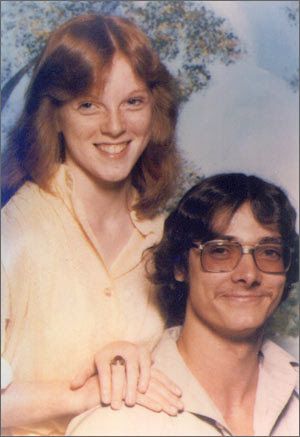
Wanda Thompson and Brad McCoy at his prom, 1978 (photo source


The Crime

It began eleven years earlier, in 1981 in Grundy, a small, working class town thirteen miles from the West Virginia border, fifteen miles from the Kentucky border, sixteen miles from the infamous site of the Hatfield and McCoy feud, and roughly fifty miles from both North Carolina and Tennessee.  Grundy is in the heart of the Appalachians, seven hours from Virginia's capital city of Richmond.  A coal mining town, Grundy hardly fit the slogan Virginia would adapt for itself - "Virginia is for Lovers" - or the genteel southern image of colonial style and plantation homes that would dot Williamsburg, Yorktown and Jamestown.  Only about five square miles in size and with a population of roughly 1,000 residents, alcohol wasn't sold in Grundy in 1981.  Those who wanted liquor had to drive across state lines or partake in moonshine made in the mountains.

In spite of its small size and religious, hardworking citizens, wife beating, rape, and murder were not foreign to the area.  Coal mining, being hard, dangerous work, especially in Buchanan County, it wasn't unusual for the sheriff's department to get domestic calls after workers returned home sweaty and covered in coal dust and grime.  It also wasn't unusual for liquor - moonshine or otherwise - or drugs to be involved.  Buchanan County had seven murders in 1980, making its murder rate twice that of the state as a whole.  All seven of the cases had been successfully prosecuted by Mickey McGlothlin, the county's prosecutor.

Wanda Thompson McCoy wasn't from Grundy but Home Creek, about twelve miles outside of Grundy, very nearly in Kentucky.  The fifteenth of sixteen children and the daughter of a coal miner, Wanda was a quiet and obedient girl, shy with strangers but without a mean bone in her body.  A born homemaker, as a child she had liked nothing better than making clothing and working on crafts.  She would be remembered as an average student in school with pretty strawberry blonde hair and a welcoming smile. 
   
Her future husband, Brad McCoy, was a member of that  McCoy clan.  Brad's father Max, known as "Hezzie," was proud of the family's lineage.  Hezzie worked for United Coal and on the side drove a white stretch limo for weddings and other events.  

While the legendary McCoys were ill-tempered and rude, Brad was as soft-spoken and gentle as his future wife.  Two years older than Wanda, he too went to Grundy Senior High School.  They met through Wanda's older sister Lydia, who worked with Brad at the local Piggly Wiggly grocery store.  Brad initially nursed a crush on Lydia but Lydia suggested he turn his attention to Wanda and it wasn't long before the two hit it off and were going steady.  

On June 13, 1978, Brad graduated from Grundy Senior High.  Three days later, he began working for United Coal.  His easygoing nature, combined with his brightness, helped him to place aboveground as a parts clerk in United Coal's Repair Shop No. 1.  In July, he and Wanda were married at the Grundy Baptist Church.  The McCoys and the Thompsons were happy with the match and apparently had no reservations over the age of the groom (18) or the bride (16).  

The newlyweds moved into the subdivision of Longbottom, east of Grundy, and by Slate Creek.  The subdivision consisted of newer brick and frame ranch homes in the front and older frame houses in the back.  Brad and Wanda rented one of the older homes, located less than two blocks from Brad's parents.  

Wanda had originally planned to return to school in the fall of 1978 and begin her junior year but she found that she enjoyed keeping house, making clothing, and working on her crafts.  The life of a housewife suited her and Brad's salary was enough to support the two of them, so she dropped out of school.  

Over the next nearly three years, Brad and Wanda settled into a comfortable routine of working and visiting with friends and family.   


Tuesday, March 10, 1981 should have been just another day for Wanda and Brad.  The couple, approaching their third wedding anniversary, had spent the morning at home.  Wanda had watched television while she sewed and Brad read the newspaper and generally took it easy before he had to leave for his shift at United, which was the 3 p.m. to 11 p.m. swing shift.  It was a cold day in Grundy, around 42 degrees, when Brad left the house shortly after 2 p.m. to run a couple of errands before clocking in.  

Brad would later remember his work shift as being fairly uneventful.  There were no breakdowns, mine shutdowns, or accidents that day and he was able to take his regularly scheduled dinner break and eat the food that Wanda had prepared and packed for him.  He took a coffee break at 9 p.m. so he could call home and check in on his wife.  She did not like to be home alone, especially at night, when Brad was working and he tried to call her during his shift to soothe her anxiety and also break up the loneliness for her.  

The two chatted for nearly fifteen minutes, about how the remainder of their day had gone, what Wanda was watching on television (BJ and the Bear) and how they would spend the tax refund money they were expecting.  It seemed like dozens of other similar conversations they had had.  Brad had no way of knowing it was to be the last time he would ever speak to her.

After hanging up the phone, Wanda apparently went back to watching television, curled up on the sofa with a handmade afghan wrapped around her.  At some point she drank a Coke; the empty bottle was later found on the living room floor.

Brad left work promptly, as soon as his shift ended at eleven.  Once he crossed the bridge over Slate Creek and drove up to Oak Street, he would have been able to see anyone coming and going from the front door of his home.  He initially noticed nothing unusual this evening, other than the porch light was off.  Wanda normally left it on for him when he was working.  It was approximately 11:10 p.m. 

Climbing the ten steps to the porch and front door, Brad found that the storm door was unlocked.  He was immediately concerned as Wanda, a creature of habit, normally kept the house locked up tight.  The front door of the home had a glass door pane and a previous resident had covered it over with paint.  Brad had scratched a section off, creating a peephole of sorts, and he peered through this peephole into the living room where he saw Wanda's afghan lying on the sofa but no Wanda.  Using his key, he let himself into the home and directly into the living room.  The television set was on, as were the lights, and the coffee table, normally in front of the sofa, was out of place, the empty Coke bottle on the floor, likely having fallen off the table when it had been bumped or moved.  

Brad may have already subconsciously known something was very wrong when he noticed the light on in the spare bedroom and headed that way.      

Wanda McCoy, just nineteen years old, lay on the floor.  She was on her back, her arms over her head, her legs spread straight out and her hair covering her face.  Both her sweater and bra were pushed up around her neck, revealing her breasts.  Her blue jeans lay on the bed and a pair of blue and white striped socks were still on her feet.  A pair of dark blue satin underwear was twisted around her left ankle.  

Wanda's head was surrounded by a large pool of blood that was continuing to grow and Brad could see that she had been stabbed twice in the chest.  From somewhere underneath the sweater that was around her neck blood was still oozing.  

Brad knew his wife was dead and so he did not touch her or disturb her body in any way.  Given that the blood was still spreading in the room, he realized she had not been dead long.  He ran back to the living room, where he called his father Hezzie, begging him to come over as Wanda had been raped or killed.  Then, fearful for his own safety and worrying that the killer or killers might still be in the house, Brad waited first on the front porch for Hezzie before setting off on foot down the hill toward his parents' house.  He ran into his father backing his car out of the garage.  Seeing Brad's frantic state, Hezzie went back into the house for his gun and then also to call the Buchanan County Sheriff's Department.  That call was logged in at 11:21 p.m.  

Hezzie and Brad returned to the home Brad shared with Wanda.  While Brad waited outside, Hezzie had briefly gone inside, viewed Wanda, and confirmed Brad's belief that she was dead.  He was back outside on the porch with Brad when the first two officers arrived on the scene.  It was now 11:25 p.m. 

Deputy Sheriff Steve Coleman entered the house and went immediately to the spare bedroom.  He lifted the heavy sweater around Wanda's neck and attempted to check for a pulse.  Unsuccessful, he found that she had no intact vessel.  Her throat had been cut so badly, her head was nearly severed from her body.  

Grundy Chief of Police Randall Jackson arrived on the scene at 11:31 p.m.  Viewing Wanda's body, he noted, as Brad had, that fresh blood was still oozing from underneath her sweater.  Jackson felt Wanda's wrist and found no pulse but discovered that she was still warm.  

He ordered the scene to be secured, as well as thoroughly searched.  Like Brad, he considered that the killer or killers might still be hiding in the house.  


Jackson arranged to have Dr. Thomas McDonald, the medical examiner who lived nearby, picked up by a patrol officer and brought to the scene.  Dr. McDonald officially pronounced death around 11:45 p.m. and made a preliminary determination that Wanda had died due to the slashing wound in her neck.  He also felt that she had been dragged from the living room to the bedroom.  Based on body temperature, Dr. McDonald felt the time of death was somewhere between 10 p.m. and 11 p.m.  

Although Brad McCoy had been seen at work and leaving work at 11 p.m., an officer was dispatched to question him at his parents' house, where he was waiting.  As with all murder cases, the spouse is always the first suspect.  

At 11:45 p.m., Dr. McDonald left the scene to return to his own home.  Chief Jackson waited for Jack Davidson, an investigator from the Virginia State Police whom he had called especially, to arrive from his home in Vansant, a town east of Grundy.  Jackson hoped that Davidson would take over the investigation.  

Inside the house, Wanda's body had stopped bleeding and had begun the first stages of rigor mortis.  


The house where Wanda died (photo source)


The Investigation

One of Davidson's first acts in the investigation was to speak to Brad McCoy.  He quickly cleared him as a suspect, although he did verify with United Coal what hours Brad had worked that day.  He requested that Brad take a polygraph examination, an examination to which Brad agreed but that would not be administered for nearly two weeks for unexplained reasons.  Later that evening, Brad became so agitated and upset that his parents took him to the local hospital, where he was sedated. 

Examination of the McCoy home itself revealed more clues as to what had happened to Wanda and how.  On the outside screen door, a latent fingerprint was lifted.  On the front door molding, just over three feet from the floor, was a pressure, or pry, mark.  Supporting Dr. McDonald's belief that Wanda had been dragged into the spare bedroom, there was a small bloodstain on the floor of the living room and the marks and patterns suggested that something was indeed dragged through it.  Smaller bloodstains, or spatter, was found on the living room wall and on the white shade to a lamp that was on a table at the hallway entrance.  Davidson believed that this was where Wanda was initially attacked and received the defensive wounds to her hands he had noted.  Other than these three areas of blood only the coffee table and Coke bottle seemed out of place.  To the trained investigator's eye, it seemed as though Wanda had let her killer or killers into the home.

The spare bedroom had more to tell.  The massive amount of blood found in that room suggested that the fatal cut to Wanda's throat happened there.  Noting the position of her arms over her head in the direction of the bedroom door, Davidson thought that Wanda had been dragged feet first into the bedroom.  He also believed that she never regained consciousness, otherwise her hands would have been covered in her blood from the instinctual response to grab at or cover the throat wound.

A black substance coated Wanda's hands, which Davidson felt certain was coal dust from her killer or killers.  The same black substance was also noted on the sleeves of her sweater and both of her upper thighs.  

At 9:30 on the morning of Wednesday, March 11, paper bags were placed on Wanda's hands to protect them from contamination and loss of any potential evidence and her body was taken to Roanoke for autopsy.  

The autopsy began at 8:30 on the morning of  Thursday, March 12 and would testify to Wanda's frightening and violent end.  Dr. David Oxley found that she had died from the brutal wound to her throat, some four inches deep and so vicious that it severed her right carotid artery, jugular vein and larynx.  The wound was made with a single stroke by a sharp instrument and ran in a downward motion from the right side of Wanda's throat to her left.  

She had also sustained two deep and penetrating stab wounds to her chest; one just below her breastbone and one near the inside of her left breast.  The first wound penetrated her liver, the second, her left lung and heart.    There was no significant bleeding resulting from either wound, leading Dr. Oxley to conclude that the wounds were delivered when Wanda was already dead or so near to death that it mattered very little.

Dr. Oxley discovered two foreign hairs on Wanda's genital area that did not match her own.  Although he did not note any traumatic injury to either her vagina or rectum, he took swabs from both areas to test for the presence of sperm.  He took samples of her blood and the black substance that had been found on her hands and those, along with her clothing, were preserved.  Although Dr. Oxley noticed that Wanda's fingernails were broken and her hands covered with blood, he stated in his report that there was no significant amount of material underneath her fingernails and rather inexplicably, took no action to preserve it for analysis.  He also neglected to test the blood on her hands, assuming it came from her own wounds.  Dr. Oxley's report failed to mention the defensive wounds on Wanda's hands that Jack Davidson had noted or the large bruise or abrasion present on her upper right arm that was noticeable in the autopsy photos.     

On Saturday, March 14, the funeral service for Wanda Faye Thompson McCoy was held in the Big Rock Freewill Baptist Church, the church she had attended Sunday School in as a child.  The minister who had married Brad and Wanda nearly three years earlier joined two ministers from Big Rock to conduct the service after which her body was taken to Mountain Valley Memorial Park to be buried.  

The residents of Grundy, most of whom had paid their respects to Wanda at the church and then again at the cemetery, were stunned and grief-stricken over her murder.  Grundy had more than its fair share of violence but not to God-fearing good girls like Wanda.

On Monday, March 16, Jack Davidson learned that the vaginal and anal swabs Dr. Oxley had sent for analysis had tested positive for the presence of sperm.  Two tests had to be done on the samples in order to get the blood type of the man who left the sperm in Wanda's vaginal canal:  he was a type B secretor.  (Brad McCoy, who admitted to having sexual relations with his wife roughly 48 hours before her death, was type A).  The testing done on the anal swab, for whatever reason, came back "inconclusive."  Although the scientific world was still over a decade away from DNA testing, the blood type was good news to investigators.  Only ten to thirteen percent of the population in the southeastern United States have type B blood.

By comparison, the sample of the black material found on Wanda's hands, which Jack Davidson had been positive was coal dust, came back as being organic soil and plant material.  However, as no such material had been found anywhere in the McCoys' home other than on Wanda's body, Davidson was certain it had been brought in by her killer or killers.  


Roger Coleman and Trish Thompson (photo source)


A Suspect

Brad McCoy had, naturally, been Davidson's first suspect in Wanda's murder.  He was the first person Davidson spoke to, making note of his clothing and a cut on his left thumb.  Brad had no scratches or wounds on him that Wanda would have left had she been fighting him for her life and his clothing had no bloodstains or tearing.  Furthermore, he had cried copiously and cursed over what had befallen Wanda.  He would provide relevant information to Davidson, though.

Brad informed Davidson that months earlier Wanda had been receiving nuisance and obscene phone calls and that the last person to visit their home had been Wanda's younger sister, Patricia (known as Trish).  Before that, it had been Brad's friend and coworker, Junior Stevenson.  According to Brad, he had had problems with a neighbor.  He confirmed that Wanda had been afraid to be home alone at night and would keep the doors locked and bolted.  She would never have given a stranger admittance into the house.  Outside of Brad, his father and her father, the only other men she would have let into the home would have been Junior Stevenson, her former brother-in-law Danny Ray Stiltner, and Trish's husband, Roger Coleman. 

Junior Stevenson was interviewed and said he had been so tired when he got home from work on the afternoon of the murder that his wife had to help him out of his truck.  Once inside his home, he had fallen asleep on the sofa and had not woken until the next morning, when he got up to return to work.  His wife verified his account.  

In speaking with Wanda's mother Marie and her sister, Peggy, who had been married to Danny Ray Stiltner, Davidson learned that it had been Wanda's belief, as well as of the Thompson family, that Stiltner had been behind the obscene phone calls Wanda had received months earlier.  

Despite these suspicions and a rumor that Danny felt Wanda was responsible for the breakup of his marriage with Peggy, Davidson did not interview Stiltner for two weeks.  When he finally did, on March 24, Stiltner denied making any calls to Wanda and denied any involvement in her murder, saying he had been with his mother and father at the time Wanda was killed.  He told Davidson that when he had been married to Peggy, Trish's husband Roger had come to their house often, bringing liquor.  In contradiction to the rumor saying otherwise, Stiltner felt that it had been Roger that had caused the breakdown in his marriage, not Wanda, and that Roger was "crazy" and probably guilty of the murder.

Roger

Roger Keith Coleman had been born in Georgia to a military family.  When his father was transferred to Germany eight months after he was born, Roger and his mother moved to Grundy to live with his father's family.  Only four months after that, Roger's mother moved to Michigan and got a divorce.  Although she sent for Roger, she eventually returned him to Grundy and his grandparents when he was six.  Neither his father nor his mother seemed to have any interest in raising or caring for him and so his grandparents formally adopted him.  

He was thirteen when he had his first brush with the law.  He and a friend were caught making obscene phone calls to a female classmate in which she received numerous calls where descriptive sexual fantasies were told to her.  Even her younger sister was subjected to them when she answered the phone.  Roger claimed to have made the calls because he was lonely and a voice in his head told him to do it.  As he had never been in trouble before, and he was a good student with an above-average IQ, a social worker advised that he receive psychiatric counseling, which he did.  

Roger proved to be tenacious.  He wanted to join the basketball team, despite his height (5'9") not suggesting he might be a natural, and so he did.  He excelled in sports and did well academically in high school, although he didn't achieve the high marks his IQ inferred he might.  He worked after school and on weekends, not only to put some money in his pocket, but also to give his grandparents for food and clothing.  When he wasn't going to school or working, he spent his time fishing, hunting, hiking around the countryside and reading.  Roger was an avid reader.

Getting closer to graduation, he wanted to avoid a life of working in the coal mines.  Wanting to go to college but coming from a financially strapped family, he instead applied for enlistment in the Army.  Everything seemed to be falling into place for him - until April 7, 1977.  

On April 4, 1977, Grundy had been struck by flash floods that resulted in two buildings on Main Street being torn from their foundations and carried away in the raging waters, collapsed bridges and roads in and out of the city being blocked and closed.  The emergency led to businesses being closed and that included the high school.  

Brenda Rife was a schoolteacher in Grundy, along with her husband, Preston.  She had been home with their six-year-old daughter Megan on April 7, while Preston had gone to check on the car lot he ran on the weekends and holidays.  A young man she estimated to be around eighteen and wearing a Grundy High letter jacket and sailor hat came to her front door, claiming to be part of a crew of volunteers cleaning up the flood damage, and requested a glass of water.  Once he was let into the house, he pulled a roll of adhesive tape from his pocket, along with a pistol, and ordered Brenda to tie her daughter to a chair.   Terrified, she complied.  At gunpoint, she was taken throughout the house and upon getting to the master bedroom, the man ripped her bathrobe open, pushed her down on the bed, climbed on top of her and began kissing her.  She scratched him hard on the neck, infuriating him.  As he went for his gun, she fled the room and ran for the sliding door downstairs, yelling for her daughter to follow her.  The little girl was taped too tightly and could not escape her restraints and so Brenda went back for her child.  The man caught her on the porch and a struggle ensued, with Brenda screaming for help.  She managed to get ahold of his gun and throw it;  when he ran to fetch it, she noticed two neighbors walking up the road, who had heard her screams.  The man noticed them too, and after running to retrieve his hat, which had come off in the struggle, he fled the Rife home through a side door and took off into the woods.  

The local authorities were busy with the flood damage and so once she had calmed herself, Brenda pulled out the last several years of Grundy High's yearbooks.  In short order, she recognized the young man she believed had attacked her - Roger Coleman.   When Brenda was taken later that day to Roger's place of employment, she gave a positive identification.  

Roger denied having anything to do with the attack on Brenda Rife and had two witnesses (the Grundy High superintendent and his daughter) who placed him at the high school up until 10:30 that morning; Brenda Rife believed her attacker arrived at her home between 10 a.m. and 10:15 a.m.  Despite the time discrepancy and the lack of any scratch marks on Roger's neck, he was arrested and charged with attempted rape.

Roger was out on bail when he graduated from high school on June 17, 1977.  A month later, a jury found him guilty of the charge and on July 29, he was sentenced to three years in prison.   Finding out about his conviction, the Army canceled his enlistment.  His conviction, whether justifiable or not, put an end to Roger's dreams of college and escaping Grundy and the life of coal mining.  

He served exactly twenty months and one day of his three year sentence, being released on March 30, 1979.  By April, he was working in a mine a few miles outside of Grundy.

In the summer of 1979, he met Trish Thompson, Wanda McCoy's youngest sister and the one she was closest with.  Trish was only fifteen years old, a vivacious and exuberant redhead.  Initially thinking that Roger's convict past was exciting and dangerous, in reality she found him to be articulate, thoughtful, and intelligent.  Their dating became serious very quickly and they were soon talking marriage.  While the Thompson family had been supportive of Wanda marrying early, they were less than happy with Trish wanting to marry so early and to a man with a record.  Although her parents and siblings begged her to at least finish high school, she would not be swayed.  After gaining her parents' consent, she and Roger were married on August 8, 1980.  Because Trish and Wanda were so close, it seemed only natural that Brad McCoy and Roger would become friends as well. 

On January 12, 1981, almost exactly two months before Wanda was killed, two female librarians at the Buchanan County Public Library were victimized by a man who entered the library just before closing time and exposed himself to them.  According to the librarians, the only two in the building since it was bitterly cold and snow was falling, he masturbated in front of them and ejaculated across their checkout desk before running out the door.  Although a well known town drunk was at first suspected (he had run naked through the streets of Grundy only a week earlier), both women identified a photograph of Roger Coleman from a Grundy High School yearbook as the perpetrator.  

That case was still pending (charges were eventually dropped) when Wanda McCoy was raped and murdered.   The librarians claimed that a week after Wanda's death Roger Coleman returned to the library to read books in the forensics section of the library, as well as the part of the library that housed its copy of the Code of Virginia.  


Roger Coleman (photo source)


Jack Davidson Closes In

When Davidson heard that of the three men that Wanda would trust enough to let into the home when Brad wasn't there, one of them -- Roger Coleman -- had a record for sexual assault, he honed in on him as the prime suspect.  

Before Davidson had questioned Danny Ray Stiltner or Junior Stevenson, he was anxious to learn Roger's whereabouts on the evening of March 10, 1981.   Speaking to Davidson on March 11, Roger provided a very detailed account of his whereabouts on the night his sister-in-law was killed.  He had left for work between 8 p.m. and 8:30 p.m.; he worked the night shift in a drill mine about three miles outside of Grundy.  Upon arriving for work, he was informed that his shift had been laid off without notice.  Roger said that he had chatted with another man at the mine before heading back home.  When he reached Grundy, he realized he had left his coveralls and knee pads at the mine and turned around to go back and retrieve them, as he planned on searching for work the next day.  He arrived at the mine the second time that evening between 9:45 p.m. and 9:50 p.m.  After retrieving his gear, he spent about ten minutes talking to the shift foreman and other workers, departing once more around 10 p.m.  He ran into a friend on the road home and said that the two had stopped their vehicles and chatted until around 10:30 p.m.  From there, he drove to a nearby trailer park to visit with yet another friend, who was out of work; Roger said he thought the two of them might do some job hunting together the following day.  Upon arriving at the friend's trailer, he found no lights on and did not bother knocking at the door.  According to Roger, it was around 10:45 p.m.  He did, however, see the neighbors across the street watching t.v. and recalling that he had left an eight-track music tape there days earlier, stopped by and retrieved it.   He then returned to Grundy and went to the miner's bathhouse where, although he had not worked, he followed his usual routine of showering and changing into clean, non-work clothes.  Roger took his work clothes, which were covered in coal dust, put them in a plastic bag and headed to the home he shared with his wife and his grandparents, arriving, he claimed, around 11:05 p.m.  

Davidson noted that Roger had no obvious scratches on his arms, neck, or face.  Still, he asked for the clothing Roger had worn and Roger turned them over, as well as a wet washcloth and a damp towel.  The legs of the blue jeans were wet, which Roger said must have happened at the mine.  Examination of the jeans found two or three small areas of blood on the right leg and a tiny speck on the left.  That blood was found to be type O, the same type as Wanda's.

Two knives that Roger voluntarily turned over to detectives were examined and one, a pocketknife with a three-inch blade was found to have a very minute quantity of blood, so small that it could not be determined whether it was animal or human.  

On March 13, hair samples were taken from Roger.  The pubic hair sample was found to be "consistent" with the unknown pubic hair recovered from Wanda's body.  

On April 13, an indictment for rape and capital murder was handed down against Roger Keith Coleman.  He was arrested the same day and jailed without bond.  

On Trial

At his arraignment on April 14, 1981, Roger informed Judge Nicholas Persin that he could not afford to hire an attorney.  Although Persin spoke to experienced criminal defense attorneys in the area, all of them begged off for one reason or another and Persin did not push the issue or assign any of them the case.  He instead chose Terry Jordan from Grundy and Steven Arey from Tazewell, neither of whom had tried a murder case and both of whom had very little criminal trial experience.  They were officially appointed on April 16.

Nearly a year would pass before the case came to trial, a time in which Trish Thompson Coleman, Roger's wife and Wanda's sister, changed her opinion and support of Roger from innocence to guilt.

The case was called for trial on March 15, 1982, a year and a day after Wanda had been buried.  The defense had brought a motion for change of venue, which was denied.  Also denied was a request to sever the rape and murder charges.  

Roger's defense team was seriously outmaneuvered by Mickey McGlothlin and the team of prosecutors but they did manage to score several points, namely that there was an unidentified fingerprint found on the McCoy front door that did not match Roger and that Dr. McDonald, when examining Wanda's body, had rolled her over, an action that could have led to the pubic hair being deposited on her.  They also elicited testimony from their own expert that no coal dust was found on Wanda's body and that the black substance, initially thought to be coal dust (of which none was found) by investigators was actually soil.      

Unfortunately for the defense, the couple that lived in the trailer park that had returned an eight-track cassette tape to Roger on the night of March 10, 1981 testified that he had arrived at 10:20 p.m., which would have given him a small window of time in which to rape and murder Wanda if she had been attacked and killed closer to 11 p.m.

The friend of Roger's who had spoken to him that night on the roadway until about 10:30 testified as such - but Roger's defense team failed to obtain his timecard, which showed his clock-in time at 10:41 p.m. and would have corroborated Roger's timeline.  

The defense called Trish, Roger's estranged wife, as a witness, which turned out to be a blunder.  Initially, Trish had told investigators that Roger had arrived home on the night her sister was murdered around 11:05 p.m.  She had been in bed reading and had looked at the clock when he came in.  On the stand, however, she denied knowing what time it was that Roger returned home.  Rather than demonstrating he could not possibly have raped and killed his sister-in-law had he been home at 11:05, his attorneys succeeded in showing the animosity Trish had for Roger.  

The defense also called his Roger's grandmother, as he and Trish had been living with his grandparents at the time of Wanda's murder.  His grandmother testified that Roger arrived home at 11:05 p.m., but by doing so, she impeached her earlier statement to investigators that Roger had arrived home as the eleven o'clock news was ending.  She claimed she had been mixed up a year earlier, as she had just gotten out of the hospital.  Worse, she voluntarily added that Roger had not been drinking and was not acting nervous; as she had not been asked that question, the statement was perceived that Roger had indeed been drinking and had been acting nervous.    

The state's last witness was a criminal by the name of Roger Matney, who had been in the Buchanan County Jail with Roger Coleman.  Matney testified that Coleman confessed to him that he and another man had been at the McCoy residence with Wanda when Brad called around 9 p.m. and after that phone call, the other man had attacked Wanda with the knife, after which the two of them had raped her.  Matney claimed that Coleman had drawn a diagram of the murder scene, although one was not produced.  The defense attorneys did manage to elicit Matney's record and the fact that although he had been sentenced to four years' time a year earlier, he was already out - seemingly in exchange for his testimony.  They didn't know, however, that at the time Matney was called as a witness, he was facing serious charges for beating and threatening to kill a fellow inmate while forcing him to perform oral sex.  Nor were they aware that even Jack Davidson and Randy Jackson had little credence for Matney's testimony.  

Roger took the witness stand on the morning of March 18, 1982 to testify on his own behalf.  Despite badgering by the prosecution, he remained calm, cool, and collected as he recounted details from the year previous.  He denied having anything to do with his sister-in-law's death and denied Roger Matney's account while admitting that he had told other inmates details of the case he said he learned from his wife and other family members.  When asked to explain the drops of type O blood that was found on his jeans, his only explanation was that his cat could have scratched someone and that someone had bled on his pants.  This allowed the prosecution to call Trish Coleman for rebuttal, to testify that she had never seen the cat scratch anyone.  

The defense rested after Roger testified and the case went to the jury at 6:01 p.m. on the evening of March 18   The jury deliberated until 8:15 p.m., when they broke for dinner until 9:35 p.m.  At 10:50 p.m., they announced they had a verdict.  They found Roger guilty of rape and murder.  For the rape charge, his punishment was life in prison.  As the murder charge was a capital one, a separate hearing would need to be held to decide on his sentence.

The following day, March 19, 1982, over defense objections, Brenda Rife was called as a witness to describe to the jury what Roger had done to her and her daughter five years earlier.  To counter Mrs. Rife's testimony, Roger's attorneys called two ministers to testify that Roger's religious conversion was sincere and that his life should be spared.  Following brief closing arguments by both sides, at 2:33 p.m. the jury retired to deliberate on whether Roger Coleman should be put to death or receive life in prison.  At 6:17 p.m. they returned to the courtroom with a verdict of death.

(photo source)


Death Row and Appeals

Under Virginia law, the presiding judge of a criminal trial has the right to review a death sentence and affirm it, or review it and substitute a life sentence.  Judge Persin had never before sentenced anyone to death and, in fact, opposed capital punishment.  He later admitted that he was surprised by the jury's verdict of death as he did not believe the prosecution's case met the required "absolute certainty" that was necessary to impose the death sentence.  On April 23, 1982, after agonizing over the sentence since the jury returned its verdict, Persin announced to a packed courtroom that he could find no legal reason to overturn the jury's recommendation and sentenced Roger Keith Coleman to death.  As he handed down the sentence, tears ran down his face.  

On April 25, Coleman was transported seven hours away to the Richmond State Penitentiary, where he was placed in isolation while he was evaluated.  Following his evaluation, he was sent to Mecklenburg Penitentiary.  In 1982, Mecklenburg housed Virginia's most dangerous criminals, as well as being a cesspool of violence and corruption.  

On August 27, his attorney Terry Jordan wrote him to say that the divorce Trish had filed after Coleman's trial ended had been granted three days earlier.   

More bad news followed for Coleman when, in September of 1983, the direct appeal filed by Jordan and Steve Arey was rejected by the Virginia Supreme Court and his conviction and death sentence was reaffirmed.   The United States Supreme Court denied certiorari in 1984.  

The petition that he filed for writ of habeas corpus was denied on September 4, 1986 after a two-day hearing, although the clerk did not docket it until September 9, 1986, an action that caused a legal quagmire of sorts.    

The following month, on October 7,  Coleman filed a notice of appeal with the Circuit Court.  It was 33 days after the official date of final judgment but within 30 days of the entry of that judgment.   Under Virginia state law, missing the deadline for a notice of appeal constitutes a procedural default to further appeals.    

On October 25, he moved the circuit court to correct the final judgment date to September 9, making his notice of appeal timely.   The circuit court denied the motion, leading Coleman to appeal to the Supreme Court of Virginia on December 3.    It wouldn't be until May 19, 1987 that the Virginia Supreme Court issued an order denying Coleman's appeal based on the late filing, thus preventing him from entering any other appeals in the state court.  

At that time, a subsequent petition for rehearing was also denied.

On April 26, 1988, Coleman next filed a petition for a writ of habeas corpus in the United States District Court for the Western District of Virginia.  In it, he presented four federal constitutional claims he had raised on direct appeal in the Virginia Supreme Court and seven claims he had raised for the first time in the state habeas.  The District Court found that, based on the the dismissal of his appeal, he had procedurally defaulted the seven state claims but went on to address the merit of all eleven of his claims.  The Court ruled against Coleman on all eleven claims and denied his petition.  The United States Court of Appeals for the Fourth District affirmed the decision in 1990.

The Court did, however, grant Coleman's petition for permission to have PCR-DNA testing performed on evidence from the crime scene.     

On October 29, 1990, his third attempt at a petition for writ of certiorari was finally granted by the Supreme Court,  setting the case for argument on February 25, 1991.  

On November 7, 1990, results from the PCR-DNA testing that was done in California were returned.  The tests failed to eliminate Coleman as a suspect and, in fact, indicated that the donor of the sperm found in Wanda McCoy accounted for only two percent of the population.  Roger Keith Coleman was in that two percent.   However, three alleles were identified in the sperm sample, indicating two donors.

On June 24, 1991, in a six-to-three decision, the Supreme Court held that the mistake made by Coleman's lawyers in filing a document days late created a procedural default that prevented consideration of his federal petition for writ of habeas corpus.  

Once again, Coleman filed a petition for rehearing and once again, on September 24, 1991, the petition was denied.  

On October 14, 1991, Coleman's attorneys filed his second state habeas corpus petition in the Circuit Court of Buchanan County.  In addition, the attorneys filed motions for discovery and a request for an evidentiary hearing based on new evidence that Coleman was not Wanda's killer.   The Commonwealth filed a motion to dismiss and a hearing was held on the matter on December 4, 1991.  On December 14, the Commonwealth's motion was granted.


Roger with his girlfriend Sharon (photo source)

Setting the Date

With fewer chances to prevent Coleman's execution, his attorneys and friends began going to the press, indicating that Coleman was innocent, that his attorneys had named a viable suspect (a next door neighbor of Brad and Wanda's with both a history of violence against women and alleged drug use), but that the Commonwealth of Virginia was prepared to execute him anyhow.  

In February of 1992, the Commonwealth pressed for an execution date in March, while Coleman's attorneys requested that a date not be set until after a final petition for federal habeas corpus be heard and decided.  Neither got their request.  Roger Coleman was scheduled to be executed on May 20, 1992, unless another court or the governor of Virginia intervened. 

While Governor Douglas Wilder had intervened on behalf of an inmate only hours before he was scheduled to die January 23, 1992, public support for the death penalty gained by the day and although Coleman's attorneys continued in their quest to prove that the former next door neighbor was Wanda's real killer, they knew their client was likely to die on May 20.  

On March 31, 1992, the first national story about Roger Coleman appeared in Newsweek magazine, complete with a large photo of Coleman in handcuffs and leg chains and with text declaring him innocent of the crimes he was convicted of.  In short order, The Washington Post, The New York Times, and The New Republic all wrote articles on the case that were favorable to Coleman and berated the Commonwealth of Virginia for what would surely be a fatal error if they executed him.  

Around the same time, at the end of March, Brad McCoy was persuaded to have his blood tested to be matched against the extra allele detected in the November 1990 PCR-DNA testing.  On April 7, 1992, it was determined that the extra allele did appear to come from Brad and matched his account that he and Wanda had last had sexual relations a day or two prior to her murder.  

On April 24, 1992, Coleman's attorneys filed his petition for writ of habeas corpus, along with a motion to stay his execution pending a final decision on the petition.  Oral arguments by Coleman's attorneys and the Commonwealth were scheduled for May 6.  

On May 1, 1992, Coleman was moved from the Mecklenburg Penitentiary to Greensville Penitentiary, in a deathwatch cell only steps away from the electric chair.   Shortly after that transfer, Time magazine sent a writer and photographer to Greensville to interview and photograph Coleman.

On Monday, May 11, the issue of Time, with Roger Coleman on its cover, hit newsstands.  It was the first time in 32 years that Time had devoted its cover to a condemned man.    

On Tuesday, May 12, Coleman's final petition for writ of habeas corpus was denied.  

On Thursday, May 14, a press conference was held in Richmond, in which a phone line was set up so that Coleman could participate; the media appeared in droves.  That night, via a remote feed, Coleman, calm and articulate, appeared on Larry King Live.  

By Friday, May 15, the governor's office was flooded with mail and phone calls, all begging for Coleman to be given clemency.  Even Pope John Paul II and Mother Teresa made public pleas for clemency.  Media outlets from as far away as England, France, and Japan turned up not only in Richmond but Grundy.  

On Saturday, May 16, Governor Wilder announced that he had not made a decision on Coleman's case but was reviewing it.    

On Monday, May 18, a memorial service for Wanda was organized and held in Grundy by Brad and the Thompson family.  Around 10 a.m., Coleman's lawyers learned from the governor's office that Governor Wilder would not be granting Coleman clemency.  

On Tuesday, May 19, after weeks of back and forth arguments, arrangements were made for Coleman to take a lie detector test.  His attorneys, wanting to use their own expert, asked for a seven to ten day postponement in the execution.  Governor Wilder agreed to the lie detector test but insisted it be administered by the Virginia State Police on Wednesday morning, the day of Coleman's execution.  That evening, the guards that had been assigned to Coleman were changed for a new "crew" that were assigned to watch over him and then escort him to the electric chair.  

On Wednesday, May 20, shortly after 6 a.m., Coleman was taken to Richmond for the lie detector test.  Despite being told otherwise, his attorneys were not allowed to be present.  Reportedly, Coleman broke down in tears when the electrodes were first attached, necessitating a break.  By the time the test was completed, the press had been alerted and were waiting outside as Coleman was returned to Greensville.   Around noon, Coleman's legal team received the results that Coleman had failed the lie detector test and very soon after that, the story was picked up by the media.  Coleman had a last visit with Sharon Paul, a woman he became pen pals with in 1983, with their relationship becoming romantic in 1988.  After she left around 4 p.m., his attorneys visited with him and shared his last meal shortly after 6 p.m. - Tombstone pizza, Sprite and fudge stick cookies.  By 9 p.m., Coleman's head was completely shaved and he was dressed in the approved prison attire for execution.  Shortly after 11 p.m., with all appeals denied and no clemency to be granted by Governor Wilder, Coleman was strapped into the electric chair.  Asked for any final words, Coleman said, "An innocent man is going to be murdered tonight.  When my innocence is proven, I hope Americans will realize the injustice of the death penalty as all other civilized countries have.  My last words are for the woman I love.  Love is eternal.  My love for you will last forever.  I love you, Sharon."  The mask was then placed over Coleman's head and the switch was thrown.  

Roger Keith Coleman was pronounced dead just over five minutes later.  He was 33 years old and had spent just over ten years on Virginia's death row.   He was the first Virginia inmate executed in 1992 and the 17th one to die that year in the United States.  

No one from Wanda's family went to Coleman's execution, save Brad McCoy, who made the trip to Greensville with his brother.  Brad was not allowed into the death chamber to witness the execution but he and his brother stood outside to wait for the official announcement.  He later told reporters that he had waited for eleven years for justice for Wanda and it had been important for him to be there.  


Wanda (photo source)


In the Years Following

Following his execution, Coleman's body was cremated.  He had told Sharon in his final days that he wanted his ashes scattered in the mountains around Grundy.  

On Saturday, May 23, 1992, Coleman's family, joined by Sharon and his legal team, as well as other Grundy residents, gathered outside the Coleman family home to pray and read a eulogy written by Jim McCloskey, the executive director of Centurion Ministries, a group that had been working with Coleman's attorneys to prove his innocence.  Then a cassette player was flipped on so that as Sharon spread Coleman's ashes, "Amazing Grace," as performed by a lone bagpipe, could be heard.


The years moved on, the town of Grundy and its residents with them.  Coleman's case was often cited by death penalty opponents, further fueled by the publication of May God Have Mercy in 1998, written by  Chicago lawyer John C. Tucker, who had believed Coleman to be innocent of the crime for which he was executed.  

In 2000, following the Georgia case of Ellis Wayne Felker, who had been executed in 1996 but then had post-execution DNA testing done four years later in an attempt to prove his guilt or innocence for the murder he was alleged to have committed, Centurion Ministries was joined by four publications, including The Washington Post, to have DNA evidence from the McCoy-Coleman case reexamined.   In 2002, the Supreme Court of Virginia declined the request, leading Centurion to appeal directly to Governor Mark Warner.  

On January 5, 2006, Governor Warner ordered retesting of Roger Coleman's DNA evidence.  So that there might not be any accusations of corruption or favoritism, the tests were done at the Centre for Forensic Sciences in Toronto, Canada.  A week later, Governor Warner announced that the lab in Toronto had found that Roger Keith Coleman's DNA matched the semen that was recovered from Wanda McCoy's body, with no exclusions.  Furthermore, there was only a one in 19 million chance of a random match, conclusively confirming Coleman's guilt.  

The death penalty opponents who had hoped that the tests would reveal Coleman's innocence were disappointed and angry that Coleman's case not only did nothing to support their cause but harmed it.  Coleman's legal team, his family and friends, were devastated by the results.  Jim McCloskey told reporters that he felt "betrayed" by Coleman, whose last words had been the statement of "an innocent man is going to be murdered tonight."  McCloskey did not understand how a guilty man could, with such dignity, make those words.  In the years following the test results, his opinion mellowed and by 2020, he believed that Coleman and Wanda McCoy could possibly have been engaged in an affair, explaining the presence of Coleman's semen.  He thought that the dirt found on Wanda's hands had come from her taking out the trash the night of her murder, allowing her true killer to gain entry to the home.  

To this day, McCloskey continues to debate whether Coleman was truly guilty.

Brad McCoy remarried in February of 1983 and went on to have a son and a daughter with his second wife.  He told John C. Tucker, the author of May God Have Mercy that although he had a wonderful life with his family, he would never be able to forget the image of Wanda that night in 1981.  He also told Tucker that he had not initially suspected Roger Coleman; Coleman was not only his friend but was family.  It was only after learning of the blood typing and hair results and of Coleman's earlier record that he accepted that Coleman had raped and murdered his wife.  

Wanda's mother died in 2002, at the age of 82, and her father followed in 2005, at the age of 90.  They were buried at Mountain Valley Memorial Park next to Wanda.   

Wanda's final resting place (photo source


Sources:


Bluefield Daily Telegraph (September 20, 2020).  Jim McCloskey Still Haunted by Roger Keith Coleman Murder Case.

Coleman v. Thompson, et al., 895 F2d 139 (4th Cir 1990).

Coleman v. Thompson, et al., 501 U.S. 722 (1991).

Coleman v. Thompson, et al., 112 S. Ct. 1845 (1992).

Coleman v. Thompson, et al., 798 F. Supp. 1209 (W.D. Va. 1992).


Tucker, John C. May God Have Mercy. Dell Publishing, 1997.

Washington Post (January 13, 2006).  DNA Tests Confirm Guilt of Executed Man